

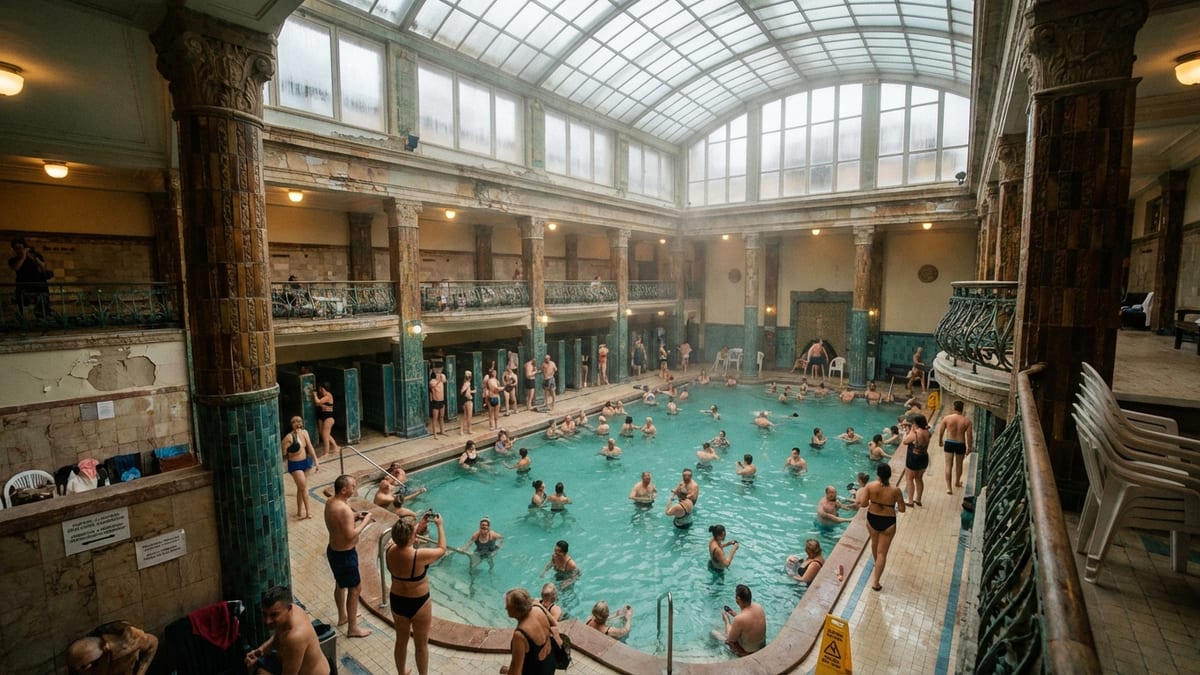
I went to Gellért Thermal Bath with pretty high expectations. Between the dreamy photos of turquoise tiles, vaulting Art Nouveau ceilings and the sense that this was “the beautiful, less touristy alternative to Széchenyi,” I had convinced myself it would be the refined, atmospheric spa day of my Budapest trip.
In reality, my visit was a mixed bag: visually stunning and historically fascinating, but also crowded, somewhat worn, and more transactional than tranquil. With the bath now closed for major renovations until a planned reopening around 2028, I have had time to reflect on whether it was actually worth the time and money, and what future visitors should realistically expect when it finally comes back to life.
First Impressions: Getting There, Tickets and That Famous Facade
Arriving at Gellért felt surprisingly easy. I took the M4 metro to Szent Gellért tér, walked a couple of minutes, and suddenly the famous facade and dome were right in front of me. The building is huge and imposing, sitting at the foot of Gellért Hill near Liberty Bridge, and it really does look like something from a faded postcard. Even before going inside, I felt that glow of “I’m finally here.”
The mood shifted a bit at the ticket hall. By the time I visited, Gellért was firmly on every “Top Things to Do in Budapest” list, and it showed. The line was not outrageous, but it was long enough to make me glad I had checked opening hours in advance and arrived early in the day. Prices were higher than the old guidebooks and blog posts had led me to believe. Years of tourism inflation had done their work, and I felt the bath had firmly moved out of “cheap local experience” territory into “mid- to high-priced attraction by Central European standards.”
Once I got to the counter, the staff were efficient but not exactly warm. It felt a bit like buying a ticket to a busy museum: quick, slightly rushed, and very much business. I opted for a cabin instead of just a locker, paying a bit extra for the privilege of having my own small changing stall. I am glad I did, but even that choice reminded me how nickeled and dimed big attractions can feel. By the time I had paid for entry, cabin, and a towel rental, I was uncomfortably aware of the total cost. This was not ruinously expensive compared to Western European spas, but it was not the bargain some glossy travel content still hinted at.
Walking from the ticket desk into the main hall improved my mood instantly. The iconic central swimming pool under the glass roof is genuinely breathtaking, even if you never get into the water. Columns, railings, mosaics and that intense turquoise pool create a theatrical first impression. My expectations, which had just been dented by the ticket process, shot back up.
The Pools: Beauty, Atmosphere and the Reality of Sharing It With Hundreds of People
My main reason for coming to Gellért was the thermal water. Budapest’s springs are legendary, and Gellért draws on the same mineral-rich sources that people have used for centuries. The bath offers multiple indoor pools of different temperatures along with a large swimming pool. On paper, it sounded like the perfect formula.
In practice, the thermal experience was good but not transcendent. I moved between a series of smaller, hotter pools and slightly cooler ones, adjusting to the heat and letting my muscles relax. The water itself felt silky and mineral-heavy in a satisfying way, and after fifteen or twenty minutes of alternating between hot and warm, my body did feel looser and calmer.
What cut into the magic was the sheer number of people. Gellért had become one of Budapest’s star attractions before the closure, and the interior spaces are not as sprawling as Széchenyi. That means a lot of bodies in relatively small rooms. In the more intimate thermal pools, it was difficult to find a quiet corner. Conversations bounced off the tiles, and it was impossible to forget that I was sharing the experience with tour groups and weekenders just like me.
There is a romantic image of soaking in almost monastic silence under stained glass windows. The reality looked more like a crowded Roman bath, with selfie-takers, couples chatting in multiple languages, and people squeezing past each other in narrow spaces. The atmosphere was not rowdy or disrespectful, but it was social rather than contemplative. If you are expecting a spa-level hush, this may not match your mental picture.
Architecture and Decay: Swimming in a Fading Masterpiece
The strongest argument for Gellért, in my experience, was visual and architectural rather than purely about the hot water. I spent as much time looking around as I did soaking. Zsolnay tiles in intricate patterns, graceful columns, stained glass, and decorative details almost everywhere you look make the interior feel like a turn-of-the-century fantasy. Even walking up and down the corridors between the pool areas felt like wandering inside an old theatre or grand hotel.
Yet the closer I looked, the more obvious the wear and tear became. Cracked tiles, patched grout, discolored surfaces, and corrosion showed up in corners and around fixtures. It was not neglect in the sense of dirt or filth; the place was being cleaned and maintained. It was more that the underlying infrastructure was tired and had reached the point where superficial fixes could not disguise age any more.
In some ways, the decay added to the mood. The “faded glory” aesthetic is part of why people love Budapest in general, and being in a thermal bath that clearly dated back a century gave me a strong sense of history. But this is also where expectations versus reality came into play. Photos and tourism marketing often highlight Gellért as a gleaming Art Nouveau jewel. In person, it looked like a jewel that had been worn daily for a hundred years and was now overdue for a full restoration.
Knowing now that engineers later found serious issues in the pump house and technical systems, leading to a full closure from October 2025 for a multi-year renovation, that visible fatigue makes sense in hindsight. At the time, I just felt a combination of awe at the beauty and concern that parts of the building looked physically stressed. I am not surprised the city finally committed to what is planned as a multi-year, multi-billion-forint overhaul.
Practicalities: Facilities, Cleanliness and Small Annoyances
On the practical side, Gellért performed adequately rather than impressively. The changing cabins gave me a bit of privacy, which I appreciated in a co-ed environment. Locking mechanisms worked, and I never felt my belongings were unsafe. The overall layout, however, could be confusing, especially on a first visit. I found myself retracing my steps more than once trying to navigate between pools, saunas and showers.
Cleanliness in the wet areas was decent but not spotless. With so many people moving from pool to pool, water inevitably collected on the floors. Slippery tiles are part of the Budapest bath experience, but this is an area where I had to constantly remind myself to move carefully. There were staff visible, and I did not see obvious trash or neglect, yet this still felt like a busy municipal facility with heavy foot traffic, rather than a polished private spa with obsessive attention to detail.
A couple of things disappointed me. Some steam rooms and saunas were closed or not working properly during my visit. That is normal for older baths, but when you have paid a premium price and built your day around this one attraction, unavailable facilities register as a real drawback. Signage about closures was present but not especially prominent. It felt like something you discovered the hard way rather than being clearly warned about at the ticket counter.
Showers and basic amenities were serviceable but not luxurious. Water pressure was fine, and I could rinse off without trouble, but nothing about the setup felt modern or indulgent. It reminded me constantly that Gellért was straddling an awkward line between historic monument and tourist-serving wellness center. In some respects, it was not excelling at either.
Crowds, Vibe and Who You Will Be Sharing the Baths With
The character of a place like Gellért is shaped as much by the people in it as by the architecture. By the time I visited, the bath was clearly more international than local. I heard English, French, German, Spanish and more. Hungarian was present, but it did not dominate. This felt like a global attraction more than a neighborhood favorite.
The upside of that mix was a relaxed, casual tone. Most people were there to enjoy themselves, not to perform for social media or treat it as a pub. There was laughter and conversation, but it rarely tipped into obnoxious behavior. I did not see aggressive drinking, and security and staff presence gave the space a generally orderly feel.
The downside was that it felt less like discovering a hidden corner of Budapest culture and more like joining a long line of people ticking off an item on their itinerary. If you are seeking a deeply local bathing culture experience, you may find Gellért slightly overexposed. Popular alternatives like Rudas or Lukács, or smaller neighborhood baths, are often recommended now for anyone chasing a more traditional atmosphere, and based on my own time in the city I can see why.
As for etiquette, most visitors behaved reasonably, but photography was a recurring irritation. Official rules limit where and how you can take photos, yet I still had to weave around people posing for pictures near the main pool. It was not endless, but it was enough to pull me out of any meditative state. This is not unique to Gellért; it is simply what happens to beautiful public spaces in the Instagram era. If that sort of thing drains your enjoyment, it is worth adjusting expectations in advance.
Massages, Extras and the Question of Value for Money
One of my dilemmas with Gellért was whether to splurge on extras like massage treatments. In the end I chose a basic, shorter massage on top of my entry fee, reasoning that I should experience the “full spa” side, not just the pools. That turned out to be one of the more disappointing aspects of the visit.
The massage was fine but unremarkable. The therapist was professional, the room acceptably clean, but the overall feeling was brisk and impersonal. It felt closer to a high-volume airport massage service than a pampering spa ritual. For the price, particularly once converted into my home currency, it did not feel like great value.
Factor in the base ticket, cabin, towel rental and treatment, and Gellért became one of the pricier experiences of my Budapest stay. I did not resent spending the money, because I wanted to see the famous bath at least once, but I could not shake the sense that I was paying museum-of-myself prices to use infrastructure that was past its best days.
After the fact, I felt that the core ticket, without extras, was the best trade-off. Simply bathing and exploring the architecture justified the cost in a city where many top-tier attractions have crept up in price. Adding secondary services, however, crossed a line where my expectations for quality and ambiance were not met. On a future visit after the renovation, I would consider skipping most add-ons unless reviews specifically raved about upgraded wellness facilities.
Closure, Renovation and What Future Visitors Should Expect
All of these pros and cons came into sharper focus when news emerged that Gellért would undergo a full closure from 1 October 2025 for a multi-year reconstruction, with reopening not expected until around 2028. The problems I noticed at ground level, from worn tiles to closures of specific rooms, were symptoms of deeper structural issues in the pump house and technical systems. At some point, patchwork maintenance simply could not keep up.
The renovation plans, as publicly discussed, go well beyond a simple refresh. Engineers and city officials have spoken about modernizing the mechanical and technological backbone of the bath, reinforcing the building, improving energy efficiency, and at the same time restoring the historical Art Nouveau interiors. There is even talk of new wellness spaces, panoramic saunas and better-organized changing areas. In theory, the Gellért that eventually reopens should offer a significantly upgraded experience, both in terms of reliability and comfort.
However, big heritage projects have a way of slipping in both timeline and scope. I would be cautious about planning a Budapest trip around a specific reopening date until the operators clearly confirm it and the bath is actually accepting visitors again. Travel articles, guidebooks and even tour operators can lag behind reality. When I visited, some online sources still described opening hours or services that had quietly changed months earlier.
For now, if you are going to Budapest before Gellért reopens, you have to treat it as a piece of the city that is temporarily off the table. The upside is that the renovation should address many of the issues that bothered me: the sense of fatigue, partial closures, confusing layout and dated facilities. The downside is that improving comfort and efficiency usually pushes prices higher and encourages even greater visitor numbers. When Gellért returns, I expect it to be more polished, more expensive and probably more popular than ever.
So Was It Worth It For Me, And Who Would I Recommend It To?
Looking back, I am glad I went to Gellért, but not for the reasons I originally imagined. It did not turn out to be my ideal day of deep relaxation. The crowds, the worn infrastructure and the transactional feel at the entrance all chipped away at the pure spa fantasy I had in my head. If I had gone in thinking “I am visiting a historic, slightly frayed monument with hot water,” I would have been closer to the truth.
Where it delivered was in the intersection of history, architecture and lived experience. Floating in warm mineral water while staring up at stained glass and tilework from a different era felt special. I could imagine generations of locals and visitors doing something similar long before wellness became an industry buzzword. That connection to place and time is what made the bath memorable for me, more than any particular pool temperature or treatment.
In terms of value, I would not call Gellért a must-do for every visitor, especially when it reopens. If your budget is tight, if you are indifferent to historic architecture, or if you mainly want big outdoor pools and a party-leaning atmosphere, you might be happier at other baths or even skipping the thermal experience entirely. Budapest has enough to keep you busy without spending half a day in hot water.
On the other hand, if you care about Art Nouveau design, if you enjoy older public spaces that carry the traces of time, and if you can tolerate some degree of crowding and commercialism in exchange for that, then Gellért is still likely to be worth it when it is back in operation. Just do not expect a quiet, exclusive wellness retreat. Expect a beautiful, busy, historically significant bath that has to serve thousands of people a day and is priced accordingly.
The Takeaway
If I could go back and change anything about my own Gellért visit, I would do three things differently. First, I would lower my expectations from “perfect spa day” to “iconic historic bath experience.” Second, I would avoid paying for extras like massages unless I had very current recommendations saying they had improved. Third, I would plan to arrive early on a weekday, spend a solid two or three hours enjoying the pools and building, and then leave before fatigue and crowds turned magic into mild irritation.
The upcoming renovated version of Gellért will almost certainly correct some of the flaws I encountered. Updated mechanical systems should reduce the number of random closures. Reworked layouts and new wellness zones could make moving through the space less confusing and more comfortable. Restored interiors should bring back more of the original brilliance that older photos hint at. At the same time, a more modern, marketable Gellért will likely lean even harder into its role as a flagship attraction, not a hidden gem.
So, is Gellért Thermal Bath worth visiting? My honest answer is yes, but conditionally. It is worth it if you are interested in Budapest’s spa culture as heritage, not just as a place to relax. It is worth it if you can accept that famous places are rarely serene and that your ticket pays as much for tilework and atmosphere as for bathing. It is worth it if you treat it as one chapter in your Budapest story, not the entire plot.
When the doors finally reopen after the long renovation, I would go back, but with more measured expectations. I would treat my time there as a way to step into a carefully restored piece of history, soak for a while, admire the details, and then leave satisfied rather than searching for a spa-level transformation. Under those conditions, and for travelers who value that blend of beauty, history and honest imperfection, Gellért can absolutely still earn its place on the itinerary.
FAQ
Q1. Is Gellért Thermal Bath open right now?
As of early 2026, Gellért Thermal Bath is closed for a large-scale renovation project that began with a full shutdown on October 1, 2025. The current plan is for the bath to reopen sometime around 2028, but I would not plan a trip around a specific month until the operators make a clear public announcement.
Q2. Why did Gellért Thermal Bath close for renovations?
Engineers identified serious issues with the bath’s pump house and technical systems, which are shared with the neighboring Gellért Hotel. Years of heavy use, mineral-rich water and cleaning chemicals had taken a toll on the structure and equipment. A comprehensive renovation was deemed necessary to ensure safety, upgrade the mechanical systems and restore the historic Art Nouveau interiors.
Q3. What will change at Gellért after the renovation?
The renovation aims to preserve and restore the historic architecture while modernizing the infrastructure. Plans discussed publicly include reinforcing the building, improving energy efficiency, updating the thermal water and heating systems, and reorganizing guest areas such as changing rooms. There has also been talk of adding new wellness spaces and panoramic saunas, so the post-renovation Gellért will likely feel more contemporary and comfortable while maintaining its historic character.
Q4. How much did it cost to visit Gellért before it closed, and will prices go up?
Before closure, prices had already risen into a mid- to high-range level for Budapest, especially once you added a cabin, towel rental and any treatments. While exact future pricing is unknown, my expectation is that a fully renovated, modernized Gellért will reopen with higher ticket prices than before, reflecting both the investment in restoration and its status as a flagship tourist attraction.
Q5. Are there any age restrictions or special rules I should know about?
In its final operational seasons before closing, Gellért implemented age limits for certain times and services, and similar or stricter policies are likely after reopening, especially if the focus shifts more toward a calm, wellness-centered environment. In general, Budapest baths enforce rules about swimwear, hygiene, and appropriate behavior. I would expect updated house rules when Gellért returns, and I would check them close to my visit.
Q6. What are good alternatives to Gellért while it is closed?
During the closure, most visitors who might have chosen Gellért are redirecting to other major Budapest baths. Széchenyi offers large outdoor pools and a lively atmosphere, Rudas has a mix of historic and modern spaces plus great Danube views, and Lukács is a solid choice for a slightly more local feel. Smaller neighborhood baths and newer complexes can also be worthwhile if you prioritize fewer tourists over famous architecture.
Q7. How crowded was Gellért, and will that change after renovation?
When I visited, Gellért was busy enough that finding a quiet corner was difficult, especially in the smaller thermal pools. Given its global reputation and the publicity around the renovation, I expect it to be at least as popular, if not more so, once it reopens. The redesigned layout may manage the flow better, but crowd levels will probably remain high at peak times.
Q8. Is Gellért a good choice if I am mainly looking for deep relaxation?
In my experience, Gellért was better suited to people who care about history and architecture than those seeking a quiet, spa-like retreat. The combination of tourists, groups and limited space meant the atmosphere was more social than serene. After the renovation, comfort should improve, but crowds will probably still limit how tranquil it feels. If deep relaxation is your top priority, you might prefer a less famous bath or a dedicated wellness spa.
Q9. What should I bring when visiting Gellért once it reopens?
Based on my visit and the norms at other Budapest baths, I would plan to bring a swimsuit, flip-flops or sandals with good grip, a towel if you want to avoid rental fees, and a light bag or backpack that can fit in a locker or cabin. I would leave valuables at my accommodation where possible, because even with secure storage, managing expensive electronics or jewelry in a wet, crowded environment adds stress.
Q10. Would I personally go back to Gellért after the renovation?
Yes, I would, but with different expectations. I would go back to see how the historic spaces have been restored and to experience the updated facilities, treating the visit as a cultural and architectural experience first and a spa day second. I would budget for higher prices, aim for a weekday morning visit to minimize crowds, and focus on enjoying a few hours of soaking and exploring rather than trying to extract full-day wellness value from a single ticket.