

I arrived in Winnipeg with a suitcase full of layers and a head full of clichés. I had heard the jokes about Winterpeg, about mosquitoes the size of drones in summer, about a downtown that empties after work. At the same time, glossy photos of The Forks and the Canadian Museum for Human Rights had me expecting a compact, culture-rich city break.
After spending time in Winnipeg across different days and weather moods, my honest verdict is more complicated. Winnipeg did surprise me, just not always in the ways tourism brochures promise.
First Impressions: A City That Feels Smaller Than the Map
Flying into Winnipeg, the city looked flatter and more spread out than I had pictured. From above, it is a grid of low buildings, wide roads, and two brownish rivers carving through the middle. On paper it is a decent-sized city, but from the airport ride into town it felt more like an overgrown prairie town with a few mid-rise clusters than a bustling metropolis. I did not feel the rush of arriving somewhere conventionally “big city.”
Getting from the airport to downtown was straightforward but not charming. The airport itself is modern and easy to navigate, and the distance to the city core is short, but the route in passes light industrial strips and generic commercial streets that do not exactly build anticipation. I had the sense of entering a place that functions well enough but is not trying to impress arrivals. The lack of traffic jams was refreshing, though. Within 20 to 25 minutes I was downtown, checked in, and already noticing how quiet the streets were for a city of this size.
That quietness became my first real surprise. Even in what should have been busy hours, the sidewalks downtown felt underused. The core has office towers and a few attractive historic facades, but I did not get that hum of street life I associate with other Canadian cities of similar scale. It was not dead, but it felt like a place people move through rather than linger in. My expectations of a compact, lively downtown were checked fairly quickly.
The Forks and the Rivers: Where Winnipeg Finally Clicked for Me
The moment Winnipeg began to make sense to me was when I walked down to The Forks. This riverfront area, sitting at the meeting point of the Red and Assiniboine Rivers, is where locals had told me to start, and they were right. The shift from office blocks and parking lots to open river views, public art, and a repurposed market building was dramatic. It finally felt like a place designed with both residents and visitors in mind.
Inside The Forks Market, the atmosphere was warm and busy in a way the streets outside were not. Long communal tables, food vendors from comfort fare to lighter, more modern options, and a decent selection of local beer and wine made it easy to settle in and people-watch. It was not cheap, but it felt fairly priced for what you get. The main drawback was noise and crowding at peak times; if you are sensitive to that, pick an off-hour. Still, compared to the quiet downtown blocks, the energy here was welcome.
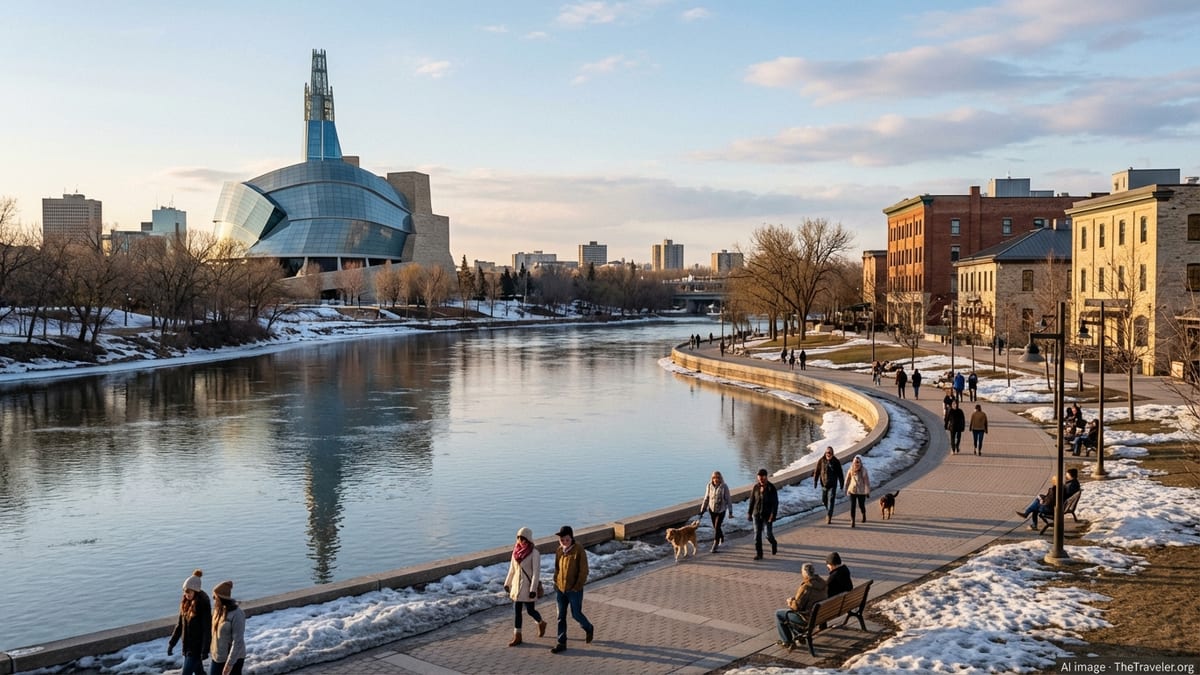
Walking the river paths around The Forks was another highlight. On a cool but sunny day, I followed the trail along the water, passed families with strollers, cyclists, and people out with dogs. The rivers themselves are not postcard-pretty; they can be murky and high depending on the season. But the openness of the space and the sightlines toward the city, especially with the Canadian Museum for Human Rights looming with its unusual glass tower, gave me the sense that Winnipeg’s best self hides along the riverbanks rather than its main streets.
Culture and the Canadian Museum for Human Rights: Powerful but Heavy
I went to Winnipeg expecting the Canadian Museum for Human Rights to be the marquee cultural experience, and it was. The building is striking from a distance and even more intriguing up close, with angular glass and stone textures that look almost out of place against the otherwise low-rise skyline. Inside, the museum is spacious, thoughtful, and emotionally heavy. Exhibits deal with difficult histories from Canada and around the world, and it is not something you breeze through on a whim.
What surprised me was how much time and emotional energy the museum asked from me. I had initially planned for a quick visit, but the layered exhibits and interpretive design kept pulling me deeper. I found myself needing breaks and quiet corners to process what I was seeing. This is not a “fun” attraction, and it is not meant to be. It is powerful, educational, and at times overwhelming. If your idea of a city break is light sightseeing, this may feel like work. For me, it was absolutely worth it, but I wish I had dedicated more of a day and gone in with lower expectations of ticking off multiple attractions afterward.
Beyond the museum, Winnipeg’s cultural scene is more subtle than splashy. The Exchange District, with its dense cluster of early 20th-century warehouse buildings, galleries, and studios, felt like walking a condensed history of prairie commerce and architecture. Some streets were alive with small shops, coffee spots, and murals. Others were quiet to the point of feeling slightly abandoned. I walked through in the afternoon and again early evening, and both times I felt that the ingredients for a vibrant arts district were there, but the energy waxed and waned block by block. If you come expecting something like Montreal’s Plateau or Toronto’s Queen Street West, you may find it subdued. If you like slow wandering and old brick facades, it is satisfying.
Neighborhoods, Food, and Nightlife: Hit and Miss
Once I ventured beyond downtown, Winnipeg began to feel more human. Osborne Village, across the river from the core, was one of the first places where I actually felt part of a neighborhood rather than just a visitor passing through. Low- and mid-rise apartments, independent shops, small bars, and cafes gave the area a lived-in, slightly bohemian feel. It was not as hip or polished as some travel articles implied, but it felt authentic and, importantly, walkable. I could imagine staying here rather than downtown on a future trip.
Food was a mixed bag. I had a few memorable meals that showcased local ingredients and hearty prairie cooking, but I also had underwhelming experiences with bland dishes and sleepy service. Winnipeg’s restaurant scene does not feel oversaturated, which means the standouts are really appreciated but also that you can easily land somewhere generic if you do not research in advance. I learned quickly to ask locals for specific recommendations rather than relying on whatever was closest to my hotel. When I did that, my meals improved substantially.
Nightlife, at least on the nights I went out, was modest. There are bars and venues, particularly around Osborne Village and in parts of the Exchange District, but I did not encounter the kind of dense bar-hopping area you might find in larger cities. Some places were lively, but others felt half-full even at peak times. The upside is that I rarely had to deal with lines or overcrowding. The downside is that if you are seeking a high-energy nightlife destination, Winnipeg will likely fall short unless you time your visit to a major festival or event.
Weather Shock, Safety Perceptions, and Emotional Whiplash
I knew Winnipeg was cold in winter. I still underestimated it. On one of my days, the temperature with wind chill dropped well below what I would consider tolerable for casual sightseeing. Even walking a few blocks between buildings became an exercise in endurance. Buses felt like moving lifeboats, and any exposed skin complained instantly. The city does provide warming spaces, and people are clearly used to it, but as a visitor I had to accept that there were hours of the day when being outside simply was not comfortable, no matter how many layers I wore.
In contrast, another day was relatively mild, with bright sunshine that made the snow sparkle and encouraged people out onto trails and rinks. That sudden swing from unforgiving to pleasant created a strange emotional whiplash. On the harsh day, I questioned why anyone would choose to live here. On the milder one, I could see the charm of a winter city that embraces skating trails, outdoor gathering spots, and a kind of stoic camaraderie among residents. My biggest lesson was that timing is not a small detail in Winnipeg; it is central to whether you enjoy yourself.
On the topic of safety, my feelings were nuanced. I did not experience any incidents, but I did notice a visible presence of poverty and homelessness in certain parts of downtown. Some blocks felt rough around the edges, with boarded-up storefronts and people clearly struggling. It did not feel uniquely dangerous compared to other North American cities, but the contrast between shiny new developments and nearby areas of visible hardship was stark. I stayed aware of my surroundings, especially after dark, and avoided aimless wandering late at night. With basic urban common sense, I felt fine, but the city’s social challenges are hard to ignore.
Getting Around: Walkable Pockets and Transit Frustrations
Winnipeg is not a city that reveals itself easily on foot, but it does have walkable pockets. The downtown core, The Forks, parts of the Exchange District, and Osborne Village can all be linked on foot if you are reasonably fit and the weather cooperates. I enjoyed stitching these areas together in a long wandering day. However, the distances between some sights, the wide roads, and stretches with little pedestrian interest made certain walks feel more like commuting than exploring.
Public transit, primarily buses, did its job but rarely with grace. Routes from the airport into the city and between major nodes exist and are functional, but service can be slow, especially if you need to connect or are traveling outside peak hours. On cold days, even a modest delay feels much longer while you wait on a windswept curb. I appreciated that the network is being updated and expanded, but as a visitor I still spent more time staring out a bus window than I wanted.
Rideshare and taxis filled in the gaps. They are not particularly cheap, but for certain cross-town trips or late-night rides back from restaurants, paying for a car felt worth it to avoid long bus journeys and exposed waits. If I were to return, I would seriously consider renting a car, especially in summer when day trips to surrounding attractions might be more appealing. Winnipeg is designed around driving more than wandering, and first-time visitors feel that.
Parks, Nature, and the Constant Sense of Space
Where Winnipeg quietly excels is in its sense of space. Assiniboine Park, spread along the river in the western part of the city, was one of the few places where I felt an immediate “wow” that rivaled my expectations. Wide lawns, mature trees, formal gardens, and riverside paths all combine into a green escape that feels much larger than you would expect inside city limits. It was easy to lose track of time wandering between the pavilion, the open fields, and quieter wooded corners.
The attached zoo, with its focus on northern species among others, was better than I had cynically expected. I am cautious about zoos, but the enclosures I saw appeared thoughtfully designed, and the focus on cold-weather animals made sense in this climate. It is not the cheapest outing, and families could spend a small fortune over a full day, but as a visitor it added context to the region’s ecology and wildlife.
What I kept noticing during my time in Winnipeg was how quickly you can transition from urban fabric to open space. Even outside marquee parks, there are modest neighborhood parks, river trails, and pockets of naturalized land that break up the grid. It made the city feel breathable, particularly compared to denser urban centers. For travelers who crave a mix of urban convenience with fairly quick access to nature, Winnipeg quietly checks that box, though it does not shout about it.
Expectations vs Reality: Who Does Winnipeg Actually Surprise?
Going in, I half expected Winnipeg to either fully defy its reputation or completely confirm it. The reality was more in between. The stereotypes about brutal cold, a somewhat sleepy downtown, and a car-oriented layout are grounded in truth. I felt those things in my bones and in my feet. At the same time, the city offered more creativity, friendliness, and pockets of beauty than its detractors admit. The surprise was not that Winnipeg is secretly a world-class destination, but that it is more textured and layered than its punchline status suggests.
If you arrive imagining a compact, European-style old town or a nightlife-heavy urban playground, you will be disappointed. Winnipeg is not that. Its charms are spread out: a powerful museum here, an atmospheric warehouse district there, a riverfront meeting place anchoring it all, and big, generous parks stitched along the edges. You have to be willing to assemble your own experience rather than have it handed to you neatly in one or two districts.
Where Winnipeg shines is in the intangibles: the easy conversations with strangers who seem genuinely interested in where you are from, the sense of local pride that surfaces when you ask about favorite spots, and the resilience that comes from living in a place that regularly tests you with extreme weather. Those are harder to market, but they are what stayed with me longest after I left.
The Takeaway: Is Winnipeg Worth It for First Time Visitors?
After my time there, I would not call Winnipeg an essential stop for every traveler, but I also would not write it off. It is a city that rewards certain kinds of visitors more than others. If you are curious about Canadian history, human rights, and prairie culture, and you are willing to put in some effort to move around and plan your days, Winnipeg can absolutely be worth your time. You will likely come away with a more nuanced view of the country and a deeper appreciation for life in the center of the continent.
On the other hand, if you are looking for an easy, highly walkable city break with instant wow factor, dense nightlife, and mild weather, Winnipeg will probably frustrate you. The distances, the cold in winter or heat and insects in peak summer, and the unevenness of the urban experience will feel like compromises rather than quirks. In that scenario, there are other Canadian cities that match that wish list better.
If I were to do it again, I would visit in late spring or early fall, base myself in a neighborhood like Osborne Village or near The Forks instead of in the business core, rent a car for part of the trip, and build in more flexible time for parks, riverside wandering, and local recommendations. I would give the Canadian Museum for Human Rights a full half day on its own and not stack too much else on that same day. With those adjustments, I can see Winnipeg being not just surprising, but quietly satisfying.
In the end, Winnipeg did surprise me. Not as a hidden gem waiting to be “discovered,” but as a place that refuses to fit neatly into a single narrative. It is imperfect, sometimes harsh, occasionally dull, but also sincere, spacious, and more complex than its reputation. For travelers who appreciate that kind of honesty in a destination, Winnipeg might just be the kind of surprise that stays with you.
FAQ
Q1. Is Winnipeg worth visiting for a first timer compared to other Canadian cities?
For a first trip to Canada, I would not put Winnipeg ahead of places like Vancouver or Montreal, but if you are interested in prairie culture, human rights history, and quieter, more spacious cities, Winnipeg can be a rewarding and less obvious choice.
Q2. How many days should I spend in Winnipeg on my first visit?
I found that two to three full days was enough to see The Forks, the Canadian Museum for Human Rights, the Exchange District, and Assiniboine Park without rushing, though an extra day helps if you want a slower pace or a day trip.
Q3. Is Winnipeg safe for solo travelers?
In my experience, central areas felt reasonably safe with normal urban precautions, but some downtown blocks can feel rough and quiet at night, so I stuck to well-lit streets, limited late-night wandering, and used rideshare when I felt unsure.
Q4. What is the best time of year to visit Winnipeg?
After feeling the extremes, I would aim for late spring or early fall, when temperatures are more comfortable, river paths and parks are inviting, and you can still catch local events without the deep-freeze or peak summer heat.
Q5. Do I need a car to get around Winnipeg as a visitor?
You can manage with buses, walking, and rideshare if you stay near downtown or The Forks, but I often found transit slow and would strongly consider renting a car if you plan to explore farther-flung neighborhoods or surrounding areas.
Q6. Is Winnipeg walkable for sightseeing?
I found that certain pockets like The Forks, the Exchange District, and Osborne Village are pleasantly walkable, but long, less interesting stretches and harsh weather can make crossing between them feel more like a chore than a stroll.
Q7. What surprised me most about Winnipeg?
The mix of heavy, world-class storytelling at the Canadian Museum for Human Rights, the amount of open green space in and around the city, and how genuinely friendly and chatty locals were, even when the weather was punishing, all surprised me.
Q8. How expensive is Winnipeg for food and activities?
Overall, I found Winnipeg slightly cheaper than Canada’s biggest cities, but not a bargain; casual meals and entry fees add up, and you still need to budget sensibly, especially if you are visiting attractions like the zoo or eating in trendier spots.
Q9. Is Winnipeg a good destination in winter?
Winter can be beautifully atmospheric with skating trails and snowy parks, but the cold is extreme, so I would only recommend a winter trip if you are well-equipped, genuinely curious about winter cities, and comfortable adjusting plans when temperatures plunge.
Q10. Who would I recommend Winnipeg to as a first time visitor?
I would recommend Winnipeg to curious, flexible travelers who value culture, history, and parks over nightlife, do not mind a bit of planning and transit juggling, and are okay with a city that reveals itself slowly rather than dazzling you instantly.