

The road was never really the point. Over a week of driving through New England, it was the small towns themselves that kept rearranging my sense of what travel can be. Each stop, from weathered harbors in Maine to quiet greens in Vermont, asked me to slow down, listen more carefully, and remember that some of the most transformative journeys happen far from big-name cities and bucket-list attractions.
Tracing a Route Through the Quiet Corners of New England
My trip began with a map scribbled over coffee and a loose plan: leave Boston, hug the jagged Atlantic coast into Maine, swing back through New Hampshire’s lakes, and drift south across Vermont and western Massachusetts before returning via coastal Rhode Island and Connecticut. I deliberately left blank spaces in the itinerary. In small-town travel, the most meaningful moments tend to live in the margins, in places you only discover when you take the slower road instead of the faster one.
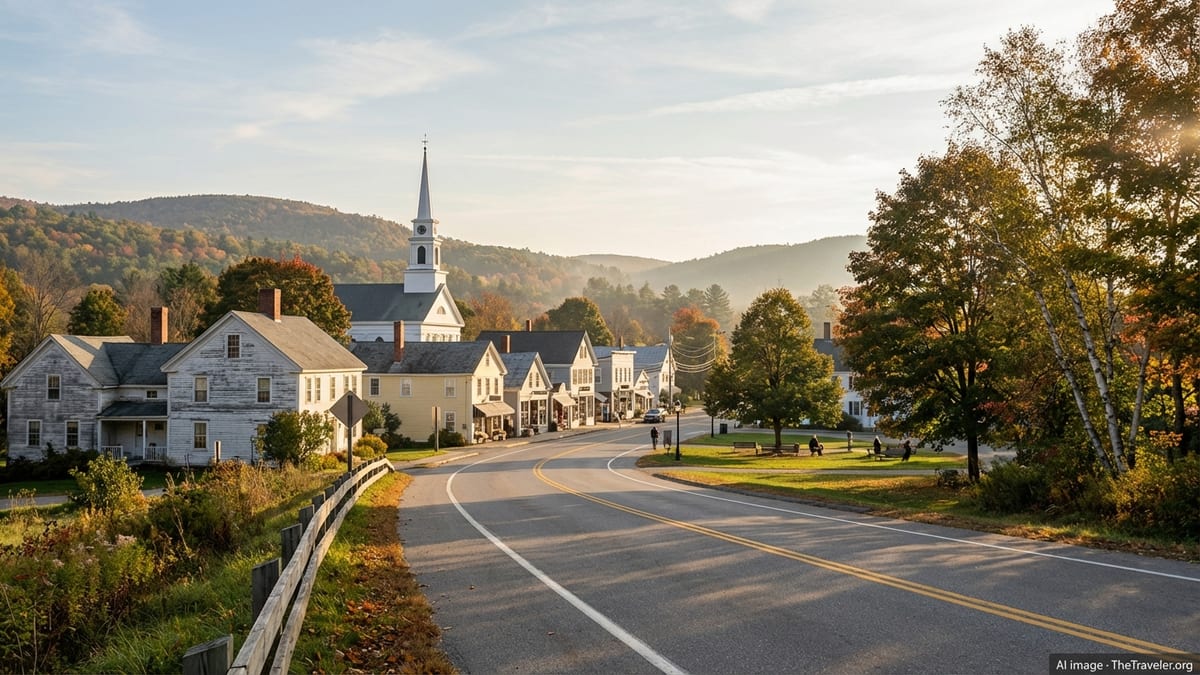
Rather than anchor the journey around a single destination, I used towns as stepping stones. Coastal villages like New Harbor and Ogunquit in Maine, and later Little Compton in Rhode Island, became natural pauses between longer stretches of driving. Inland, Vermont’s compact communities scattered along two-lane routes offered their own rhythm: general stores, church steeples, and glimpses of the Green Mountains unfolding just beyond white clapboard houses.
What surprised me was how coherent the region felt, despite the differences from harbor to hill town. There was a shared sense of proportion, of places built to human scale. Sidewalks still mattered. Village greens remained the social heart. Independent bookstores and bakeries acted as de facto welcome centers, where the most reliable advice still comes not from an app but from a conversation across the counter.
This was not a road trip of famous skylines or marquee museums. It was a mosaic of moments: the exact shade of evening light on cedar shingles, the sound of gulls over a working harbor, the rustle of maple leaves in an inland valley. New England’s small towns turned the drive itself into a kind of moving meditation, where the distance between places became as interesting as the places themselves.
Harbor Towns That Still Smell Like Salt and Sawdust
In coastal Maine, small-town life remains anchored to the tides. New Harbor, a compact village tucked within the town of Bristol, felt like a still-working postcard. Traps were stacked on wharves, small boats motored in and out, and the conversations drifting across the docks were more about weather and lobster prices than tourism. It is the kind of place that has been recognized in recent years for its neighborly spirit, yet it still feels first and foremost like a community that happens to welcome visitors, not a destination built entirely around them.
Farther down the coast, towns like Ogunquit and Old Orchard Beach show a different face of small-town coastal life. Ogunquit has long attracted artists and summer visitors, and its cliffside walking path, the Marginal Way, threads between sea and village in a way that turns an everyday stroll into a scenic event. Old Orchard Beach, by contrast, opens onto a long sweep of sand lined with simple lodgings and seasonal businesses. Both places have clearly grown up around visitors, yet at quieter hours you can still glimpse the working roots: delivery trucks before sunrise, fishermen heading out while the arcades sit dark.
Traveling this shoreline by car reveals how varied New England’s coastal settlements really are. Some, like Mystic and Milford in nearby Connecticut, have been singled out by national travel and lifestyle publications for their restaurants, museums, or retirement appeal. Others simply hum along with modest downtowns and family-run diners. To move between them in a single trip is to see a continuum of coastal life, from deeply traditional working harbors to polished getaways that still manage to retain a sense of place.
What gives these harbor towns their power is texture. Weathered shingles, leaning piers, and boats tied in irregular lines all signal that this is a lived-in coast. As a traveler, you are reminded that the ocean is not just a view but a livelihood, and that a town’s identity is often shaped as much by what happens at dawn, before visitors wake up, as by what appears on postcards.
Slow Roads and Mountain Towns in Vermont and New Hampshire
Leaving the coast for the interior, the road began to rise and coil. Vermont and New Hampshire do not unfold in dramatic vertical leaps so much as in gentle, persistent climbs that carry you from river valleys into true hill country. Here, small towns are threaded along state routes and classic scenic byways, some of which have been highlighted in recent regional coverage for their foliage views and quiet charm. Route 100 in Vermont, for instance, knots together a string of communities where a lone steeple or covered bridge often signals the next stop before you even see a town sign.
In towns like Stowe, Waitsfield, and Manchester, the mountains are never out of sight. In autumn, regional outlets and public radio stations regularly point travelers toward these areas as some of the best places to see changing leaves without overwhelming crowds, especially if you time your visit away from peak weekends. Even outside foliage season, these communities reward unhurried exploration. A short stroll may carry you from a farmer’s market to a trailhead, or from a craft brewery to a quiet riverbank fringed with birch.
New Hampshire’s contribution to this inland circuit lies in its lakes and back roads. Skirting around Lake Winnipesaukee or tracing smaller roads through the foothills of the White Mountains, I found towns where the post office, library, and general store still formed a kind of civic triangle. None are large, and few appear in conventional top-ten lists, yet nearly all offered what I had secretly come north to find: a sense of daily life proceeding at a scale where individual interactions still matter.
The mountain and lake towns underscored how much small places can teach us about seasonality. In conversations at diners and co-ops, people talked about mud season in spring, crowds in high summer, and the delicate balancing act of fall foliage tourism, which in some Vermont communities has grown intense enough to spark local concern about traffic and trespassing. All of this, more than any viewpoint, reminded me that visiting is a privilege that relies on year-round residents choosing to welcome those who pass through.
What Small Towns Gave Me That Cities Rarely Do
Some lessons only reveal themselves when you have driven the same kind of two-lane road for hours and begun to feel the difference between passing through and arriving. New England’s small towns recalibrated my expectations of what travel should feel like. I found myself caring less about checking off attractions and more about noticing tiny details: hand-painted signs for suppers at local churches, the exact shade of blue on a harborside bench, the way people in a village store automatically moved aside to make room for one another.
Small towns asked less of my attention and gave more in return. There were no aggressive skylines demanding a photograph, no rush of competing events, no sense that I might be missing something if I chose to sit and linger. Instead, the reward was in the act of staying put. In one Vermont village, I spent nearly an hour on a green bench watching children invent games around a war memorial and older neighbors greet each other by name. In a Rhode Island coastal town, a simple walk from the common to the rocky shore felt like a lesson in how tightly land and sea are woven together.
The trip also made community feel tangible. In several places, I arrived during small, informal events that never would have appeared on a national tourism calendar: a volunteer-run book sale in a church hall, a Friday-night concert on a town green, a school fundraiser at the fire station. These were not staged for visitors, yet I was welcomed in without hesitation. That easy hospitality, unadorned and unmonetized, is a powerful reminder that some of the best travel experiences come from participating in ordinary life rather than observing it from a distance.
Perhaps most importantly, small-town travel encouraged a different sense of time. Without subways or expressways, it is hard to move quickly even if you want to. Ferry schedules in Maine, narrow village streets in New Hampshire, and winding roads in Vermont all conspired to slow the pace. In a culture that often equates movement with progress, lingering in one place long enough to watch evening settle felt quietly radical.
Traveling Responsibly Where Everyone Knows Everyone
Moving through small towns is not just a change of scenery. It is an entry into places where anonymity is rare and the impact of tourism is highly visible. In recent seasons, Vermont in particular has seen heated local conversations about fall visitors who stray onto private land in search of the perfect photograph or overwhelm narrow back roads during peak foliage weekends. Local news and public radio reports have chronicled how some communities have responded with new parking rules, partial road closures, or signage urging visitors to respect property boundaries and drive carefully.
These stories were on my mind every time I pulled over for a view. Traveling through small communities carries a responsibility that goes beyond familiar advice about leaving no trace. It means understanding that the scenic barn you want to photograph is often someone’s workplace or home, that quiet dirt lanes are also emergency routes, and that seemingly empty fields and forests are part of local livelihoods. In places that have become social media darlings, residents are increasingly asking visitors for a different kind of presence: more curious, less extractive.
On this road trip, that translated into practical choices. I parked only where it was clearly allowed, skipped any location that required ignoring a sign or a barrier, and asked permission before taking close-up photos of people or property. I tried to spend money in independent businesses rather than chains, even when it meant driving a little farther or waiting an extra few minutes. I stayed in family-run inns when possible, booked midweek where I could to ease weekend pressure, and kept my expectations flexible when weather or local events disrupted plans.
None of this felt burdensome. Instead, it deepened my sense of connection. Every time I paused long enough to talk with a shopkeeper, ferry crew member, or café owner, I learned something about how the town was adapting to both opportunity and strain. Responsible travel in small places is not about perfection; it is about remembering that you are a guest in someone else’s everyday landscape and acting accordingly.
How Small Towns Change the Economics of a Road Trip
Driving through New England’s lesser-known towns reshaped my sense of value. In big cities, budgets tend to be devoured by a few large expenses: marquee museums, high-end restaurants, or headline hotels. In small towns, the spending pattern shifted. Money flowed into a series of modest interactions: a bowl of chowder at a harbor diner, a bag of apples from a roadside stand, a locally made book purchased from a tiny store that might otherwise close early on a quiet afternoon.
Travel coverage in recent years has increasingly highlighted how tourism can either support or strain small-town economies, and that tension is evident on the ground. A place like Mystic, recently praised in national travel magazines for its waterfront, food, and maritime history, benefits from visitor dollars that help sustain museums and independent businesses. At the same time, nearby towns watch closely to see how to welcome visitors without losing affordability or accessibility for residents. Coastal communities in Maine and Rhode Island have similar conversations around housing, seasonal employment, and the rise of short-term rentals.
For the traveler, the opportunity lies in being intentional. Choosing a home-style inn over a distant chain, accepting slightly shorter opening hours in exchange for buying local, or lingering long enough to attend a midweek event can all make a difference. In a town where the population may number in the low thousands or even hundreds, a handful of extra off-season diners, museum visitors, or bookstore customers can help keep doors open. That awareness turned every small purchase on my trip into a quiet vote for the kind of places I hope will still be here when I return.
In this sense, small-town road trips can be surprisingly powerful economic choices. They distribute spending across a network of communities instead of concentrating it in a single urban hub. They encourage travelers to think beyond headline destinations and recognize the value embedded in places that rarely make national lists but are no less essential to the regional fabric.
The Takeaway
By the time I rolled back into the city, the odometer told one story. A longer, less visible story lived in the accumulation of small-town encounters that had slowly rearranged my understanding of travel. New England’s villages and harbor towns showed me that journeys do not need spectacle to be meaningful. They need texture, humility, and the willingness to pay attention to quiet places that have been here far longer than our itineraries.
Small towns along this route demonstrated the power of everyday hospitality: the café that stayed open an extra ten minutes for a tired driver, the librarian who drew a map on scrap paper, the innkeeper who recommended a side road that became the highlight of the day. These gestures, modest and unadvertised, delivered the kind of connection that many travelers say they seek but rarely find in busier destinations.
If this road trip taught me anything, it is that choosing small towns is less about escaping the world and more about seeing it clearly. In New England’s compact communities, you can watch how history, landscape, and present-day pressures meet in real time. You can contribute in small but concrete ways to the life of a place, and in doing so, allow that place to shape you in return. The power of small-town travel lies precisely in that exchange: a slower, gentler form of tourism that leaves space for both traveler and town to remain fully themselves.
FAQ
Q1. What is considered a “small town” in New England for a road trip?
For a trip like this, a small town is typically a community with a few hundred to several thousand year-round residents, a compact main street or village center, and a limited but locally focused set of services such as a general store, cafés, and small inns.
Q2. How many days do I need for a New England small-town road trip?
A week allows you to sample coastal villages and inland towns without rushing, but even a long weekend can be rewarding if you focus on one or two regions rather than trying to see the entire map.
Q3. When is the best time of year to visit New England’s small towns?
Late spring and early fall are ideal for mild weather and scenery, but each season has its appeal. Autumn is especially popular for foliage, while late spring and early summer often feel quieter.
Q4. How can I travel responsibly in small communities that see a lot of visitors?
Respect private property and local rules, park only where permitted, keep noise low, support independent businesses, and remember that you are moving through someone else’s everyday environment, not an open-air museum.
Q5. Are New England’s small towns expensive to visit?
Costs vary by state and season, but many small towns offer a range of modest lodgings and casual dining. Avoiding peak holiday weekends and booking in advance can help keep a trip more affordable.
Q6. Do I need a car for this kind of road trip?
Yes. While a few towns have limited public transit or seasonal shuttles, a car gives you the flexibility to reach quieter places, follow scenic back roads, and adjust plans around weather or local recommendations.
Q7. How can I find lesser-known towns that are still worth a stop?
Regional newspapers, public radio travel features, and state tourism sites often spotlight smaller communities. Once on the road, ask locals which nearby towns they visit for markets, walks, or day trips.
Q8. Is it safe to road trip alone through these areas?
Most New England small towns have low crime rates and feel comfortable for solo travelers, though it is wise to follow general safety habits, keep someone informed of your route, and be mindful of weather and road conditions.
Q9. How can I make sure my spending actually benefits local residents?
Prioritize independent inns, shops, and restaurants, look for local products at markets and co-ops, and consider traveling slightly outside peak periods so your visit supports more sustainable, year-round business.
Q10. What should I pack for a small-town New England road trip?
Pack layers for changeable weather, comfortable walking shoes, a reusable water bottle and shopping bag, paper maps or offline navigation, and enough patience to embrace slower roads and unplanned stops.