

I thought I knew the Midwest. To me it was endless interstate, cornfields and quick overnight stops on the way to somewhere else. Then I traced the Ohio shoreline of Lake Erie, island by island and harbor by harbor, and realized how wrong I had been. The lake’s changing light, working waterfronts, restored wetlands and small resort towns forced me to rewrite my private map of the region. This was not flyover country. It was a freshwater coast, and spending time along Lake Erie’s shores fundamentally changed how I see Midwest travel.
Meeting the Lake: First Impressions of a Freshwater Coast
Lake Erie does not ease you in. Driving north from the Ohio Turnpike, I expected a glimpse of water behind warehouses. Instead the land simply stopped and the horizon turned to silver. Ships moved like slow punctuation marks on the distance. Gulls wheeled over marinas that smelled of wet rope and diesel. It felt coastal in a way I usually associate with New England, yet the license plates around me were from Ohio, Michigan and Indiana. From the start, the lake scrambled my categories of what the Midwest is supposed to look like.
Along this stretch of shoreline, the lake is close enough to shape daily life. Weather comes in off the water without warning. Spring can feel like winter, and then a south wind suddenly turns the lake a softer blue and fills the parks. Locals talk about the lake with the same mix of respect and affection you hear in seaside towns. It feeds them with walleye and perch, cools heavy August afternoons and occasionally eats pieces of the bluff. The more I listened, the more Lake Erie felt less like a scenic backdrop and more like a central character in a long regional story.
What I had imagined as a quick pass-through turned into deliberate exploration. Instead of racing from city to city, I followed the subtle changes in shoreline: marshy in the west, more rocky and wooded as I headed east. Small differences in water color, wind direction and birdlife from one day to the next started to matter. For the first time on a Midwest road trip, I felt the same sit-and-watch-the-horizon pull that usually belongs to oceans.
That shift in perspective was quiet but profound. The Midwest, I realized, is also a place of coasts, ferries, historic lighthouses and waterfront redevelopment debates. Lake Erie merely makes those truths visible in a concentrated way. Once you have seen the Midwest framed by a vast sheet of water, it is hard to go back to thinking of it as landlocked.
Between Wetlands and Boardwalks: Discovering Maumee Bay
My first real pause came at Maumee Bay State Park, a short drive east of Toledo. From a distance, it looked like many state parks: a lodge tucked into low trees, a campground, a sweep of shoreline. Up close, I realized it is also one of the best introductions to the complexity of the western Lake Erie coast, where open water blends into wetlands and managed recreation has to coexist with fragile ecosystems.
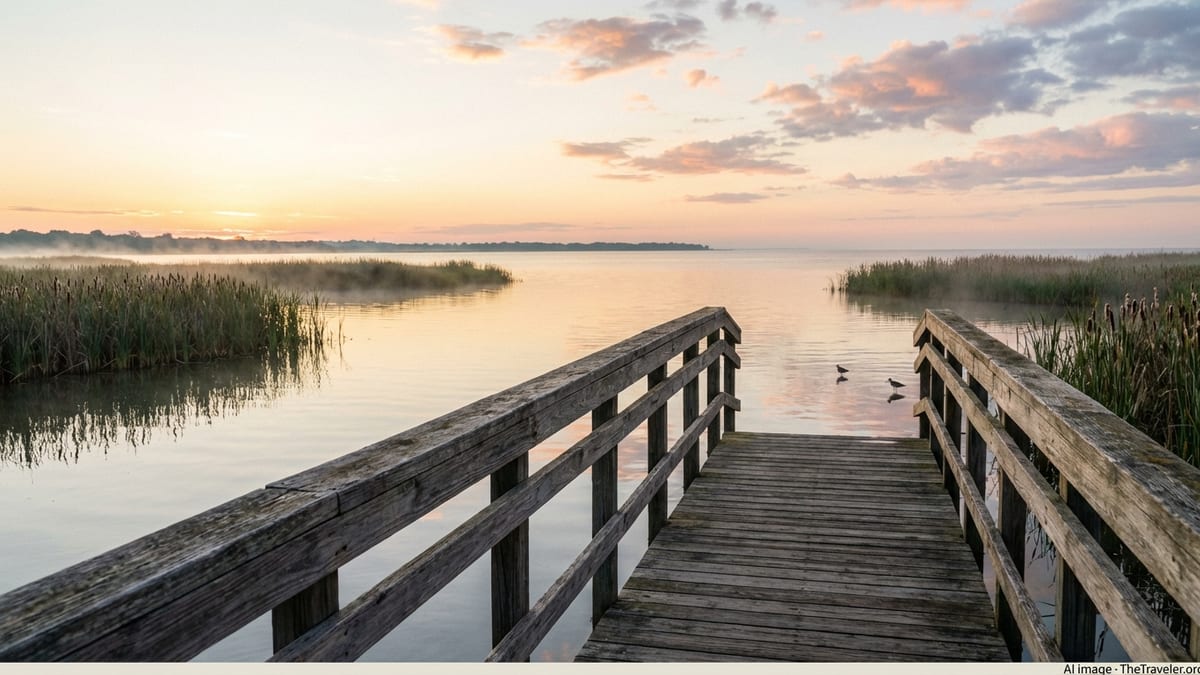
A two-mile boardwalk loops through marshland that hums with life. I walked just after sunrise, when the light was still soft and the lake breeze pushed low clouds inland. Red-winged blackbirds claimed cattail stalks as if they owned them. Turtles slid from logs at the slightest vibration. In one direction I could see an uninterrupted wall of reeds. Turn slightly and there were the angular lines of the lodge, the golf course and, beyond them, the sheen of the open lake. It felt less like a park and more like a working compromise between protection and access.
Standing on one of the boardwalk overlooks, I thought about how often we flatten the Midwest into farmland and factories. Here, in a county where industrial history is never far from view, the state has protected over a thousand acres of shoreline and wetland for hiking, birding, boating and winter sports. I watched families push strollers along the boards, anglers heading out with tackle boxes, and a group of school kids listening to a ranger explain how wetlands filter water flowing into Lake Erie. It felt like a living argument that Midwest travel can be about ecology and education as much as scenery.
Maumee Bay also reshaped my sense of pace. I had driven in on a rigid schedule, the kind that usually governs cross-country trips. The boardwalk had other ideas. It rewards slowing down, lingering over the texture of tree bark, the shifting pattern of lily pads, the way the wind ripples through grass. By the time I left, the idea of simply “checking off” Lake Erie felt impossible. This was a place that asked to be returned to in different seasons, to see the marsh under snow or in the height of spring migration.
Lighthouses, Ferries and Island Time: Life Offshore
Lake Erie’s islands were what finally shattered my old mental map of the Midwest. Before this trip, I could not have told you there was an entire island culture just offshore from northern Ohio. Out there, separated by a short ferry ride but a much longer psychological distance from the mainland, the lake is not scenery. It is the road, the pantry and the weather report.
From the Marblehead Peninsula, cars and foot passengers roll onto ferries that cross to Kelleys Island and South Bass Island. The ferries run with warm-weather regularity, but locals know that everything depends on conditions. Ice, wind and storms dictate when service begins in spring and when it ends in late fall. Schedules can look predictable on paper, yet every captain I spoke with framed them as intentions, not guarantees, because Lake Erie has its own opinions.
On Kelleys Island, the pace changes almost immediately. Golf carts drift through village streets. Porches face the water as if every home were built around the ritual of watching sunset. The island is close enough to the mainland that you can still see the smokestacks and grain elevators along the coast, yet it feels self-contained. Trails pass glacial grooves cut into the bedrock and quiet forests where the only sound is wind in the canopy. For many visitors, this is their first taste of island life without leaving the Midwest.
South Bass Island, anchored by the village of Put-in-Bay, presents a livelier face. Day-trippers arrive with coolers, ready for a festive afternoon. But step away from the harbor, and another side emerges: vineyards catching the late light, narrow roads edged with old stone walls, and monuments that recall the War of 1812, when this seemingly placid water was a strategic battleground. Out on the lake, sailboats tack between buoys while distant freighters track the deeper shipping channels. Surrounded by water on all sides, the Midwest feels less like the middle of the continent and more like a place defined by inland seas.
Marblehead and the Human Scale of History
If the islands introduced me to Lake Erie as a road, Marblehead Lighthouse and its small surrounding park revealed the lake as a historical constant. Rising from a promontory of limestone, the white tower has been guiding ships since the 1820s. The structure is modest by modern architectural standards, but standing at its base you sense how it has anchored generations of sailors, fishers and local families.
On a clear afternoon, I watched as visitors traced their fingers along the stone blocks, reading interpretive signs about the light’s keepers and storms survived. Children pointed out passing barges as if they were oversized toys, but the shipping lanes they marked are part of a much larger Great Lakes economy. This single lighthouse, modest in scale and design, connects the dots between maritime trade, coastal safety and federal investment in inland navigation. It is a reminder that the Midwest has always been more connected to the wider world than its landlocked reputation suggests.
From the park, the view sweeps toward the islands and back along the peninsula, taking in both recreational boaters and industrial silhouettes. In the space of a slow 360-degree turn, you see families picnicking, anglers lining the rocks, and freighters moving raw materials toward distant factories. The scene complicates the easy narratives of decline that often cling to Great Lakes stories. Yes, there are challenges here, from water quality to economic transitions. But there is also continuity and adaptation, visible in every ship that still follows light and buoy to safe harbor.
For me as a traveler, Marblehead underscored how physical landmarks can change emotional geography. Before this trip, I thought of lighthouses as mostly coastal curiosities. Here, in the middle of the country, one became a lens through which I saw the whole lake as an active, working waterway. It made my previous image of the Midwest feel incomplete, like a map sketched without its essential borders.
Cities on the Water: Cleveland’s New Lakefront Story
When people talk about visiting Cleveland, they often focus on museums, sports and food. On this trip I arrived with a different curiosity: how a major Midwest city is trying to reconnect itself to its lake. For much of the twentieth century, Cleveland’s downtown waterfront was sealed off by highways, parking lots and a powerful football stadium. The lake was something you glimpsed between concrete structures, not a space you naturally strolled to after dinner.
That reality is now shifting. In recent years local leaders, planners and community groups have converged around a fresh vision: transforming surface lots and underused waterfront land into a mixed-use district with parks, plazas, new housing and better access to the water. Plans call for a pedestrian land bridge linking downtown directly to the shore, making it possible to walk from office towers to lakefront promenades without dodging traffic. The goal is not Miami-style spectacle, but a lived-in neighborhood that acknowledges Lake Erie as Cleveland’s front yard, not its back alley.
Walking along the existing paths near the stadium, I tried to imagine what the next decade might bring. On one side, the lake rolled in patient waves against breakwalls. On the other, survey markers hinted at future construction. News reports describe federal and state funding already committed to improving access, and civic debates over how to balance public space with private development. More recently, regional leaders have pushed for closing a nearby lakefront airport to open hundreds of acres for parks, housing and economic projects. For visitors, that conversation is more than policy. It will reshape the way future travelers first encounter Cleveland, trading fences and runways for open water and green space.
The broader point for me was this: Midwest travel is not just about visiting what is already finished. On Lake Erie’s shore, it can also mean witnessing a city in the middle of rewriting its relationship to the water that shaped it. The cranes on the skyline and community meetings in repurposed warehouses are as much a part of the story as restored historic districts. That realization added a new layer to my journey. I was not only collecting scenic moments; I was seeing a region test new ideas about public space, climate resilience and equitable development, all under the steady gaze of the lake.
Reimagining What Counts as a Midwest Getaway
Before Lake Erie, my template for a Midwest getaway leaned heavily on lake cabins deep in the woods, or downtown weekends built around a concert and a brewery crawl. Charming in their own ways, yes, but also familiar. Traveling the length of Ohio’s shoreline offered a different model: a trip organized around water, ferries, wetlands and working harbors, but still grounded in accessible driving distances and small-town budgets.
I met families who return to the same island cottage year after year, treating the ferry crossing as a ritual that marks the start of summer. Birders timed their visits to migration peaks and spoke about the western Lake Erie marshes with the same reverence other travelers reserve for national parks out west. Cyclists planned multi-day rides along the coast, connecting state parks, small towns and city waterfronts into a kind of informal Lake Erie trail. None of them spoke about “escaping” the Midwest. They were leaning into a version of it that quietly defies stereotypes.
What struck me most was the variety packed into a relatively short stretch of shoreline. In a single long weekend you can watch the sunrise over a marsh boardwalk, take a mid-morning ferry to an island, tour a historic lighthouse in the afternoon and end the day in a city neighborhood debating its future with the lake. That density of experiences challenges the notion that you need to cross several state lines or chase dramatic mountain passes to feel that you have truly traveled.
From a practical perspective, Lake Erie shores also suggest a different rhythm. Trips here are less about ticking off marquee attractions and more about finding your own balance of quiet and connection: a morning paddle, an unhurried lunch at a harbor diner, an evening spent listening to waves slap against breakwalls. It is a form of travel well suited to travelers who crave substance over spectacle, and who are open to being surprised by places they thought they knew.
The Takeaway
My time exploring Lake Erie’s shores did not erase the rest of the Midwest I thought I knew. The farms and interstates are still there, and so are the cities far from any large body of water. What changed, instead, was the frame I place around the region. The Midwest is no longer a distant interior in my mind. It is a place of coasts and islands, environmental experiments and ambitious waterfront plans, rooted communities and new arrivals who choose these shores precisely because they feel both grounded and open-ended.
Standing on a pier one evening, watching the last fishing boats return as a freighter’s lights traced a slow line across the horizon, I realized that Lake Erie had done something subtle but important. It had turned the Midwest from a region I passed through into a landscape I wanted to return to, season after season, to see what changed and what stayed the same. That, in the end, is what meaningful travel does. It takes a familiar word like “Midwest,” holds it up to the light of lived experience, and reveals more colors than you expected.
If you have ever written off this part of the country as a place you fly over on the way to a coast, consider rerouting your next trip toward Lake Erie. Come ready for boardwalks and ferries, for historic lighthouses and city planning meetings, for quiet marsh mornings and city nights with the lake wind funneling down the streets. You may find, as I did, that a few days along this freshwater shore are enough to redraft your mental map of what Midwest travel can be.
FAQ
Q1. Is Lake Erie really worth a dedicated trip, or just a stop on a longer Midwest drive?
Lake Erie’s Ohio shoreline can easily fill several days, with islands, state parks, small towns and city waterfronts that reward slowing down rather than passing through.
Q2. When is the best time of year to explore Lake Erie shores in Ohio?
Late spring through early fall usually offers the most reliable ferry service, open attractions and comfortable temperatures, though each season has its own character.
Q3. Do I need a car to visit places like Kelleys Island and South Bass Island?
You will typically need a car to reach the ferry docks, but once on the islands many visitors rely on walking, bicycles or golf carts instead of driving.
Q4. How should I plan around variable Lake Erie weather and ferry schedules?
Build flexibility into your itinerary, check schedules shortly before travel, and be prepared for delays or changes if wind, waves or ice affect conditions.
Q5. Are Lake Erie coastal towns and parks suitable for families with children?
Yes. Boardwalks, beaches, shallow swimming areas, ferries and lighthouses all tend to appeal to children, and many communities cater to multigenerational trips.
Q6. What kinds of outdoor activities can visitors expect besides beaches?
Hiking, birding, boating, fishing, cycling and winter sports are common along the Lake Erie coast, especially in larger state parks and nature preserves.
Q7. How does Lake Erie travel compare in cost to more famous coastal destinations?
Lodging and dining are often more affordable than on ocean coasts, especially outside peak summer weekends, though prices still vary by town and season.
Q8. Is it possible to combine city experiences with quiet nature on a single Lake Erie trip?
Yes. Visitors frequently pair time in cities like Cleveland or Toledo with nearby state parks, islands or small harbor communities on the same itinerary.
Q9. Do I need special gear or experience to enjoy Lake Erie safely?
Basic outdoor clothing layers, appropriate footwear and life jackets for boating are usually sufficient, along with observing local safety guidance and posted warnings.
Q10. How is Lake Erie travel changing as communities rethink their waterfronts?
Many communities are investing in better public access, trails, parks and mixed-use districts, gradually shifting once-industrial shorelines toward more visitor-friendly spaces.