

The first thing that struck me about Churchill was the silence. After the plane door opened to subarctic air and we walked down the metal stairs onto the tarmac, the world seemed reduced to snow, sky and the distant outline of Hudson Bay. Somewhere beyond that horizon, polar bears were pacing and waiting for the sea ice to form. I had come to see them, but what I discovered in Churchill was a complex northern town, a fragile ecosystem and an experience that felt far more immersive and humbling than any brochure could convey.
Arriving at the Edge of the Arctic
You do not simply “drop in” on Churchill. Perched on the southwest shore of Hudson Bay in northern Manitoba, the town is isolated from the road network, so visitors arrive either by plane from Winnipeg or on a long, lumbering train that crosses boreal forest and tundra. Stepping off the aircraft in October, I could feel why this place is often described as the edge of the Arctic. The wind cut across the flat landscape, the air felt dry and sharp, and even the light seemed different, slanting in at a low angle that made every snowdrift glow.
Churchill itself is small, with just a few streets, no traffic lights and a working port and rail yard that remind you this is a real community, not just a tourist stage set. Pickup trucks share the road with tour company vans, and ravens patrol the sky above low wooden houses and shipping containers. Between them sit the hotels, guesthouses and outfitters that anchor an economy now driven heavily by wildlife tourism, especially in the peak polar bear season from roughly mid October to mid November, when bears gather near town awaiting the freeze up of Hudson Bay.
From the beginning, there is a sense that you are entering a place where people and wildlife overlap in ways that demand constant awareness. At the tiny airport, new arrivals are often briefed about safety around bears and the reality that these animals can and do walk through town. That message continues on the drive in, where you pass the Polar Bear Holding Facility, the so called bear jail where problem bears are held before relocation rather than being killed. It sets the tone for a visit grounded in both wonder and respect.
Accommodation ranges from simple motels and family run lodges to higher end options, but nothing about Churchill feels flashy. Rooms are comfortable and well heated, with thick curtains to keep out the wind and, if you are lucky, a glimpse of the northern lights. Prices can feel steep compared to southern Canada because everything, from food to fuel, must be shipped or flown in. It is part of the reality of traveling in a remote subarctic town that maintains services not only for visitors but for a year round population that lives with long winters and short summers.
What Polar Bear Season Really Feels Like
Polar bears are the headline attraction, and for good reason. Churchill lies near the migration routes of the western Hudson Bay polar bear population, one of the most southerly on earth and one of the few that regularly gathers near a town. In late fall, as the temperatures drop and thin ice begins to form offshore, bears move toward the coast and linger there, resting, sparring and roaming as they wait for solid sea ice and their seal hunting season to begin. The result is a relatively concentrated viewing window when chances of sightings are high, though nature, of course, offers no guarantees.
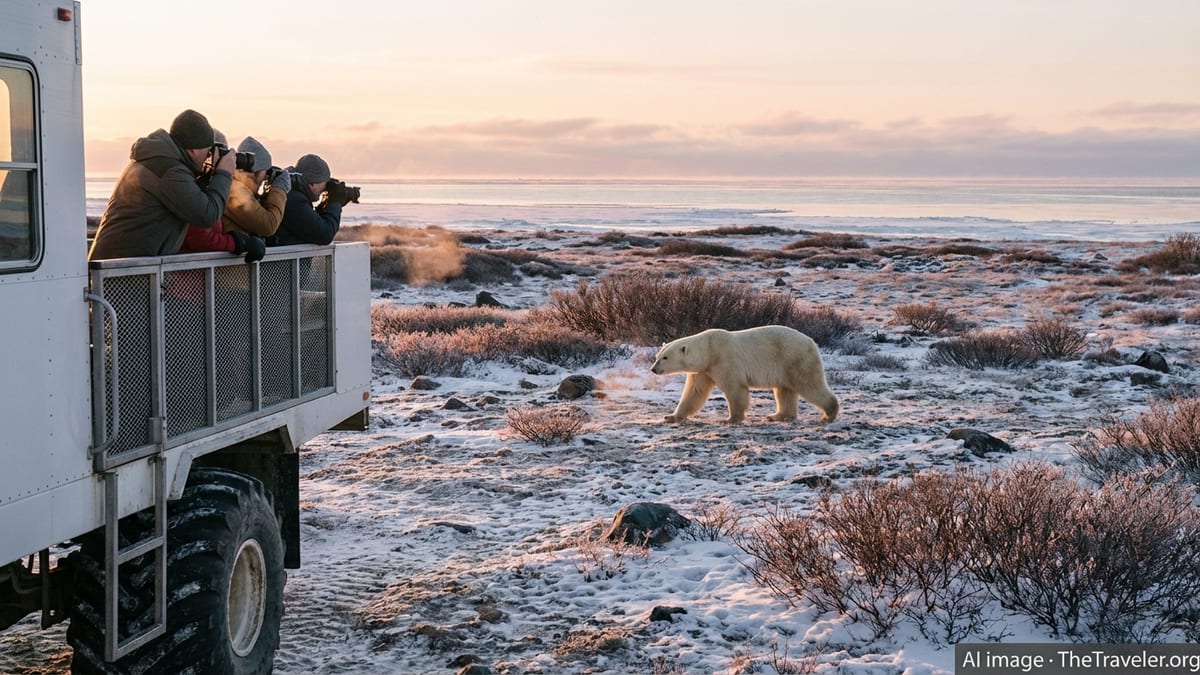
Seeing your first polar bear from a tundra vehicle is a jolt of pure adrenaline and awe. These custom built machines ride on huge tires and carry visitors far out across the frozen tundra in a designated wildlife management area east of town. From the elevated windows and open viewing platforms, I watched a large male emerge from a snow filled hollow and walk slowly toward us, his fur catching the pale sun. Even at a cautious distance, the scale of the animal is hard to process. Adult males can reach several hundred kilograms in weight and stand far taller than a person when they rear up, yet they move with a calm, almost fluid grace.
The mood on board oscillates between quiet absorption and excited whispers. Naturalist guides are quick to remind guests that the bears are wild and that the goal is to observe without influencing behavior. The vehicles follow strict rules about speed, distance and where they can travel, part of a set of regulations designed by provincial authorities to limit stress on the animals and protect both bears and people. It is tempting to believe you are on a polar bear safari, but in reality you are an invited guest in their habitat, and the operation is intentionally conservative.
Polar bear season is also a lesson in patience and weather. Some days are full of activity, with bears walking, play fighting or testing the forming ice on the bay. Other days are quiet, with animals sleeping in snow drifts, their only movement a slow lift of the head or a paw thrown lazily in the air. The weather can change quickly, from clear skies to blowing snow that reduces visibility to a blur of white. Temperatures often sit well below freezing, and wind on the open tundra can make it feel colder still. Dressing in layers, wearing insulated boots and protecting exposed skin are not suggestions but necessities if you want to enjoy time on deck rather than hiding inside with fogged up camera lenses.
Life in a Town That Lives With Bears
One of the most surprising aspects of visiting Churchill is discovering how deeply polar bears are embedded in daily life. This is a town where people routinely check around corners and carry flares or bear deterrents when walking after dark in bear season. Residents are careful about leaving doors unlocked on vehicles and buildings, not for human convenience but so anyone confronted by a bear can take quick shelter. The relationship is not romantic. It is practical, sometimes tense and rooted in long experience.
Churchill’s approach is built on coexistence. Conservation officers and local patrols monitor bear activity around town, using loud deterrents to push animals back toward the coast and, when necessary, capturing and holding repeat offenders in the secure Polar Bear Holding Facility until they can be flown or transported out onto the ice. The existence of this facility is a stark reminder that despite their charisma, polar bears are apex predators. It is also evidence of how policies have shifted over recent decades from simply shooting bears that approach town to trying to keep both people and animals safe.
Walking around town during bear season feels different from a typical resort destination. There are clear signs warning about bears, and guides are explicit about the fact that it is unsafe to hike alone outside of designated areas. Still, there is room for relaxed exploration. Colorful murals brighten the sides of buildings, the legacy of public art projects that brought international artists north to paint large scale works featuring Arctic wildlife and Indigenous themes. Small shops sell northern crafts, including Inuit carvings and beadwork, alongside practical gear like mitts and toques. Cafes and restaurants serve hearty dishes aimed at people who have spent the day in cold wind and need warming comfort.
Inside the Itsanitaq Museum, one of the town’s most compelling cultural stops, I spent an afternoon examining Inuit artifacts, sculptures and tools that speak to thousands of years of life in the North. Exhibits help place Churchill within a larger narrative of Indigenous presence, Catholic mission history and Arctic exploration. It is an essential counterpoint to the sometimes single minded focus on bears and northern lights and a reminder that this landscape has been home to people long before it became a destination.
Beyond the Bears: Belugas, Northern Lights and Winter Adventures
Although autumn bears dominate Churchill’s global image, the town has distinct seasons that offer very different experiences. In summer, the icy bay softens, wildflowers emerge on the tundra and thousands of beluga whales move into the Churchill River estuary to feed and calve. Boat and zodiac tours head out on the water to watch the white whales as they roll and surface in pods, often approaching vessels with apparent curiosity. It is a gentler experience than polar bear viewing but no less affecting, as the whales’ vocalizations can sometimes be heard through hydrophones, creating an underwater soundtrack to the trip.
Summer also brings chances to see bears in a very different context, sometimes on rocky shorelines or resting in fields of pink fireweed. Sightings then can be less predictable than during the concentrated fall migration, but specialized tours and remote lodges along the Hudson Bay coast offer on foot excursions with expert guides behind protective fences. These trips are designed for small groups and follow stringent safety protocols, allowing guests to observe bears and other Arctic wildlife at ground level while minimizing disturbance.
From late fall into winter, Churchill becomes one of the more accessible places in Canada to see the aurora borealis. Long, dark nights and often clear, cold skies give visitors a good chance of watching green and sometimes purple ribbons of light ripple across the sky. Aurora tours use viewing domes, glass fronted lodges or heated vehicles that allow you to stay warm between bursts of activity. The experience feels distinctly different from daytime wildlife watching, more meditative and almost unreal, yet firmly tied to the same solar and atmospheric processes that drive life at high latitudes.
Winter also opens up dogsledding on snowy trails, cross country skiing and even indoor activities like curling and skating at the local complex. Dogsled camps outside town give visitors a window into a mode of travel that has deep roots in northern culture. Sitting on a sled as a team pulls you through the quiet forest or along the river under a dim winter sun is both exhilarating and surprisingly peaceful, a reminder that not every powerful experience here involves a top predator or dramatic sky.
Practical Realities: Costs, Comfort and Climate
There is no avoiding the fact that a trip to Churchill, especially during polar bear season, is a substantial investment. The combination of remote logistics, specialized vehicles, experienced guides and limited accommodation means that multi day packages can run into many thousands of dollars per person. Flights to and from Winnipeg, gear rentals, meals and incidentals add to the total. For many travelers, this is a once in a lifetime journey, and it makes sense to think carefully about timing and trip style to get the most from it.
Most visitors join organized tours that bundle lodging, activities and meals, either staying in town with day trips out to the tundra or sleeping in lodge style accommodations parked on the tundra itself. Each option has trade offs. In town, you have more flexibility to explore local culture in the evenings and can choose from several restaurants and shops. On the tundra you are immersed in the bear environment around the clock, often with chances to see wildlife right from your bunk or dining car, but you are far from the amenities of town and more exposed to weather related disruptions.
Comfort in this context is relative. Tour operators generally provide warm vehicles, high quality gear and hearty food, and staff are practiced at helping guests adapt to cold conditions. At the same time, you should expect early mornings, long hours outside, rough tracks across frozen ground and the possibility that snow, ice or high winds may alter the schedule. Travel days can be long, and delays are not unusual when storms move through. Flexibility and a sense of adventure go a long way toward keeping spirits high when the itinerary needs to change.
Another practical reality is climate change. Researchers and local residents alike have been watching patterns on Hudson Bay shift as autumn sea ice forms later on average and breaks up earlier in spring. That has implications for bears, which depend on sea ice platforms to hunt seals, and it also affects the timing and feel of polar bear season. In some years, thin ice appears only briefly before wind clears it, and bears may linger longer onshore. In others, early cold allows them to head out sooner, shortening the period when many are visible near town. Tour operators are adapting, but it is wise to understand that you are visiting a region where environmental change is underway and where tourism, conservation and community livelihoods are closely intertwined.
Ethics, Expectations and Emotional Impact
Spending time in Churchill forces you to think harder about what it means to be a wildlife tourist. On the surface, the trip slots neatly into the category of bucket list adventures, a chance to tick “see a polar bear in the wild” off a personal list. On the ground, the experience is more complicated. You are traveling to see an animal whose long term future is tied to the global climate and the choices made far from this windy shore. You are also entering a community where people have lived with these bears for generations and where tourism brings both opportunity and pressure.
Most reputable operators in Churchill emphasize low impact practices, from limiting numbers on each vehicle to following established routes, adhering to government regulations and supporting conservation efforts and research. Guests are briefed on how to behave around wildlife, how to limit noise and sudden movement and why feeding or trying to attract bears is strictly prohibited. Participation in these guidelines is not a burden. It is part of the privilege of being there, and it allows you to watch natural behavior rather than responses conditioned by human interference.
Managing expectations is also important. Photographs and documentaries often highlight dramatic scenes of bears sparring or standing framed perfectly against sunset skies. Those moments do happen, but much of what you see may be quieter: a mother resting with her cubs half buried in snow, a bear ambling along the shoreline, an Arctic fox trotting past with a scrap of food. The power of the trip lies less in isolated scenes of drama and more in the cumulative effect of many hours spent in this environment, getting comfortable with long silences and sudden bursts of excitement when an unexpected bear appears on the horizon.
Emotionally, the experience can be intense. Watching an underweight bear search for food or listening to local guides talk about changing ice patterns and their worries for the next generation puts a human and animal face on climate statistics. Some visitors leave feeling hopeful, inspired by the dedication of scientists, conservation groups and Indigenous leaders working to chart a sustainable path. Others feel a heavier mix of awe and concern. Both reactions are honest. The key is to let that emotional response inform what you do after the trip, whether that means learning more about Arctic ecosystems, supporting organizations engaged in research and policy or making changes in your own life related to energy and travel choices.
Preparing for the Journey: Safety, Gear and Mindset
Preparation for Churchill starts long before you board a flight in Winnipeg. Choosing season and style of trip, booking early for popular dates, and building in buffer days for travel can all help reduce stress. Autumn bear season especially sees high demand, and packages often sell out many months in advance. Travelers with specific interests, such as photography, northern lights or cultural experiences, may want to select specialist departures that place extra emphasis on those elements, often with smaller groups and more field time.
Packing well is crucial. In fall and winter, think in layers: moisture wicking base layers, insulating mid layers, and windproof, waterproof outer shells. Many tour companies provide heavy parkas and insulated boots, but confirm what is included so you can bring or rent anything missing. Warm gloves or mitts, a toque, neck gaiter, thermal socks and hand warmers will all see heavy use. Sunglasses and sunscreen matter even in cold conditions because snow and ice reflect light efficiently. For cameras and phones, extra batteries are your friends, as cold weather drains charge quickly. A simple dry bag or sealable pouch keeps gear protected from blowing snow when you step onto open viewing decks.
Safety in bear country is a shared responsibility. Guides and conservation officers handle the serious deterrent tools and make decisions about when and where to move, but guests contribute by listening carefully to briefings, staying close to leaders when outside vehicles and resisting any urge to wander off alone. In town, respect local warnings about where it is safe to walk and at what hours, especially in shoulder seasons when bears may still be in the area. Remember that for residents, these precautions are part of daily life, not an adventure activity.
Finally, the right mindset may be the most important item you bring. Churchill is not a manicured resort. Things can feel rough around the edges, and schedules bend to wind, ice and wildlife, not the other way around. If you arrive expecting absolute predictability, you may be frustrated. If you come prepared to adapt, to be surprised, and to appreciate the unscripted moments in between headline wildlife sightings, you are likely to find the trip deeply rewarding.
The Takeaway
Looking back on my time in Churchill, what lingers most strongly is not a single photograph or sighting but a texture of experiences layered together. The sudden hush that falls over a crowded tundra vehicle when a bear appears out of the blowing snow. The crackle of radio chatter between guides coordinating positions on the tundra. The warmth of local hospitality in a small diner when everyone is thawing out after a day in the wind. The swirl of aurora over the rail yard. The quiet presence of Inuit carvings in a museum case that connect the present to a much deeper past.
Churchill calls itself the polar bear capital of the world, and for now that description rings true in a way that is hard to grasp until you stand there yourself, watching a bear lift its nose to the wind as if reading news carried in scents from the frozen bay. Yet what makes the journey truly meaningful is everything around that moment: the community that has learned to live beside these animals, the science and conservation work taking place at the town’s edge, the visible signs of a changing climate and the ongoing conversations about how to adapt.
Visiting Churchill is neither cheap nor effortless, and it is certainly not a passive vacation. It asks something of you in preparation, attention and reflection. In return, it offers a rare, unfiltered encounter with the North that is likely to stay with you long after your flight south has landed and the cold has faded from your fingers. If you are willing to embrace the realities along with the romance, a trip to this small town on Hudson Bay can reshape the way you think about wild places, the animals that depend on them and our place, however distant, in that story.
FAQ
Q1. When is the best time to visit Churchill to see polar bears?
The most reliable polar bear viewing typically occurs from about mid October to mid November, when many bears gather near Hudson Bay waiting for sea ice to form.
Q2. How do you get to Churchill if there are no roads?
Most visitors fly from Winnipeg on scheduled regional flights, while others take a long distance passenger train that runs through northern Manitoba to Churchill.
Q3. Is it safe to walk around Churchill during polar bear season?
It is generally safe within town when you follow local advice, stay alert, and avoid walking alone at night or near the outskirts where bears are more likely to roam.
Q4. Do I have to join a tour to see polar bears?
Yes in practical terms, because viewing areas are remote and tightly regulated. Licensed tour companies provide vehicles, permits, guides and safety protocols required for bear watching.
Q5. How cold does it get in Churchill during polar bear season?
Autumn temperatures are often below freezing, with wind chills that can make it feel significantly colder, especially on open tundra where wind is strong.
Q6. Can I also see northern lights on a polar bear trip?
Yes, you may. Nights in October and November are long and often dark enough for aurora, though winter trips from late November through March usually offer higher chances.
Q7. What should I pack for a trip to Churchill?
Pack moisture wicking base layers, insulating mid layers, a windproof outer shell, warm hat, mitts, thermal socks, insulated boots, and spare batteries for electronics.
Q8. Are polar bear tours in Churchill ethical?
Reputable operators follow strict government regulations, maintain safe distances, limit vehicle numbers, and work with scientists and local authorities to reduce disturbance to wildlife.
Q9. Is Churchill a good destination for photographers?
Yes, it is popular with photographers. Expect changing light, fast moving weather and the need to protect cameras and batteries from cold, snow and condensation.
Q10. How is climate change affecting polar bear tourism in Churchill?
Shifts in the timing and extent of sea ice on Hudson Bay can influence when bears gather near town and how long they stay, so operators and researchers monitor conditions closely.