

On a frigid February morning on Lake Superior, I joined the slow-moving line of bundled-up figures shuffling away from Meyers Beach and out across the frozen surface toward the Apostle Islands ice caves. Eleven years had passed since conditions were last safe enough for the National Park Service to open this stretch of Wisconsin’s mainland cliffs to the public, and the sense of urgency hung in the air along with our breath. I had seen the glossy photos and breathless headlines, but what I found out on the ice and later in a kayak in summer was far more complex, more humbling, and far more rewarding than any postcard image could capture.
Meeting Lake Superior On Its Own Terms
Any honest account of the Apostle Islands sea caves has to start with the lake itself. Lake Superior sets the terms of engagement here, not your vacation plans, and certainly not social media. In winter 2026, the ice caves near Meyers Beach finally opened on February 16 after years of marginal conditions, only to close again almost immediately as a strong storm and heavy crowds combined to make the area unsafe. Within roughly 16 hours, wind and waves shattered the ice shelf that thousands of visitors had just walked on. For everyone who made it out there, myself included, the experience came with an unmistakable message: this is a fleeting privilege, not a guaranteed attraction.
On the surface, the trip can sound simple. You park in Bayfield County’s satellite lots or in Cornucopia, ride a shuttle to the trailhead, pay the National Park Service event fee, and walk 2 to 6 miles round trip over lake ice. In summer the story shifts, and kayakers launch from the Meyer’s Beach ramp or Little Sand Bay, paddling out about a mile and then tracing several more miles of sculpted sandstone. But the parts that do not make it into the brochure are the deep cold, the sudden gusts, the “confused” chop that ricochets off the cliffs, and the way both seasons force you to confront your own limits.
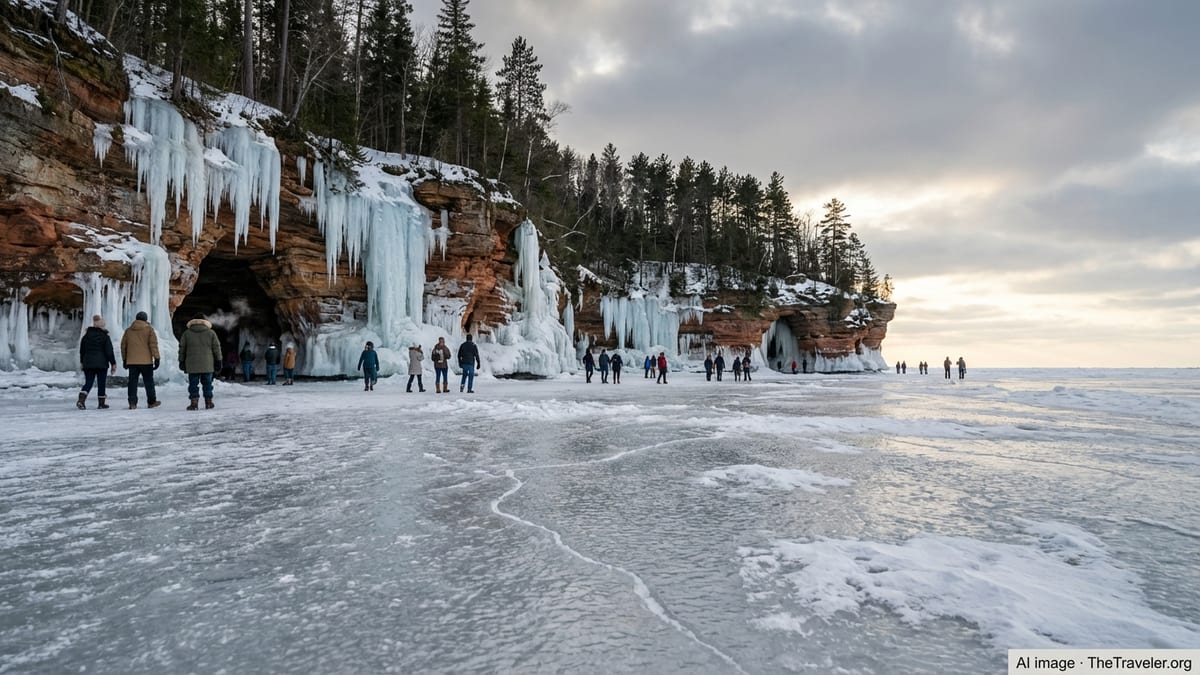
My first view of the mainland cliffs was not dramatic. The horizon was a low gray smear, the kind of light that flattens everything. Only as we got closer did vertical bands of red and honey-colored sandstone emerge from the haze, and then, almost all at once, the caves came into focus: arches, overhangs, and grottoes draped in thick curtains of blue-white ice. The scene was more delicate and more precarious than the iconic photos suggest.
The Winter Approach: Walking Into A Frozen Cathedral
Reaching the ice caves on foot begins with an unromantic trudge. From the shuttles, visitors pour down toward Meyers Beach in layers of synthetic fabric, microspikes scraping on packed snow. There is no shelter here, no warming hut, no concession stand. Cell service is spotty to nonexistent. Rangers and volunteer staff emphasize the same points over and over: ice is never completely safe, conditions can change quickly, do not approach cracks, stay away from pressure ridges, and do not stand under hanging ice. It is sobering guidance, and it should be.
The walk itself is a study in monotony that slowly becomes awe. The first stretch across the lake feels like crossing a frozen parking lot, wind scouring the surface into dunes. Footsteps crunch and squeak, and conversation dies away as people focus on their footing. Only near the two-mile mark does the shoreline begin to feel close. Suddenly the sound changes. Hard wind gives way to a hush amplified by sandstone walls and thick draperies of ice. You do not hear the lake, but you sense its weight below the surface, the subtle hollow vibrations beneath your boots.
Inside the first caves, temperature and light shift noticeably. The air turns still and heavy, the cold more penetrating. Sunlight filters through the frozen curtains in muted blues and greens, revealing bubbles, fractures, and mineral streaks locked in place. Some alcoves are tall enough to swallow hundreds of people; others pinch into narrow slots where visitors have to twist sideways to enter. Ranger warnings about not crawling into small openings and not standing below icicles feel entirely justified when you tilt your head back and see knife-edged spikes overhead, some as thick as tree trunks.
It is both magical and disquieting. The beauty is undeniable, but so is the knowledge that these formations exist because of a very specific pattern of waves, freezing spray, seeping groundwater, and prolonged subzero temperatures that are now rare. You are walking not on a frozen trail, but on the living surface of one of the most powerful lakes in the world, granted temporary permission.
Crowds, Logistics, and the Reality Behind the Photos
If you picture yourself alone in a pristine ice cavern, you will likely be disappointed. When the caves opened in mid-February 2026, enthusiasm that had built up since the last accessible winters in 2014 and 2015 boiled over. Shuttles filled early, lines backed up along Highway 13, and some visitors who paid fees never even made it out to the caves before conditions shifted. Managing expectations is part of traveling responsibly here, especially during a rare opening.
On the day I visited, the atmosphere was more like a small winter festival than a wilderness outing. People from across the Midwest merged into a steady procession along the ice highway, tripods and trekking poles in hand. Families pulled children on sleds. Photographers jockeyed for clear shots of popular arches, then stepped politely aside. At times the crowding felt at odds with the remote setting, yet there was also a sense of shared amazement, as if everyone understood we were walking through something that might not reappear for years.
The logistics reflect that tension between access and protection. With on-site parking at Meyers Beach closed during the ice caves event, visitors park several miles away and ride Bay Area Rural Transit shuttles at regular intervals, paying separate transportation and park fees. Rangers tightly manage entry and keep a close eye on the ice, pausing access when pressure ridges expand or when wind direction shifts. You must be prepared for last-minute changes: a day that looks perfect on the forecast can still end with a closure notice and an unexpected change of plans.
The best way to approach it is with flexibility and humility. Check National Park Service updates frequently before you drive north. Carry more layers than you think you need, plus food and hot drinks. Expect long waits, and remember that the same conservative judgment that might disappoint you at the trailhead is what prevents rescues and tragedies out on the lake. When you view the experience as a privilege, not a right, the inconveniences begin to feel like part of the bargain.
Summer at the Sea Caves: Trading Ice For Open Water
My second encounter with the Apostle Islands sea caves happened months later, after the lake shed its armor. By August, the mainland cliffs near Meyers Beach and the formations off Sand and Devils Islands transform from ice-lined cathedrals into honeycombed sandstone galleries. Instead of boots and traction devices, visitors slip into spray skirts and neoprene, launching touring kayaks into a lake that feels deceptively benign under blue skies.
From the cockpit of a sixteen-foot sea kayak, the caves look entirely different. Without their heavy frozen drapery, the cliffs reveal layers of reddish-brown sandstone carved by thousands of years of waves. Natural arches, slotted windows, and hollow chambers curve inward in complex patterns. The water under your hull turns glassy emerald close to shore, then darkens quickly with depth. On a calm morning, the lake can be mirror-smooth, and it is easy to imagine drifting idly in and out of the openings all day.
The park, however, does not treat this as an easy paddle, and neither should you. Rangers stress that sit-on-top kayaks, open canoes, and casual recreational craft are not suitable for these waters. The caves lie roughly 1.5 miles from the Meyers Beach launch and stretch for about 3 more miles along the shoreline, which means several hours of exposure even in good conditions. The water stays cold, often hovering near the upper 50s, and any capsize can become serious in minutes without proper gear and self-rescue skills.
I joined a small guided trip run by a local outfitter in Bayfield, and it made all the difference. Our guide carried marine radio, tow lines, and spare paddles and spent the first part of the day drilling us on wet exits and assisted rescues in sheltered water. Only after everyone had practiced flipping and reentering their boats did we head toward the caves, keeping well clear of the cliff faces when even small swells began to bounce chaotically between the walls. The lake felt much bigger and more unpredictable from that vantage point than any summer brochure would suggest.
Inside the Caves: Sound, Color, and Constant Change
In both seasons, what surprised me most inside the sea caves was not the look but the sound. In winter, the ice deadens noise, absorbing footsteps and whispers so thoroughly that voices from farther down the shoreline carry strangely clearly through the frozen corridors. You hear occasional cracking and settling in the ice overhead, like distant tree limbs shifting in a storm. Every so often there is a muffled thump from deep within the rock where new fractures form or icicles calve off the cliffs.
In summer, the caves become an amplifier. Even on relatively calm days, waves surge into the chambers and rebound off the walls at odd angles, producing a low boom that you feel in your chest. Water slaps against the hull of your kayak and ricochets in layers of echo. Paddling into a narrow slot, you can hear the rumble building before you see the back wall; even small waves stack on top of one another, creating the “confused waters” guides warn about. The effect is mesmerizing until you realize that the chaotic motion can easily unbalance a boat.
Light changes just as dramatically. Winter sun, low on the horizon, filters through sheets of ice and creates subtle gradients of blue, green, and amber. Tiny air bubbles and sediment trapped in the frozen layers refract light like frosted glass. In some alcoves, the ice takes on a faint turquoise hue reminiscent of glacial ice. Summer light, by contrast, arrives in sharp, golden shafts that slice into the darker interiors of the caves. Reflected off the water’s surface, it dances on the ceiling, throwing shifting patterns on the sandstone.
The cliffs are not static backdrops. This entire shoreline is slowly eroding, and the shapes visitors admire today will not be exactly the same in a decade. The National Park Service documents collapsed arches and newly exposed rock faces along the mainland over the years. With every winter’s freeze-thaw cycle and every summer storm, the caves evolve. That awareness adds a bittersweet note to any visit. You are admiring a moment in the life of these formations, not a permanent exhibit.
Safety, Preparation, and Respecting the Limits
The Apostle Islands sea caves reward the prepared traveler and punish the careless one. The most important preparation happens long before you set foot on the ice or dip a paddle blade into Superior. It begins with an honest evaluation of your skills, your gear, and your tolerance for discomfort. On winter visits, that means acknowledging that a two to six-mile walk on uneven, potentially wet ice in subfreezing temperatures is strenuous. On summer paddles, it means recognizing that Lake Superior behaves more like a small ocean than an inland lake and that cell phones, if they work at all, do not guarantee quick rescue.
For winter, sturdy insulated boots with traction devices, warm non-cotton layers, windproof outer shells, and face protection are not optional extras. The park cautions visitors about wind chill values that can plunge well below zero, and about the risk of falls on slick surfaces. Carrying a small daypack with extra gloves, a thermos, snacks, and a headlamp can turn an uncomfortable situation into a manageable one if conditions worsen. Even with all that, rangers emphasize a simple truth: ice is never completely safe, and each person must decide when to turn back.
For summer kayaking, preparation looks different but is equally critical. A properly fitted life jacket stays on your body at all times, not strapped to the bow. A wetsuit or drysuit offers insulation against water that can sap body heat quickly, even on warm days. Touring kayaks with bulkheads, spray skirts, and deck lines provide flotation and control that open, recreational boats lack. Perhaps most important is the ability to perform a self-rescue or participate in assisted rescues, because professional help may be thirty minutes or more away in perfect conditions and much longer in rough seas.
Respecting the limits also means knowing when not to go. Rangers explicitly advise visitors to avoid the caves in rough conditions, whether from high waves, shifting winds, or unstable ice. Outfitters cancel trips when forecasts deteriorate, even on busy weekends. Locals repeat a simple rule about Lake Superior: the lake is always capable of more than you can handle. Planning your adventure around conservative choices rather than fixed itineraries is not just good practice, it is an ethical way to travel in a landscape that can so easily be overwhelmed by demand.
The Takeaway
My trip to the Apostle Islands sea caves was nothing like the straightforward spectacular experience I had imagined from photographs. It was colder, more crowded in moments, and at times more nerve-racking than I expected. Yet it was also more moving. Walking across ice that would disintegrate within days, threading between sculpted pillars of frozen spray, then months later floating beneath the same cliffs in a small boat and hearing the lake breathe inside the rock, I felt something closer to visiting a living, volatile organism than a scenic destination.
If there is one lesson to carry from these caves, it is that they do not exist for us. They appear when a rare alignment of temperature, wind, and waves allows, and they vanish without apology. Those same forces sculpt the summer sea caves that draw paddlers from around the world. To travel here is to accept that uncertainty and to build your plans around flexibility, patience, and humility.
Go prepared for the reality rather than the fantasy. Expect long walks, biting wind, and, if you are kayaking, a lake that can change its mood in minutes. Expect to be turned back by closures or by your own limits. But also leave room for the possibility that, when conditions do line up, you will find yourself in a place where stone, ice, and water meet in ways that feel almost otherworldly precisely because they are completely natural and uncontrived. That fragile, temporary intersection is what makes the Apostle Islands sea caves worth the effort.
FAQ
Q1. Are the Apostle Islands ice caves open every winter?
Not at all. Safe access requires unusually thick, stable ice on Lake Superior and favorable winds. In many recent winters, conditions never met the park’s safety thresholds.
Q2. How far is the hike to the ice caves from Meyers Beach?
The hike typically ranges from about 2 to 6 miles round trip, depending on how far along the cliff line you explore once you reach the first caves.
Q3. Do I need a guide to visit the ice caves in winter?
You do not need a guide for the winter ice caves, but you must follow National Park Service instructions closely and be fully prepared for harsh weather and changing ice conditions.
Q4. Is it safe to kayak the sea caves on my own in summer?
It can be risky without proper skills and equipment. The park strongly recommends sea kayaks, cold-water gear, and solid self-rescue skills, or joining a reputable guided tour.
Q5. What kind of kayak is recommended for the Apostle Islands sea caves?
A 16-foot or similar length touring sea kayak with bulkheads, a spray skirt, and deck lines is recommended. Small open boats, sit-on-tops, and paddleboards are discouraged.
Q6. How cold is the water around the Apostle Islands in summer?
Even in midsummer, Lake Superior’s surface temperature often stays in the upper 50s Fahrenheit, which is cold enough to cause hypothermia in a relatively short time.
Q7. What should I wear for a winter trip to the ice caves?
Dress in warm, moisture-wicking layers with a windproof outer shell, insulated boots with traction devices, gloves, a hat, and face protection against wind and blowing snow.
Q8. Can I rely on my phone for navigation and emergencies?
Cell service around Meyers Beach and the caves is limited. Do not rely on your phone. Plan ahead, tell someone your plans, and be prepared to be self-sufficient.
Q9. How crowded do the caves get when they open?
During rare openings, crowds can be heavy, shuttles may have long waits, and popular formations can feel busy. Arriving early and being patient helps manage the experience.
Q10. What is the best way to get up-to-date information before I go?
Check current conditions and alerts from the National Park Service for Apostle Islands National Lakeshore shortly before your trip, and again on the day you plan to visit.