

I thought I knew what to expect from Vatnajökull National Park before I arrived: Europe’s largest glacier, a few famous viewpoints, and a landscape I had already seen a hundred times in photographs. What I found instead was a place that kept catching me off guard, from the way the ice sounded under my boots to the quiet human stories unfolding at its edges. This is what surprised me most during my time in Vatnajökull, and what I wish I had understood before I went.
The Scale That Photos Never Prepare You For
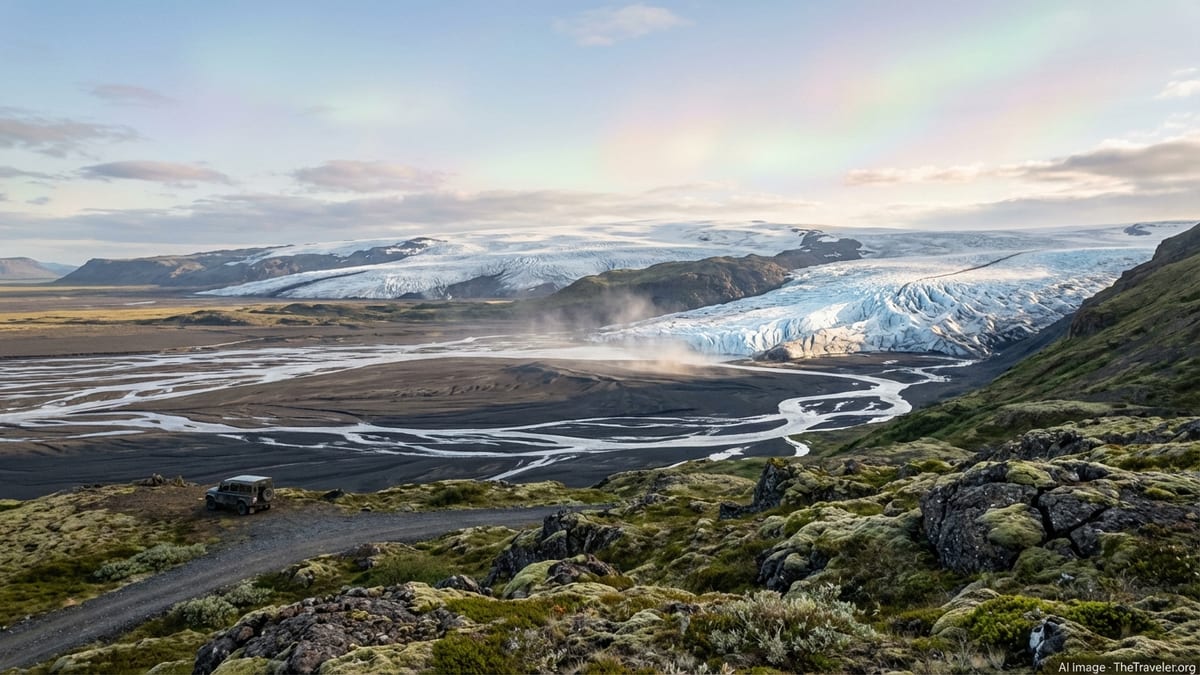
Every guidebook mentions that Vatnajökull National Park covers around 14 percent of Iceland and includes the country’s largest glacier, but none of that prepares you for how it feels to stand there in person. The glacier dominates the horizon, a white mass that seems to bend the sky around it, while its outlets spill down into valleys, lagoons, and black sand plains. You do not just visit a single site: you move through a living system of ice, water, rock, and weather that stretches from the highlands to the coast.
What surprised me first was the diversity packed into this enormous area. One morning I was walking on creaking blue ice near Skaftafell, and by the afternoon I was standing at the edge of Jökulsárlón, watching icebergs turn slowly in a tidal current. The next day, in the park’s northern territory, I stared down into a horseshoe-shaped canyon at Ásbyrgi that looked nothing like the glacial lagoons in the south. The park’s official maps and visitor information hint at this variety, but on the ground the contrast from one area to another feels almost disorienting.
That sense of scale also changes how you think about time. Glaciers move slowly, but the rivers they feed can rise quickly, and volcanic systems beneath the ice can shift on human timescales. Rangers and guides talk not only about what the landscape is today, but how it was a decade ago and how it might look a decade from now. It is impossible to walk here and not feel how large and how fragile this environment is at the same time.
Another surprise was how much of the park still feels remote, even though it touches Iceland’s main Ring Road. Outside of a few well-known spots, you can drive for long stretches with only scattered farmhouses, a visitor center sign, or a gravel track leading into the highlands. I expected a national park of this stature to be tightly choreographed. Instead, it feels like a patchwork of accessible front-country areas stitched to vast, little-visited interiors.
Glacier Reality: Safety Rules, Guides, and Banned Ice Caves
Before my trip, I imagined walking right up to the glacier and exploring its features at my own pace. The reality is much stricter and, once you see the terrain up close, clearly necessary. Vatnajökull’s surface is crisscrossed with crevasses, meltwater channels, and unstable snow bridges that can change from one day to the next. Park authorities and local guides describe it as a dynamic and sometimes unpredictable environment, not a frozen museum piece.
What surprised me most was how regulated certain activities have become. In recent seasons, authorities have tightened rules around glacier access and safety, and ice cave tours within the national park are currently banned for the summer, with officials reviewing how to manage these activities more safely in future years. That might be disappointing if you arrive expecting those luminous blue cave photographs, but the reasoning becomes clear when you hear guides talk about collapses, sudden melt, and shifting ice ceilings. Many operators now focus their cave tours on glaciers outside the park boundaries, where regulations differ, while still treating safety as a central responsibility.
On guided glacier hikes, the emphasis on preparation is immediate. You are fitted with crampons, a helmet, and sometimes a harness, and guides go through a short but serious briefing about how to walk on ice, where not to wander, and why you must follow their instructions precisely. I had assumed that some of this talk was for show, a kind of ritualized risk management. Once we reached the rougher sections of the glacier, with open crevasses and sculpted ice ridges, it became obvious that this was non-negotiable. The difference between a stable surface and a dangerous one can be a matter of a few steps.
Even the approach to the glacier is changing. Local experts talk about how glacier edges and access points can shift from season to season as the ice retreats or advances, meaning that paths and routes are not permanent. On some tongues of Vatnajökull, you now walk over bare rock and loose moraine where older photographs show a seamless expanse of ice. That gap between expectation and reality is sobering, and it reshapes the experience from a simple bucket-list activity into a lesson in how fast things can change.
Weather Whiplash and the Art of Flexible Plans
I knew Icelandic weather was famous for changing quickly, but Vatnajökull magnifies that volatility. The glacier creates its own microclimate, and the surrounding highlands funnel wind and moisture in ways that are hard to predict from a general forecast. During one three-day stretch in the south, I experienced calm sunshine, horizontal rain, low cloud that erased entire mountain ranges, and clear night skies that suddenly exploded with northern lights.
What surprised me was not the severity of individual conditions, but the speed with which they arrived and departed. A hike that began in mild, dry weather could turn uncomfortably cold and wet within an hour as clouds rolled in off the ice cap. On the glacier, visibility could drop quickly if low cloud settled, making features blend together into a flat, disorienting white. Guides stressed that forecasts for the area near the glacier must be checked repeatedly and treated as guidance, not guarantees.
This instability forces a particular way of traveling. You learn to hold your plans loosely and make decisions day by day, sometimes hour by hour. A boat trip on a glacial lagoon might be canceled due to wind, only for the following morning to be glassy calm. Roads leading inland toward more remote sections of the park can open or close based on snow, meltwater, or landslides. The park’s own driving advice emphasizes checking road conditions frequently and turning back if conditions feel unsafe, rather than improvising new routes over rough ground.
For me, adapting to this reality required a mindset shift. I arrived with a detailed list of must-see places and planned hikes. I left with a looser appreciation for following the weather, taking what the day offered, and accepting that some trails would remain unknown to me. Ironically, that flexibility made the moments of clear visibility and good conditions feel even more precious.
The Human Side: Rangers, Farmers, and Fellow Travelers
Vatnajökull National Park’s landscapes are so dominant that it is easy to forget how many people are quietly working around the edges to keep the place functioning and relatively safe. Only after spending time at visitor centers and talking with local guides did I start to appreciate this human layer, which became one of the trip’s most unexpected highlights.
Rangers in the park often wear multiple hats: they answer visitor questions, monitor sensitive areas, guide interpretive walks, and help coordinate with road authorities and emergency services when conditions change. At Skaftafell and other centers, they patiently field the same questions about weather, hiking times, and equipment, but they also share stories about past volcanic eruptions, glacial floods, and the way local communities have adapted over generations. Their emphasis is not on selling an attraction, but on helping visitors understand how to move through the park thoughtfully.
Beyond the official staff, there is a quieter network of farmers, guesthouse owners, and small-town residents who live with the glacier as a neighbor. In villages along the south coast and in the east, people spoke about growing up with the constant presence of the ice on the horizon, and about watching its edges retreat during their lifetimes. For them, Vatnajökull is both a source of livelihood and a reminder of natural forces that can never be fully tamed, whether through sudden floods or persistent glacial melt.
Fellow travelers also add an unexpected dimension. On trails and tours, I met people who had come for very different reasons: photographers chasing light, geology students, families ticking off a once-in-a-lifetime destination, and repeat visitors who return every few years to see how the park has changed. Conversations often circled back to the same themes: how enormous the glacier felt, how humbling it was to walk on it, and how the visible signs of change were impossible to ignore.
Silent Signs of Climate Change
I expected Vatnajökull to be a place where climate change felt abstract, a matter of numbers and projections. Instead, it was present in subtle but persistent ways: in the retreating glacier tongues, in new shorelines around lagoons, and in the way guides and rangers now speak about certain routes in the past tense. The park’s official information and many local voices acknowledge that the glacier is shrinking, even if exact rates vary from one outlet to another.
Walking up toward some glacier fronts, you cross zones that tell a story of withdrawal. First come moss-covered moraines and older deposits that mark where the ice once stood decades ago. Then you pass fresher piles of loose rock and gravel, still largely bare, where the glacier has more recently pulled back. Finally you reach the current edge, often fronting a newly expanded lagoon or a river that did not exist in the same form a generation earlier. Guides sometimes point out where they used to step directly onto ice at locations that now require a much longer approach.
These changes do not announce themselves with drama while you are there. There is no single moment when you watch the glacier vanish. Instead, climate reality appears in side comments: a guide explaining that a winter ice cave no longer forms as reliably as in the past, or a ranger describing new monitoring efforts around vulnerable areas. Even recent policy decisions, such as stricter rules and seasonal bans on certain ice cave tours within the park, can be read as responses to a landscape in flux and the need to rethink how visitors move through it.
For me, the most unexpected emotional response was a sense of quiet grief mixed with gratitude. It felt like visiting a cathedral that is slowly losing its foundations, still magnificent but clearly under stress. Traveling here made climate change feel less like a debate and more like a visible, ongoing process that current visitors are already witnessing.
The Everyday Practicalities That Matter More Than You Think
It is easy to romanticize Vatnajökull as a world of pure wilderness, but the practical details of visiting can shape your experience as much as the scenery. Before arriving, I had vaguely assumed that services would cluster around the park’s main gateways in a way similar to large national parks elsewhere. In reality, facilities are more scattered, and planning ahead for basics like fuel, food, and clothing makes a big difference.
Driving along the Ring Road near the southern edge of the park, you quickly notice that gas stations and supermarkets appear in clusters, followed by long empty gaps. Park authorities and local travel information sources consistently recommend fueling up whenever you have the chance and checking road and weather updates regularly. This is especially important if you plan to divert onto gravel roads or head towards the highlands, where conditions can change and services are minimal.
Clothing and equipment also matter more than many visitors expect. Conditions around the glacier can be significantly colder and windier than along the coast or in nearby towns, and they shift quickly. Local guides emphasize dressing in layers, including waterproof and windproof outer shells, and wearing sturdy, waterproof hiking boots that can take crampons when necessary. Even in summer, light gloves, a hat, and warm base layers can be the difference between cutting a hike short and staying out to fully enjoy the experience.
Finally, I was surprised by how useful the visitor centers are as planning hubs. They are not just exhibition spaces, but places where you can recalibrate your itinerary based on real-time information from people who have been out on the trails and near the glacier that day. A ten-minute conversation with a ranger often proved more valuable than an hour of online research, especially when it came to choosing routes that matched the day’s conditions and my own experience level.
The Takeaway
When I look back on my time in Vatnajökull National Park, what stays with me is not a single postcard view, but the feeling of being immersed in a huge, shifting system. I arrived expecting a spectacular glacier and a checklist of famous viewpoints. I left with a deeper respect for how complex, vulnerable, and carefully managed this landscape really is, and for the people who spend their lives working alongside it.
The biggest surprises were cumulative. The stricter safety rules and shifting guidelines around glacier and ice cave access highlighted just how dynamic the ice has become. The weather’s volatility forced a new kind of flexible, humble travel. Conversations with rangers, guides, and locals added a human dimension that no photograph can capture, while the quiet evidence of climate change turned an already impressive trip into something more reflective.
If you are planning your own visit to Vatnajökull, it is worth arriving with strong curiosity and soft expectations. The park will almost certainly differ from the images you have seen and from the plans you carefully draft at home. That is part of its power. Let it surprise you, and be prepared to adapt, listen, and learn as much as you look.
FAQ
Q1. Do I need a guide to walk on Vatnajökull glacier?
Yes, you should join a certified guided tour for any glacier walk. Conditions change quickly, crevasses can be hidden, and guides provide essential safety equipment and route knowledge.
Q2. Are ice cave tours currently available inside Vatnajökull National Park?
In recent seasons, authorities have banned organized ice cave tours within the national park during the summer while safety rules are reviewed. Some tours operate on other glaciers outside the park, so always check the latest local information before you book.
Q3. What is the best time of year to visit Vatnajökull?
Summer offers the easiest access, long daylight, and the widest choice of trails and services. Spring and autumn can be quieter but more changeable, while winter is ideal for northern lights and snow-covered scenery, provided you are prepared for short days and potential road closures.
Q4. How many days should I plan for Vatnajökull National Park?
At least two or three days will let you combine a glacier activity with visits to a lagoon and a few shorter hikes. If you want to explore both the southern and northern territories or venture towards the highlands, plan four to five days or more.
Q5. Do I need a 4x4 vehicle to visit the park?
You can reach many of the main viewpoints and visitor centers along the Ring Road in a standard car during summer conditions. However, if you plan to drive gravel routes or highland roads, a 4x4 is strongly recommended and sometimes required.
Q6. How should I dress for a day near the glacier?
Wear layers, including a moisture-wicking base, an insulating mid-layer, and a waterproof, windproof outer shell. Sturdy waterproof boots, a hat, gloves, and warm socks are important year-round near the ice.
Q7. Can I fly a drone in Vatnajökull National Park?
Recreational drone use is allowed in some areas but restricted or prohibited in others to protect wildlife and visitor experience. Always check current park rules and local signage before flying.
Q8. Is it safe to explore near glacial rivers and lagoons on my own?
You can visit many rivers and lagoons independently, but shorelines, icebergs, and riverbanks can be unstable. Keep a safe distance from the water and from floating ice, and follow any posted safety warnings.
Q9. How visible are the effects of climate change in the park?
The most noticeable signs are retreating glacier tongues, new or enlarged lagoons, and changing access routes. Guides often point out where ice once extended and how quickly some fronts have moved in recent decades.
Q10. Where should I go first if I have limited time?
If you are driving the south coast with just a day or two, Skaftafell and the nearby glacier outlets, followed by a visit to a glacial lagoon, offer an excellent introduction to Vatnajökull’s landscapes and its changing ice.