

Driving across the flat, golden plains of southern Saskatchewan, I watched the horizon shimmer in the summer heat and wondered how a small prairie city with an unusual name had become known as “Canada’s Most Notorious City.” My visit to Moose Jaw answered that question and many more. Below the unassuming streets I found tunnels steeped in legend, above them grand murals and historic brick facades, and at the city’s edge a giant moose keeping friendly watch. What makes this prairie town unique is not any one attraction, but the way Moose Jaw embraces its history, quirks, and big personality while remaining deeply, unmistakably welcoming.
First Impressions on the Prairie Edge
Moose Jaw sits along the Trans Canada Highway, less than an hour west of Regina, but it feels a world apart from the bustle of larger cities. As I exited the highway and followed signs into town, fields gave way to grain elevators, rail lines and low brick buildings that spoke of a railway past. The city grew as a key stop on the Canadian Pacific Railway in the 1880s, and you can still sense that heritage in the broad streets and industrial silhouettes that frame the skyline.
The name itself sets a playful tone. Local stories link “Moose Jaw” to a bend in nearby Thunder Creek said to resemble a moose’s jaw, and residents tend to lean into the oddity with good humor. On my first stroll downtown I heard people refer to themselves casually as “Moose Javians,” a reminder that this is a community comfortable with its identity, however quirky it may seem to outsiders.
Today the city’s population hovers around the mid thirty thousand range, large enough to support a lively cultural scene yet small enough that you recognize faces after a day or two. Within a compact area you find historic architecture, an emerging food and coffee culture, a major mineral spa, a casino and, beneath it all, the tunnels that helped the city rebrand itself as “Canada’s Most Notorious City.” Moose Jaw manages to feel both like a friendly prairie town and an unexpectedly layered destination.
What struck me immediately was the scale. You can drive across Moose Jaw in minutes, but there is far more happening here than the map suggests. From festivals that pack Main Street to year round attractions, the city seems to punch above its weight, offering visitors a surprising amount to see and do without losing the easy rhythm of prairie life.
Descending into the Tunnels of Moose Jaw
The attraction that most clearly defines modern Moose Jaw is hidden from street level. The Tunnels of Moose Jaw, a network of underground passages beneath the historic core, have been transformed into immersive theatrical tours that explore two very different chapters of the city’s past. They are part history lesson, part performance and part local legend, and together they form one of the most distinctive experiences in the Canadian Prairies.
I joined the Chicago Connection tour first, stepping down a narrow stairway off Main Street and suddenly finding myself in 1920s “Little Chicago.” Guides in period costume led us through dimly lit rooms modeled on speakeasies, gambling dens and rum running hideouts, weaving stories about bootleggers moving alcohol south during American Prohibition. Local lore claims that Al Capone himself once used Moose Jaw as a base; the guides acknowledge that the evidence is debated but delight in telling the tale. The result is an entertaining introduction to how this quiet prairie city acquired an unexpectedly notorious reputation.
The Passage to Fortune tour strikes a more reflective tone. Here the focus is on Chinese immigrants who, according to local accounts, lived and labored in difficult conditions in these same underground spaces in the early twentieth century. Moving through reconstructed dormitories, laundry rooms and cramped tunnels, the tour uses actors and audio effects to evoke the hardships, discrimination and perseverance that shaped this chapter of Canadian history. The experience avoids historical lectures and instead places visitors inside scenes, encouraging a more personal response.
On a later visit I joined Bunker 24, the third tour, which shifts the narrative to the Cold War era, casting guests as new recruits in a 1950s style bunker. This production is more playful, but it also highlights how Moose Jaw, with its nearby military air base, has long been tied to national and international events. Taken together, the tunnels demonstrate how a small prairie city can turn complicated history into an engaging cultural asset, inviting visitors to consider both the myths and realities beneath its streets.
Historic Downtown and Notoriously Charming Streets
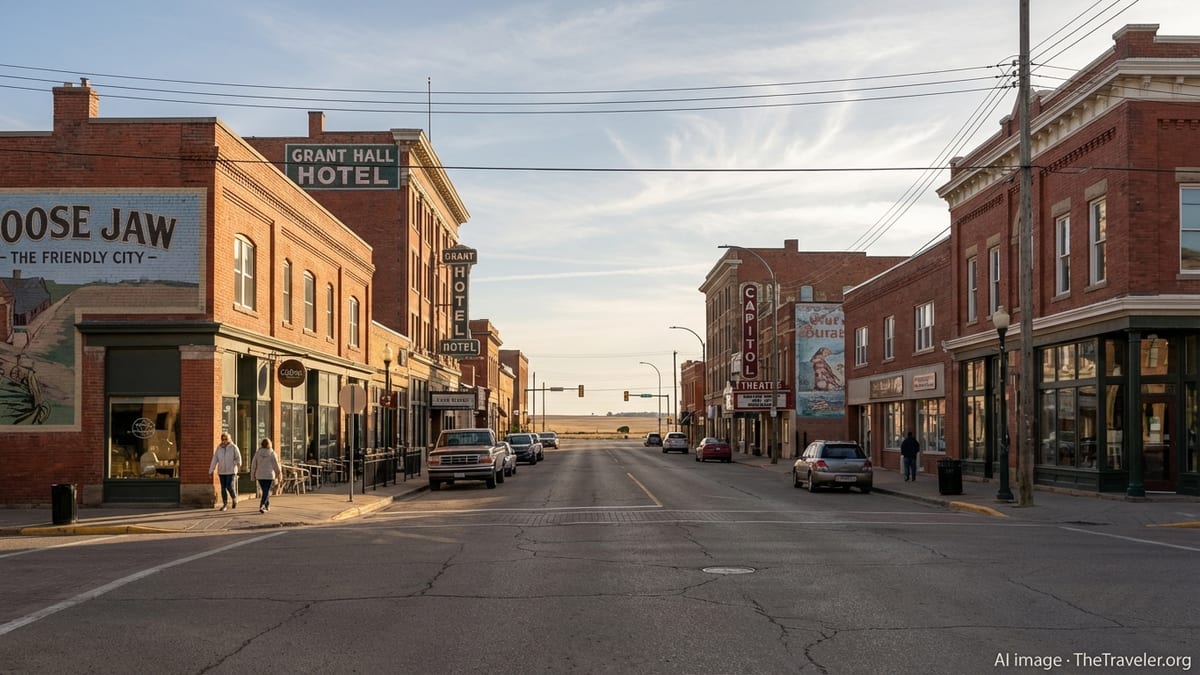
Emerging from the tunnels back onto Main Street, I began to appreciate why Moose Jaw now markets itself not just as notorious but as “Canada’s Most Notoriously Charming Downtown.” The historic core is unusually intact for a prairie city of this size. Early twentieth century brick and stone buildings, many with elaborate cornices and large storefront windows, line walkable streets that curve gently with the terrain rather than follow a strict grid.
Murals are one of the downtown’s defining features. Moose Jaw began commissioning large scale outdoor paintings in the 1990s, and today dozens of works brighten walls and alleyways. Many depict scenes from local history: early railway days, prairie homesteads, vintage streetcars and cultural figures. Others celebrate Indigenous heritage or contemporary life. On a clear afternoon, I spent hours following mural maps from the visitor center, turning corners to find yet another unexpected panorama splashed across red brick.
This is also where the city’s creativity shows up in more subtle ways. Window displays nod to the “Notorious” branding with playful references to gangsters, speakeasies and film noir, while still feeling family friendly. Cafes and bakeries spill onto sidewalks in warmer months, and independent boutiques fill restored heritage buildings with local art, handmade goods and prairie themed souvenirs. The effect is of a downtown that has deliberately chosen character over uniformity.
Seasonal festivals amplify this energy. In summer, Sidewalk Days transforms Main Street into a pedestrian zone with live music, food vendors and artisans, attracting visitors from across Saskatchewan. Literary travelers gravitate to the Saskatchewan Festival of Words, which brings authors, poets and storytellers to venues throughout the downtown. Even on a quiet weekday, you sense that this is a place designed to welcome people into the streets rather than funnel them through quickly.
Soaking in Mineral Waters and Prairie Calm
Few mid sized prairie cities can claim a geothermal mineral spa at their heart, but Moose Jaw built a key part of its identity around exactly that. Temple Gardens Hotel and Spa, located near Crescent Park and connected to Casino Moose Jaw, draws on naturally heated mineral water sourced from deep underground. For many visitors, a long soak in the rooftop pool is the highlight of their stay.
I checked in on an overcast afternoon and made my way up to the mineral pool as light rain began to fall. The water, warm and faintly scented with minerals, steamed against the cool air while the city’s low skyline stretched in the distance. Locals chatted easily at the pool edge, and I quickly learned that this was as much a social hub as a wellness retreat. The experience felt both indulgent and distinctly Moose Jaw: no fuss, no pretense, just a chance to relax above the prairies.
Beyond the spa, the city’s commitment to relaxation and wellness shows up in quieter corners. Crescent Park, a green lung just steps from downtown, features walking paths, a creek, mature trees and open lawns. On my morning walks I passed joggers, parents with strollers, and older residents carrying coffee from nearby cafes. Within the park you will also find the public library and the Moose Jaw Museum and Art Gallery, making this a cultural as well as recreational center.
For a different kind of rejuvenation, locals pointed me toward Sahara Spa, housed in the restored Canadian National Railway station near Crescent Park. Inside, original architectural details blend with contemporary spa design, offering massages and treatments in a building that once served rail passengers. It is another example of how Moose Jaw reimagines its heritage, turning historic spaces into places of rest and renewal.
Mac the Moose and the Spirit of Roadside Whimsy
No visit to Moose Jaw feels complete without meeting the city’s most famous resident: Mac the Moose. Standing beside the highway near the visitor center, this towering concrete and steel sculpture has greeted travelers since the 1980s and became a local celebrity in its own right. Mac captured global attention during a friendly rivalry with a Norwegian moose statue over which was taller, a lighthearted contest that culminated in Moose Jaw extending Mac’s antlers and reclaiming the title of world’s tallest moose in 2019.
Up close, Mac is delightfully unabashed: larger than life, a bit kitschy and entirely endearing. Families pose for photos beneath his antlers, road trippers stretch their legs in his shadow, and information panels nearby explain the moose wars story. When I visited, children recreated the tale for each other with theatrical seriousness as their parents quietly laughed. The sculpture has become a symbol of the city’s willingness to embrace humor and community pride on a grand scale.
The visitor center next door serves as a practical starting point, offering maps, festival information and suggestions tailored to the season. Staff are quick to recommend lesser known spots, from neighborhood bakeries to sunset viewpoints on the city’s edge. What stood out most in my conversations there was how much people enjoyed talking about their city. Rather than pitch a polished image, they shared favorite walking routes, local hockey rivalries and memories of growing up under Mac’s watchful gaze.
This blend of whimsy and sincerity runs through Moose Jaw’s identity. Mac the Moose may draw drivers off the highway, but the city keeps them longer with stories, hospitality and a genuine sense that visitors are part of the community, if only for a day or two. In a world of increasingly generic travel experiences, that combination feels rare.
Museums, Aviation Heritage and Prairie Horizons
Moose Jaw’s compact size hides a surprisingly rich collection of museums and heritage experiences. A short drive from downtown, the Western Development Museum explores the province’s transportation and agricultural history with exhibits that range from vintage vehicles to farm machinery. Walking through recreated streets and workshops, I gained a deeper appreciation of how rail lines, highways and grain elevators shaped life on the Prairies.
South of the city, the Sukanen Ship Pioneer Village and Museum presents another unexpected chapter. Volunteers have assembled historic buildings from around the region into a recreated early twentieth century town, complete with a grain elevator, farmhouses and small businesses. The site is named for Tom Sukanen, a Finnish immigrant who constructed an ocean going ship on the prairies in hopes of sailing home. His partially realized vessel, preserved here, is a poignant symbol of both determination and isolation, and it adds a quietly haunting layer to the region’s history.
Aviation enthusiasts know Moose Jaw as the base of the Canadian Forces Snowbirds, the country’s well loved aerobatic demonstration team. While public access to the air base itself is restricted, the presence of the Snowbirds is felt throughout the city, from murals downtown to memorabilia in local shops. When training flights trace patterns overhead, residents glance up almost unconsciously, as though checking on familiar neighbors.
Even outside formal attractions, the prairie landscape surrounding Moose Jaw shapes the visitor experience. A short drive in almost any direction delivers wide skies, gently rolling fields and the kind of horizon line that seems to move farther away the longer you look at it. At sunset, the light softens and the sky often turns layers of pink, orange and deep blue. More than once I pulled over on a gravel road simply to watch the clouds shift over ripening grain, the city’s water towers just visible in the distance.
Eating, Staying and Savoring Local Life
For a city of its size, Moose Jaw offers a varied and increasingly confident food scene. Downtown cafes serve locally roasted coffee and fresh baked pastries to a steady mix of residents and visitors. Casual restaurants focus on hearty prairie comfort food, from burgers and sandwiches to Ukrainian inspired dishes that reflect the region’s cultural roots. In the evenings, a growing number of spots highlight craft beer and regional ingredients, adding a contemporary layer to the city’s culinary profile.
Accommodation options mirror Moose Jaw’s blend of history and modernity. Temple Gardens Hotel and Spa provides a resort style experience right in the core, while smaller inns and chain hotels along the highway cater to road trippers and business travelers. Many visitors choose to stay within walking distance of Main Street, where they can leave the car parked and explore on foot. Even at busier times of year, it is usually possible to find a room, though festival weekends and major events can fill the city quickly.
In the evenings, entertainment choices range from low key to lively. Casino Moose Jaw, with its Art Deco inspired design that nods to the Roaring Twenties, draws both gamers and those curious about its architecture. Mosaic Place, the city’s multi use arena, hosts Western Hockey League games and touring concerts, bringing big city acts into an intimate venue. Smaller bars and pubs offer live music on weekends, and in summer, outdoor patios become impromptu social hubs where strangers strike up conversations as easily as old friends.
What I appreciated most about daily life in Moose Jaw was the absence of pretense. Dress codes are informal, service is unhurried but attentive, and conversations frequently drift beyond small talk. People asked where I was from, recommended favorite walking trails and genuinely seemed pleased that a visitor had chosen their city. For a traveler, that sense of being welcomed rather than merely accommodated can matter as much as any individual site or attraction.
The Takeaway
My visit to Moose Jaw challenged many assumptions I carried about prairie cities. I expected a convenient overnight stop between larger destinations; I discovered a place with a strong sense of self, a layered history and a willingness to reinvent its stories for a new era. From the theatrical Tunnels of Moose Jaw to the serene mineral waters of Temple Gardens, from Mac the Moose’s playful silhouette to the serious histories preserved in local museums, the city continually shifts between lighthearted and reflective notes without ever feeling disjointed.
What ultimately makes Moose Jaw unique is not any single attraction but the way everything connects. The notorious past lives on in branding and tunnel tours, yet so does the older identity of “The Friendly City,” visible in every conversation on Main Street and every recommendation from locals who want you to see more than the guidebooks list. Historic buildings become spas and galleries, industrial heritage becomes public art, and a roadside sculpture becomes a symbol of global community and good humor.
For travelers, Moose Jaw offers an accessible introduction to Saskatchewan’s prairie landscape paired with enough depth and novelty to justify a dedicated trip rather than a brief stop. Whether you come to soak in mineral pools, trace bootlegging legends, photograph murals or simply sit in Crescent Park watching the light change over the trees, you will likely leave with the same impression I did: this small city has an outsized personality, and it is quietly, confidently charting its own path on the Canadian Prairies.
FAQ
Q1. Where is Moose Jaw located?
Moose Jaw is in southern Saskatchewan, Canada, along the Trans Canada Highway, less than an hour’s drive west of the provincial capital, Regina.
Q2. Why is Moose Jaw called “Canada’s Most Notorious City”?
The nickname refers to Moose Jaw’s Prohibition era reputation as “Little Chicago,” when local tunnels were associated with rum running, gambling and colorful underworld legends.
Q3. Are the Tunnels of Moose Jaw suitable for children?
Many families visit the tunnels, but some scenes, loud sounds and costumed characters can feel intense for younger children, so parents may wish to review tour descriptions in advance.
Q4. What is special about Temple Gardens Hotel and Spa?
Temple Gardens is known for its naturally heated geothermal mineral pool, located on an upper level with views over Moose Jaw, offering a relaxing soak in mineral rich waters.
Q5. How much time should I plan to spend in Moose Jaw?
A full day lets you sample the tunnels, downtown and Mac the Moose, but two to three days provide a more relaxed pace to enjoy museums, the spa and surrounding countryside.
Q6. When is the best time of year to visit Moose Jaw?
Summer offers festivals, patio dining and warm weather, while shoulder seasons like late spring and early fall provide quieter streets and comfortable temperatures for walking.
Q7. Do I need a car to get around Moose Jaw?
The historic downtown is very walkable, but having a car makes it easier to reach attractions outside the core, such as the Western Development Museum and Sukanen Ship site.
Q8. Is Moose Jaw a good stop on a cross Canada road trip?
Yes, its location on the Trans Canada Highway, convenient services, unique attractions and friendly atmosphere make it a memorable stop or short side trip.
Q9. What types of accommodation are available in Moose Jaw?
Moose Jaw offers a mix of options, including spa resorts, chain hotels, motels and smaller inns, with choices both downtown and near the highway.
Q10. Is Moose Jaw suitable for winter travel?
Winters are cold, but indoor attractions like the tunnels, spas, museums and casino remain open, providing plenty to do if you dress warmly for outdoor walks.