

Kingston has a reputation for energy. Jamaica’s capital is usually framed in terms of sound systems, traffic and politics, not slow mornings and quiet afternoons. Yet over the course of a weekend, I discovered a calmer rhythm beneath the surface: tree‑lined parks where runners move in near silence, breezy verandas made for lingering over coffee and a waterfront where families gather simply to watch the sky change color. My weekend in Kingston was more relaxing than I expected, and it changed the way I think about this city entirely.
Arriving With Low Expectations for Rest
I landed in Kingston expecting stimulation rather than serenity. Friends had prepped me for music, nightlife and a traffic pattern that locals describe with a shrug and a laugh. Relaxation, they implied, was something you went to the north coast for, not a capital city framed by busy roads and industrial harbor. I booked my weekend on the strength of curiosity rather than any real hope of coming home rested.
Yet from the first taxi ride in from Norman Manley International Airport, the city felt different than I imagined. The road traces the edge of Kingston Harbour, one of the Caribbean’s largest natural harbors, with the low spit of Port Royal off to the side and the Blue Mountains in the distance. Early in the day, the water was still, the light soft and the roadside relatively quiet. It was not the picture-postcard Jamaica of all-inclusive resorts, but it was equally far from the frenetic metropolis I had braced for.
I checked into a small hotel in New Kingston, the city’s modern business district, chosen mainly for its central location. From my balcony, Kingston did not roar. It hummed. Car horns punctuated the air, but so did birdsong and the sound of sprinklers on lawns below. By the time I dropped my bag and stepped back outside, I was already reconsidering what a capital city weekend could look like.
Slow Mornings in Emancipation Park
New Kingston is an office hub on weekdays, but just a few minutes’ walk from the main hotels is one of the city’s quietest spaces. Emancipation Park, a roughly seven‑acre green space bordered by Knutsford Boulevard and Oxford Road, is best known for its striking bronze sculpture at the main entrance and its role as a monument to the end of slavery in Jamaica and the wider British and French Caribbean. In practice, it functions as the city’s front yard: a place where people come to jog, stroll and sit on benches under frangipani trees.
On my first morning, I slipped through the gates not long after sunrise. The jogging track that loops the park was dotted with runners and brisk walkers, but conversation was minimal. Fountains splashed. Sprinklers clicked rhythmically across the lawns. Office towers framed the scene, yet inside the fence line the atmosphere felt almost meditative. I walked slowly, reading the plaques that explain the park’s history and pausing to watch a few children chase each other around the edge of a fountain while their parents sat with takeaway coffees.
What surprised me most was how local the park felt. Tourists do visit, but on a weekend morning the crowd skewed heavily toward Kingstonians getting their daily dose of fresh air. Some stretched quietly on the grass; others sat in pairs talking so softly their words were lost in the hum of water and wind. In the middle of a capital city, I had found a space where nobody was in a rush to get anywhere, least of all me.
I lingered longer than planned, walking a few laps of the track at an easy pace. The bronze figures at the gate looked different each time I passed, catching new angles of light as the sun rose. For a park that opened as recently as 2002, Emancipation Park already has the feel of a long‑established ritual: a place built for reflection as much as recreation.
Shade, Gardens and Breezes at Hope Botanical Gardens
If Emancipation Park is Kingston’s front yard, then Hope Botanical Gardens is its sprawling back garden. Situated toward the foothills of the Blue Mountains along Old Hope Road, the Royal Botanical Gardens at Hope occupy part of an estate that once stretched over roughly 2,000 acres. Today, the formal gardens and lawns make up what is often described as the largest botanical garden in the English‑speaking Caribbean, with an adjoining zoo and a patchwork of themed sections, from palm avenues to lily ponds.
The drive from New Kingston took around twenty minutes, enough time to watch the cityscape shift from commercial towers to low‑rise residential streets and finally to wider, leafier avenues. At the entrance, the mood changed again. The air felt cooler, the noise softer. Families unloaded picnic baskets from cars, teenagers posed for photos under flowering trees and a few couples wandered hand in hand toward the lawns.
I found a bench facing one of the open lawns and did something I rarely manage to do in a new city: nothing at all. The gardens are dotted with mature trees, many of them introduced generations ago when the site functioned as a plant experimentation center for crops such as cocoa and coffee. You can feel that layered history in the sheer variety of foliage. Some areas feel almost English in character; others are unequivocally tropical, with palms, giant bamboo and bursts of bright hibiscus.
Later, I walked to the smaller features that give the gardens their charm: a sunken garden edged with stone, a pond where lilies float in the afternoon heat, pathways that curve just out of sight around stands of trees. Even with families enjoying the weekend, the space swallowed noise. I could hear birds and the rustle of leaves more clearly than human voices. Being just a short drive from central Kingston, Hope Gardens felt like a genuine escape rather than a simple city park visit.
Ice Cream, Verandas and the Art of Doing Very Little
No relaxing weekend in Kingston seems complete without a stop at Devon House, a heritage property that has become one of the city’s most beloved social spaces. The 19th‑century mansion, once home to a Jamaican merchant who became one of the island’s first Black millionaires, now anchors a complex of shops, food stalls and manicured lawns. For many visitors, the main draw is the ice cream, with flavors that nod to local tastes as well as international favorites.
I arrived in the late afternoon, when the light was mellow and the lawns were dotted with families and groups of friends. Children queued patiently outside the ice cream shop while parents found shade under trees or on benches. Despite the crowd, the mood was unrushed: people lingered over cones and sundaes, chatting and laughing in that low, unhurried way that signals the weekend is still fully intact.
After choosing a coconut‑based flavor, I found a seat on a low stone wall facing the lawn. The house itself, with its shuttered windows and deep verandas, looked serenely self‑possessed, a reminder of another era. Yet the scene around it felt thoroughly modern and democratic. Locals and visitors mingled, taking photos and sharing bites of each other’s desserts. No one seemed in any hurry to move on to a nightclub or another appointment. The simple act of sitting with ice cream in hand felt like an end in itself.
Devon House is a reminder that relaxation does not have to be spectacular. There are tours of the interior, and plenty of places to grab a meal or coffee, but the real pleasure is often in finding a patch of grass or a corner of veranda and settling in. For an hour or two, I did exactly that, listening to the hum of conversation and the distant rumble of Kingston’s traffic, which somehow seemed more like background music than interruption.
Harbor Breezes and Sunday Evening on the Waterfront
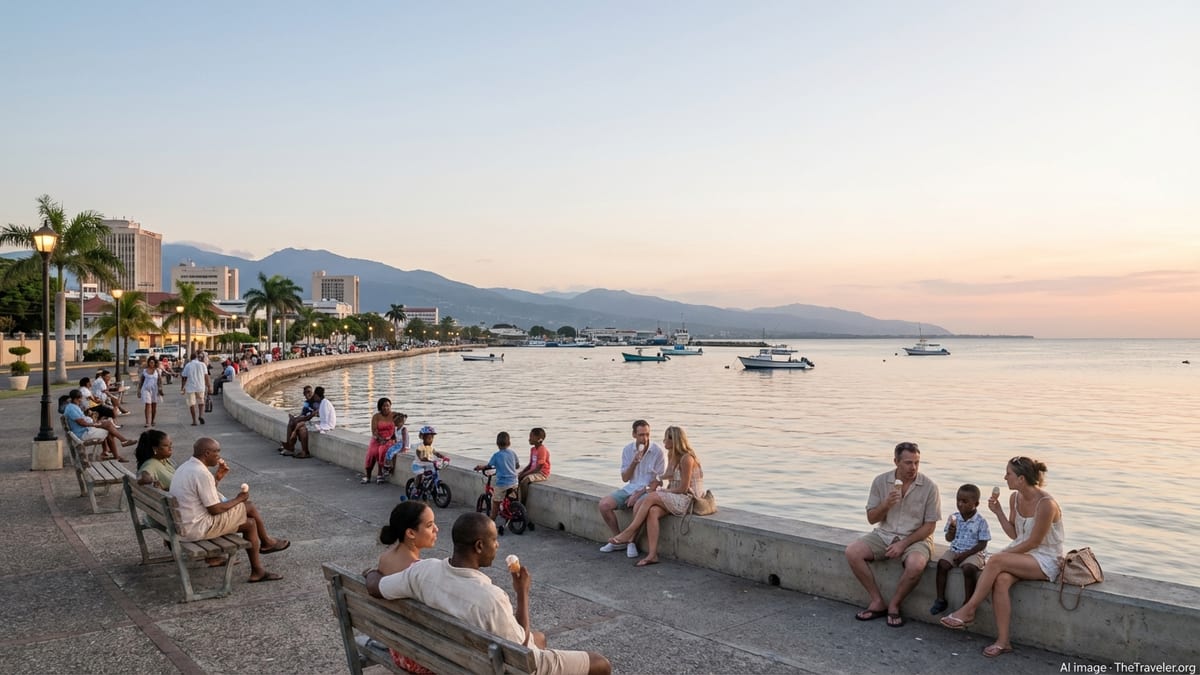
On Sunday, I followed the city’s own weekend ritual and headed downtown toward the Kingston waterfront. In recent years, the area around Ocean Boulevard and the harborfront promenade has evolved into a favored spot for evening “lymes,” the local term for informal hangs. As the heat begins to slip out of the day, people drift toward the water for ice cream, street snacks and an unhurried view of the sunset over the harbor.
By late afternoon, clusters of families and couples had already claimed benches and railings along the promenade. Children rode small bicycles in slow circles. Vendors sold cones and cups of ice cream, chilled drinks and the occasional bag of roasted nuts. A few speakers played music at low volume, but the dominant sounds were the slap of small waves against the seawall and the murmur of conversation.
I walked the length of the waterfront and then sat to watch the sky. Over the harbor, the light shifted from bright blue to a gentle gradient of pinks and oranges. Tugboats moved in the distance; gulls circled lazily overhead. For a capital city better known for its cultural output and political weight, Kingston in this moment felt entirely domestic and calm. The evening crowd was not chasing nightlife, at least not yet. They were savoring the last unstructured hours before Monday.
What struck me most was the sense of community. Strangers offered to take photos of each other against the harbor backdrop. Kids who clearly did not arrive together ended up playing impromptu games. An older couple shared a bench with me for a while, trading a few friendly remarks about the weather and how long it had been since they had taken the time to simply sit and look at the water. It was a small, ordinary scene that felt unexpectedly restorative.
A Quiet Escape to the Coast at Hellshire Beach
Kingston itself does not have classic resort beaches, but one of the city’s great weekend perks is how quickly you can get to the sea. A short drive across the causeway toward Portmore brings you to Hellshire Beach, famous locally for its fish shacks, near‑white sand with traces of darker grains and generally safe swimming conditions close to shore. Historically known as “Healthshire” for its reputation as a retreat, the area has long been associated with leisure, even if its name has evolved over time.
I set out early to catch the beach before it grew busy. When I arrived, vendors were still setting up, arranging coolers and prepping grills. The water was a gentle blue‑green, with only a light chop near the shore. A few early risers walked the beach, leaving the first footprints on the day’s still‑smooth sand. The soundtrack was a mix of waves, the call of seabirds and occasional snatches of conversation between stall owners.
As the morning unfolded, the smell of frying fish drifted across the sand. Groups of friends arrived, spreading out under makeshift shade structures or renting plastic chairs near the water. Some ordered whole fish with festival or bammy, the kind of meal that demands you set aside time and appetite. Others simply ordered a drink and settled in to watch the scene. Hellshire is no secret, and on a sunny weekend it can be lively, but even at its busiest it retains a laid‑back, come‑as‑you‑are atmosphere.
I spent most of my time at the quieter end of the bay, alternating between short swims and long stretches of reading in the shade. Looking back toward Kingston across the water, I was reminded how closely intertwined the city and sea are here. The capital might be the center of government and commerce, but in less than an hour you can step onto a beach where the main agenda is deciding whether to nap before or after lunch. It is an easy, informal kind of relaxation that fits neatly into a weekend.
Music, Hills and a Softer Side of Kingston Nights
Kingston’s musical legacy is one of the reasons many travelers visit, and I had expected this aspect of the city to be the opposite of relaxing. Yet even here, I found softer edges. On Sunday evening, I made my way up into the hills above the city, where lookout points and venues capitalize on the views stretching from the Blue Mountains down to the harbor. The climb, whether by taxi or private car, is a reminder of how quickly Kingston gives way to steeper, greener terrain.
At a hilltop spot known for its Sunday sessions, the music leaned heavily into roots and dub rather than high‑octane dancehall. The sound system was strong, but there was space between the notes, and the open‑air setting meant that the bass lines rolled out into the night instead of bouncing off concrete walls. People danced, but many also simply sat along the edges, sipping drinks and watching the city’s lights flicker below.
What might sound overwhelming on paper felt almost contemplative in person. There is a communal focus to these gatherings, a sense of shared listening that keeps the mood grounded. Conversations flowed easily, but so did comfortable silences. Strangers nodded in recognition of familiar tracks. For a few hours, the city’s reputation for intensity was channeled into something gentler: collective enjoyment that did not require shouting or jostling for space.
Later, back in New Kingston, even the drive through town seemed less harried than I expected. Traffic lights glowed on mostly empty intersections, and late‑night cookshops sent out the quiet clatter of plates and low laughter from small groups of diners. Kingston by night can certainly be rowdy in the right places, but it can also be measured, even soothing, if you choose your corners carefully.
The Takeaway
By the time my weekend in Kingston came to a close, the city’s reputation in my mind had shifted substantially. I arrived expecting stimulation and perhaps some fatigue. I left with the sense that Kingston can be as gentle as you allow it to be. The same geography and history that give it intensity also provide layers of escape: waterfront promenades that catch the evening breeze, botanical gardens that mute the noise of daily life, beaches within easy reach and hilltop venues where music and views combine into something close to meditation.
Relaxation in Kingston is not about isolation from local life. It happens right alongside it, in parks where office workers jog before their commute, at heritage sites where families share ice cream on the lawn and on promenades where Sunday evening is marked with a cone and a view of the harbor. It is a city where you can feel the weight of history and culture without being overwhelmed by it, provided you give yourself permission to slow down.
If you arrive with an open mind and a willingness to stray from the typical beach‑resort script, Kingston rewards you with textures that are deeply human. It is not a place that erases its edges, but it offers more softness than its reputation suggests. For a long weekend, at least, it was more than enough to send me home feeling unexpectedly rested.
FAQ
Q1. Is Kingston, Jamaica a good destination for a relaxing weekend?
Yes. While Kingston is a busy capital, its parks, waterfront, nearby beaches and hilltop viewpoints offer many ways to have a calm, laid‑back stay.
Q2. Which areas of Kingston feel most relaxing for first‑time visitors?
New Kingston, with its hotels near Emancipation Park, the grounds at Devon House, Hope Botanical Gardens and the downtown waterfront promenade are among the most soothing.
Q3. Can I enjoy Kingston without renting a car?
Yes. Taxis and hotel drivers can get you to most key spots. For extra peace of mind, arrange transportation through your accommodation or licensed operators.
Q4. How far are beaches like Hellshire from central Kingston?
Under normal traffic, Hellshire Beach is typically under an hour’s drive from New Kingston, making it an easy half‑day or full‑day escape.
Q5. Is it safe to walk around Kingston’s parks and waterfront?
Conditions can change, but many locals use places like Emancipation Park, Devon House lawns and the waterfront, especially in daylight and early evening. Staying aware and following local advice is wise.
Q6. What is the best time of day to visit Hope Botanical Gardens?
Early morning and late afternoon are usually more comfortable, with cooler temperatures, softer light and fewer midday crowds.
Q7. Are Kingston’s hilltop music spots very loud and hectic?
Some can be lively, but many Sunday or evening sessions in the hills focus on roots and dub with a mellow crowd, creating a surprisingly relaxed atmosphere.
Q8. Can I combine cultural experiences with downtime in Kingston?
Yes. You can visit museums or galleries, then unwind in nearby parks, at Devon House or over a slow meal with a view of the hills or harbor.
Q9. What should I pack for a relaxing weekend in Kingston?
Light clothing, comfortable walking shoes, sun protection, a hat, swimwear for beach or pool time and a light layer for cooler evenings in the hills are all useful.
Q10. How many days do I need to feel rested after visiting Kingston?
A long weekend of two to three full days is enough to sample the city’s calmer side, especially if you balance sightseeing with unstructured time.