

More news on this day
Escalating political turmoil and security fears in Myanmar are quietly redrawing Southeast Asia’s tourism map in early 2026, pushing regional travellers to look northward to China’s booming inland megacity of Chongqing instead.
From Coup Turmoil to Holiday Rerouting
Five years after Myanmar’s 2021 military coup, the country’s political crisis shows little sign of resolution. A tightly managed election that concluded in January 2026, widely denounced by Western governments and rights groups, entrenched the military’s grip on power even as conflict and airstrikes continue in large swathes of the country. For tour operators, insurers and individual travellers, the message is clear: Myanmar remains a high-risk destination.
Travel companies that once sold Yangon–Bagan–Mandalay circuits across Southeast Asia say security briefings, curfews and intermittent fighting have become near-permanent features of their risk assessments. While some limited business and pilgrimage travel persists, mainstream leisure tourism has collapsed. Regional carriers have reduced or rerouted services, and many travellers from Thailand, Malaysia and Singapore now tell agents they have simply “scratched Myanmar off the list” for the foreseeable future.
China’s growing role as power broker in Myanmar’s civil war, including ceasefire mediation near the shared border, has brought only partial relief along key trade corridors. Border-zone skirmishes, refugee movements and periodic closures still make overland itineraries unreliable. As a result, the Myanmar–Yunnan routes that once fed multi-country tours are increasingly replaced by flight-based itineraries that bypass Myanmar altogether and connect directly into Chinese cities.
For a growing segment of Southeast Asian travellers, that pivot is leading not to the familiar gateways of Beijing or Shanghai, but to a mountainous river metropolis once seen as a domestic curiosity: Chongqing.
Chongqing’s Meteoric Rise on Regional Travel Radars
Perched at the confluence of the Yangtze and Jialing rivers in China’s southwest, Chongqing has spent much of the past decade quietly investing in culture, transport and tourism infrastructure. Official data from city and national tourism authorities show domestic and inbound arrivals climbing sharply since China lifted its pandemic-era border controls, with Chongqing recording record visitor numbers during major holidays and a surge in overnight stays.
The momentum has accelerated into 2025 and early 2026. During last year’s National Day holiday the city handled more than 22 million domestic visitors, while inbound overnight stays jumped by triple digits compared with the previous year. More recently, the nine-day Spring Festival peak in February 2026 brought over 12 million domestic visitors and tens of thousands of foreign tourists, supported by heavy investment in cultural programming, discounts and accommodation packages.
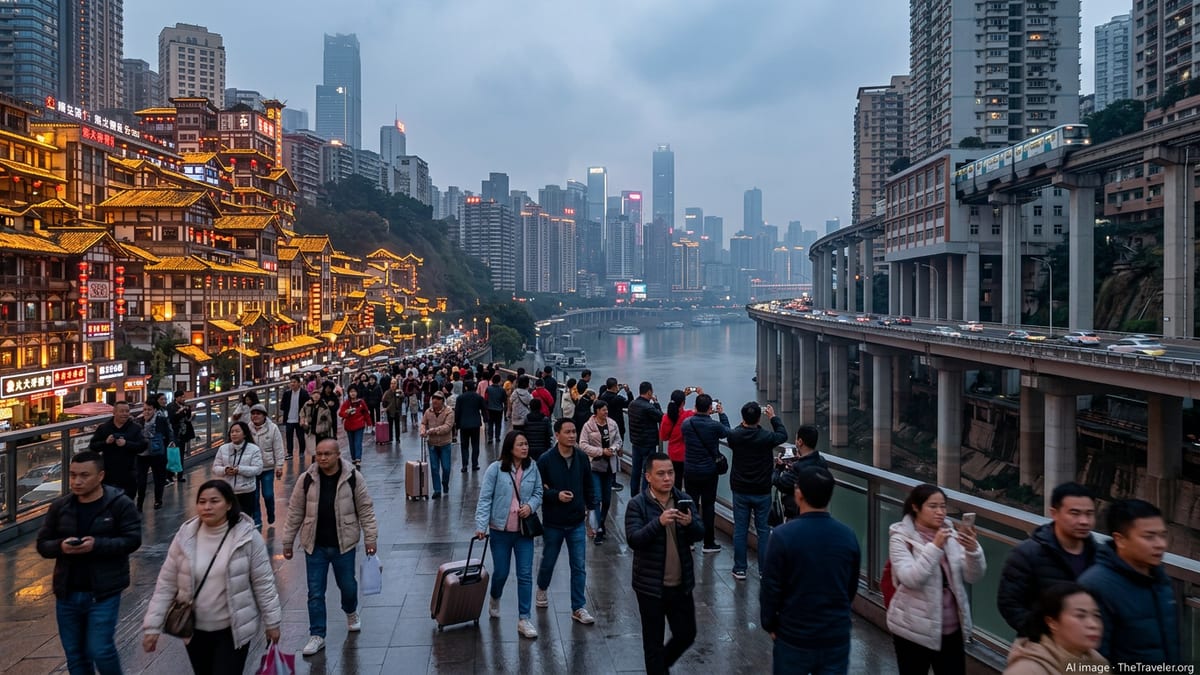
Chongqing’s international profile has also been lifted by sustained media attention. International outlets have highlighted the city’s vertiginous skyline, monorails threading directly through apartment blocks and stacked expressways that appear to hover above the rivers. Viral social media clips and travel features describe a destination that feels like a “real-life sci-fi set,” but one still grounded in traditional hotpot restaurants, cliff-side temples and steep, lantern-lit stairways connecting its multiple levels.
For regional travellers unnerved by Myanmar’s instability but still seeking something adventurous and different from the well-trodden routes of coastal China, Chongqing’s combination of novelty and perceived safety is proving compelling.
Visa-Free Gates and Air Links Pull Southeast Asians North
Policy changes have reinforced those shifting preferences. In the past two years, China has widened visa-free and visa-on-arrival access for several Southeast Asian nations, easing short-stay travel for citizens of countries such as Thailand, Malaysia and Singapore. National tourism officials report that a growing share of visitors from the Association of Southeast Asian Nations region now arrive under visa exemptions, a trend mirrored in Chongqing’s own inbound figures.
Chongqing’s airport, long overshadowed by hubs on the eastern seaboard, has rapidly expanded its international network. Border-check statistics from 2025 show a marked rise in foreign passport holders passing through the city, with hundreds of thousands of non-Chinese travellers now using the megacity as a primary point of entry into the country. Many are arriving on new or upgraded routes from Southeast Asia, where airlines and tour wholesalers are scrambling to meet demand for China itineraries that balance novelty with ease of access.
For tour operators who previously routed clients through Yangon or Mandalay, this combination of relaxed entry rules and improving connectivity is attractive. Multi-stop packages that might once have paired Myanmar’s temple plains with Laos or northern Thailand are being rewritten to link Bangkok, Kuala Lumpur or Singapore directly with Chongqing, sometimes in combination with Chengdu and the wider Sichuan–Chongqing cultural corridor.
Crucially, travel agents report that clients who might have hesitated about inland Chinese cities due to language or payment barriers now express fewer concerns. The rollout of multilingual signage, wider acceptance of foreign bank cards and simplified mobile payment options in major Chinese hubs is filtering into Chongqing’s hotels, transport nodes and headline attractions, lowering practical obstacles for first-time visitors.
A City Reinvented as an Inland Tourism Powerhouse
On the ground, Chongqing has moved quickly to capture this new audience. Municipal authorities have poured resources into promoting the city as an “international consumption hub,” combining shopping, dining, culture and entertainment in dense riverfront districts. Night-time economies have been aggressively cultivated, with illuminated cableways, cruise boats and hillside complexes like Hongyadong now emblematic of the city’s tourism brand.
Recent tourism campaigns have leaned into the megacity’s layered topography and near-constant mist, marketing it as a place where visitors can ride a monorail through an apartment tower in the morning, walk through centuries-old lanes in the afternoon and eat hotpot under neon lights at night. Museums, rock-carving heritage sites and new immersive digital attractions add depth beyond the skyline shots that dominate social feeds.
Those efforts are beginning to pay off internationally. Chongqing has climbed into the upper tier of Chinese cities on major booking platforms, ranking highly for hotel reservations and search interest among foreign users. Travel data from 2024 and 2025 show strong growth in arrivals from Malaysia, Indonesia, Singapore and Thailand in particular, with some markets recording triple-digit increases off a low base.
Local tourism businesses, from cruise operators to hotpot chains and boutique hotels, are adjusting to the shift by hiring more multilingual staff, offering halal-certified dining options and tailoring packages that cater specifically to ASEAN travellers who might once have chosen Myanmar’s river cruises or temple tours.
Risk, Perception and the New Regional Itinerary
Analysts caution that Myanmar’s tourism downturn is only one factor in Chongqing’s rise. The city’s growth also reflects China’s broader post-pandemic reopening, domestic marketing power and sustained infrastructure spending. Yet for many travellers in Southeast Asia weighing where to spend limited holiday time and money, images of ongoing airstrikes and contested borderlands in Myanmar are proving decisive.
Regional travel insurers have tightened coverage for parts of Myanmar, and some large travel agencies classify the country as a niche or specialist destination rather than a mainstream holiday choice for 2026. By contrast, China’s big cities are routinely described as stable and predictable in risk assessments, even as geopolitical tensions persist at the diplomatic level.
This divergence in perception is reshaping itineraries. Travel planners say that where a decade ago a “frontier” Southeast Asia circuit might have featured Yangon, Bagan and overland journeys toward China’s Yunnan province, the new frontier often starts with a direct flight to Chongqing, followed by high-speed rail connections deeper into China’s interior. For a rising number of regional tourists, the great river vistas, misty gorges and crowded street-food alleys they once associated with Myanmar are now being discovered instead in the terraced streets and riverbanks of China’s largest inland city.
As Myanmar’s political crisis grinds on and China doubles down on positioning itself as an accessible, experience-rich destination, Chongqing’s role as a substitute stop on the regional tourism circuit is hardening into something more permanent. For 2026 at least, the city of steep hills and swirling hotpot looks set to remain one of Asia’s most unlikely new travel hotspots.