

More news on this day
Jomo Kenyatta International Airport in Nairobi, one of Africa’s busiest aviation gateways, has been thrust into turmoil after a workers’ strike triggered widespread disruption, forcing Etihad Airways and other international carriers to cancel or heavily delay flights and leaving thousands of passengers scrambling to replan their journeys to and from Kenya.
How a Labor Dispute Brought Kenya’s Main Airport to a Standstill
The chaos at Nairobi’s Jomo Kenyatta International Airport began on Monday, February 16, when aviation workers launched a strike over stalled labor negotiations and unresolved grievances around pay, benefits and working conditions. The industrial action quickly rippled through the airport’s finely calibrated operations, slowing air traffic control services and ground handling and triggering rolling delays that mounted into hours. By Tuesday, the disruption had evolved into a full-blown operational crisis for the country’s primary aviation hub.
Authorities had been warned. The Kenya Aviation Workers Union had issued formal notice of action the previous week, accusing aviation regulators of failing to implement aspects of an earlier collective bargaining agreement. When talks did not yield progress, union members began a coordinated go-slow and walkout that affected everything from runway operations to baggage handling, touching nearly every airline serving the airport.
The strike struck at the heart of East Africa’s air transport network. Jomo Kenyatta International Airport is the main entry point for international visitors to Kenya and a critical connection point for flights throughout the region. Any prolonged disruption at Nairobi can cascade across neighboring countries’ schedules, impacting business travel, tourism and time-sensitive cargo movements.
As delays lengthened and queues of waiting aircraft built up on the tarmac, airlines scrambled to adjust flight plans. Some pushed departures back by several hours, while others diverted aircraft away from Nairobi altogether. The mounting uncertainty set the stage for a wave of cancellations, including by Etihad Airways, which suspended its Abu Dhabi to Nairobi services during the height of the disruption.
Etihad Flights Cancelled as International Carriers Reassess Nairobi
Among the hardest-hit services were international routes linking Nairobi with major global hubs in the Gulf, Europe and Asia. Etihad Airways, which operates nonstop services between Abu Dhabi and Nairobi, moved to cancel flights as the strike intensified and operational reliability at the airport deteriorated. The decision left connecting passengers stranded mid-journey, particularly those relying on Abu Dhabi as a gateway between Africa, Europe and Asia-Pacific.
Etihad was not alone. Other foreign carriers, facing unpredictable ground handling support and severe knock-on delays, reduced frequencies, rerouted aircraft or temporarily suspended operations. With air traffic control capacity constrained and turnaround times stretching far beyond normal windows, airlines cited safety, crew rostering limits and the risk of aircraft and crew being stranded out of position as key factors in their decisions.
For passengers, the cancellations translated into last-minute notifications, abruptly updated itineraries and in many cases, forced overnight stays or multi-day delays. Travelers transiting via Nairobi to regional destinations such as Entebbe, Kigali, Dar es Salaam and Lusaka were particularly vulnerable, as a single missed connection could unravel a complex sequence of onward flights.
Industry analysts noted that while airlines typically try to protect flagship long-haul services, sustained operational uncertainty often forces carriers to cut rotations rather than risk safety margins or incur spiraling costs from crew duty-time violations, passenger compensation and aircraft repositioning. In the case of Etihad, the decision to cancel its Nairobi flights during the strike underscored both the severity of the disruption and the importance of predictable ground operations for global network planning.
Passengers Stranded, Schedules Shattered and Tempers Fray
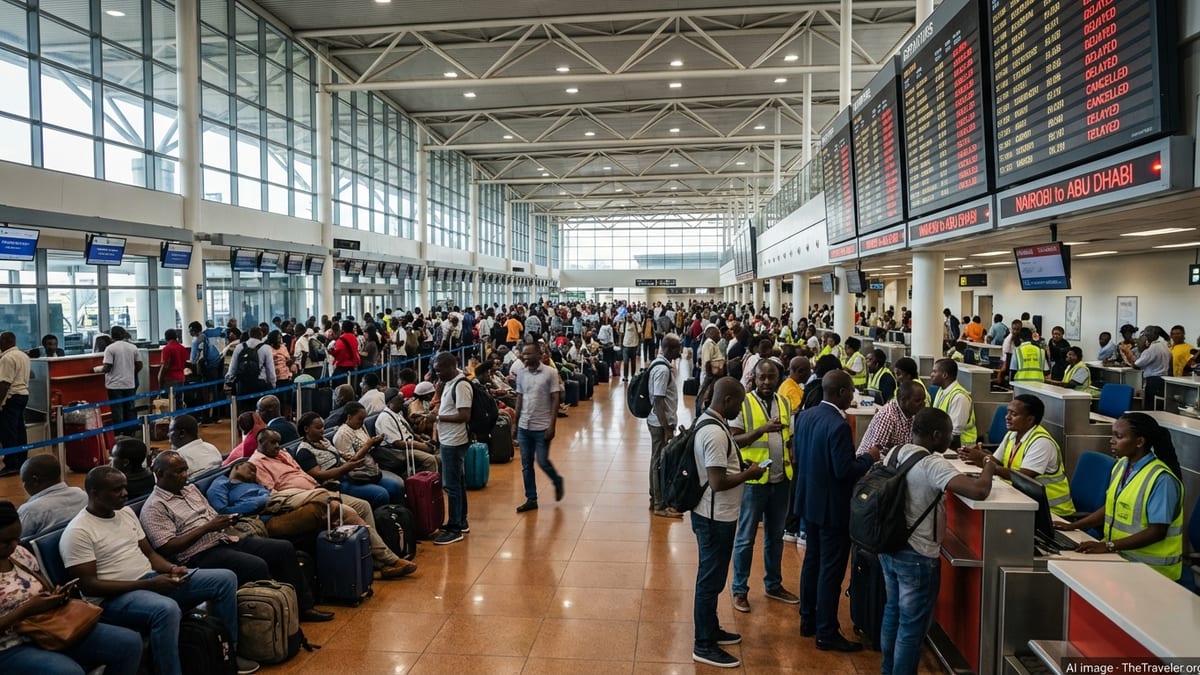
Inside the terminal, the human impact of the strike was immediately visible. Departure halls filled rapidly as check-in lines slowed to a crawl and departure boards flashed delay after delay. With air traffic control working at reduced capacity and ground staff either absent or operating under a go-slow, even minor operational issues ballooned into multi-hour holdups. Many passengers reported waiting in terminals for most of the day, only to be told that their flights had been postponed or cancelled outright.
Families found themselves separated when only some members were able to clear security before access restrictions tightened. Others, including business travelers and tourists, faced complex immigration and visa questions after their planned departure dates were missed. Some foreign visitors worried about overstaying their visas as they lined up at airline counters seeking rebooking or accommodation vouchers.
For those arriving into Nairobi, the experience was hardly better. Aircraft landing after extended holding patterns found limited gate access and constrained baggage services. Passengers disembarking late at night or in the early hours of the morning encountered congested arrival halls and uncertain onward transport, as airport shuttle, taxi and hotel services struggled to keep pace with the volatile flow of delayed flights.
Social media channels filled with images of crowded seating areas, passengers sleeping on floors and long queues at customer service desks. Frustration grew as airline staff, many themselves limited by the strike’s impact, attempted to provide updates with incomplete information and shifting guidance from airport authorities and regulators.
What Triggered the Strike and How It Was Resolved
At the heart of the disruption is a longstanding dispute between aviation workers and Kenya’s aviation authorities over pay scales, staffing levels, safety standards and the implementation of prior agreements. Union representatives argue that airport workers have been asked to sustain high levels of performance amid rising traffic without commensurate improvements in remuneration or working conditions. They also point to concerns over staffing in critical safety-sensitive roles, including air traffic control.
Authorities initially sought to contain the strike’s impact through contingency plans, including redeploying management staff and calling on non-striking personnel to maintain essential services. Public statements emphasized that safety remained the top priority and urged passengers to contact their airlines before heading to the airport. However, the scale of the disruption quickly made it clear that normal operations could not be maintained without a negotiated settlement.
Intense talks followed between the Kenya Aviation Workers Union, the Kenya Civil Aviation Authority and the transport ministry. Government mediators pushed for a rapid return to work, warning that extended disruption risked damaging the country’s reputation as a reliable aviation hub and hurting Kenya’s pivotal tourism sector, which depends heavily on smooth air connectivity through Nairobi.
By Tuesday, February 17, union leaders and the government had reached a return-to-work agreement, leading to the formal suspension of the strike. While full details of the deal were not immediately disclosed, officials indicated that key union demands on pay, benefits and working conditions would be revisited within a defined timeline. The union, in turn, called on its members to resume duties, paving the way for the gradual restoration of flight operations.
Is Jomo Kenyatta International Airport Back to Normal?
Although the strike has officially been called off and authorities have promised a swift return to normal operations, travelers should expect lingering disruption in the short term. Airlines must now work through a backlog of delayed and cancelled flights, reposition aircraft and crew and accommodate passengers whose travel plans were derailed during the two-day stoppage.
Kenya’s national carrier has indicated that it expects to restore regular schedules within about 24 hours of the agreement, but the reality on the ground will vary by route and airline. Long-haul and high-demand regional services are likely to be prioritized, while some secondary routes may continue to see adjustments as carriers rebalance capacity. Passengers with itineraries involving tight connections through Nairobi may face further schedule tweaks as the system stabilizes.
Airport authorities are urging travelers to double-check their flight status before heading to Jomo Kenyatta International Airport and to allow additional time for check-in and security while operations ramp back up. With staff returning from strike action and shift patterns being re-established, queues at check-in, immigration and security may remain longer than usual over the next several days.
For Etihad passengers specifically, the key question is when regular Abu Dhabi to Nairobi services will fully resume and whether any temporary capacity reductions or aircraft swaps will persist after the immediate crisis. While the carrier is expected to reinstate the route as stability returns, travelers with near-term bookings should closely monitor airline advisories and be prepared for revised departure times or rebooking options.
What Travelers Need to Do If They Are Affected
For anyone flying to or from Nairobi in the wake of the strike, the most important step is to stay informed and proactive. Travelers with Etihad tickets should first check the status of their flight through the airline’s official channels and ensure their contact details are up to date so that they receive any rebooking offers or schedule changes promptly. Similar guidance applies to passengers booked on other affected carriers operating in and out of Jomo Kenyatta International Airport.
If a flight has been cancelled, passengers are typically entitled to a choice between rebooking at the earliest available opportunity or receiving a refund, subject to the airline’s fare rules and applicable regulations. Many carriers also offer the option to reroute via alternative hubs, which may be particularly valuable for long-haul travelers seeking to avoid further delays. In situations where an overnight stay becomes unavoidable, airlines sometimes provide accommodation or meal vouchers, especially when disruption is within their control.
Travelers already at the airport should seek assistance at airline service counters rather than repeatedly passing through security checkpoints in search of information. Keeping all documentation, including boarding passes, booking confirmations and receipts for out-of-pocket expenses, will be helpful if compensation or reimbursement claims are pursued later. Where visas are a concern due to unexpected overstays, passengers should approach immigration officials early to explain the situation and obtain guidance.
Those planning trips in the coming days might consider building extra connection time into itineraries involving Nairobi or, where flexible, shifting departure dates slightly to avoid the immediate post-strike recovery period. Travel insurance policies that cover missed connections, trip interruption and accommodation costs can also provide additional financial protection, depending on their specific terms and exclusions.
Broader Implications for Kenya’s Aviation and Tourism Sectors
The disruption at Jomo Kenyatta International Airport carries ramifications that extend beyond a few days of chaos. As East Africa’s primary air transport hub, Nairobi’s reliability is central to the region’s appeal for tourists, investors and conference organizers. High-profile strikes and system-wide delays risk denting confidence among airlines and travelers, especially when they lead to international carriers such as Etihad cancelling services, even temporarily.
For Kenya’s tourism industry, which relies on seamless flight connections to bring visitors to the country’s national parks, coastal resorts and business centers, any perception of instability at the main gateway could translate into lost bookings. Tour operators and hotels often operate on tight seasonal schedules, and disruptions during peak travel periods can be particularly damaging, both financially and reputationally.
The strike also highlights deeper structural questions about staffing, pay and investment in Kenya’s aviation infrastructure. With passenger numbers rising and Nairobi competing with other African hubs for transfer traffic, ensuring that the workforce is adequately supported and that labor disputes are resolved before they escalate into operational crises will be crucial. The latest incident may prompt renewed calls for more robust contingency planning and clearer communication protocols between authorities, airlines and passengers.
At the same time, the resolution of the strike and the government’s commitment to address workers’ concerns could, if followed through, lead to a more stable and motivated workforce in the long term. For frequent travelers and airline partners such as Etihad, the ultimate test will be whether Nairobi can maintain reliable, disruption-free operations in the months ahead and reassure the market that this week’s turmoil was an exception rather than a sign of deeper fragility.
Key Takeaways for Future Travel via Nairobi
The turbulence at Jomo Kenyatta International Airport offers several lessons for travelers planning to use Nairobi as a gateway. First, always verify flight status close to departure, especially when connecting through major hubs where local labor disputes or weather events can have far-reaching consequences. Registering contact details with airlines and enabling notifications can ensure that any changes are communicated quickly.
Second, when flying on complex itineraries that involve multiple carriers or tight connections, consider allowing longer layovers or opting for through-tickets on a single airline alliance when possible. This can simplify rebooking in the event of disruption and reduce the risk of being stranded mid-journey without clear support channels.
Third, travelers should familiarize themselves with their rights under airline contracts and, where applicable, consumer protection frameworks that govern cancellations, delays and denied boarding. Understanding what assistance an airline is obliged to provide, and what may fall under personal travel insurance, can make it easier to navigate a crisis calmly and assertively.
Finally, while this week’s strike has been a sobering reminder of how quickly operations at even a major international hub can unravel, Nairobi remains a vital and generally dependable gateway to East Africa. As Etihad and other airlines work to restore regular services and authorities implement the promises made in the return-to-work agreement, travelers can expect conditions to gradually stabilize, albeit with a renewed appreciation for the complex web of people and processes that keep global aviation moving.