

More news on this day
Azerbaijan’s Nakhchivan exclave is set to become far more accessible from Türkiye as Azerbaijan Airlines adjusts its route strategy and Ankara pushes ahead with new rail and air links that promise to transform travel and trade across the South Caucasus.
AZAL Refines Route Strategy as Turkish Carriers Step In
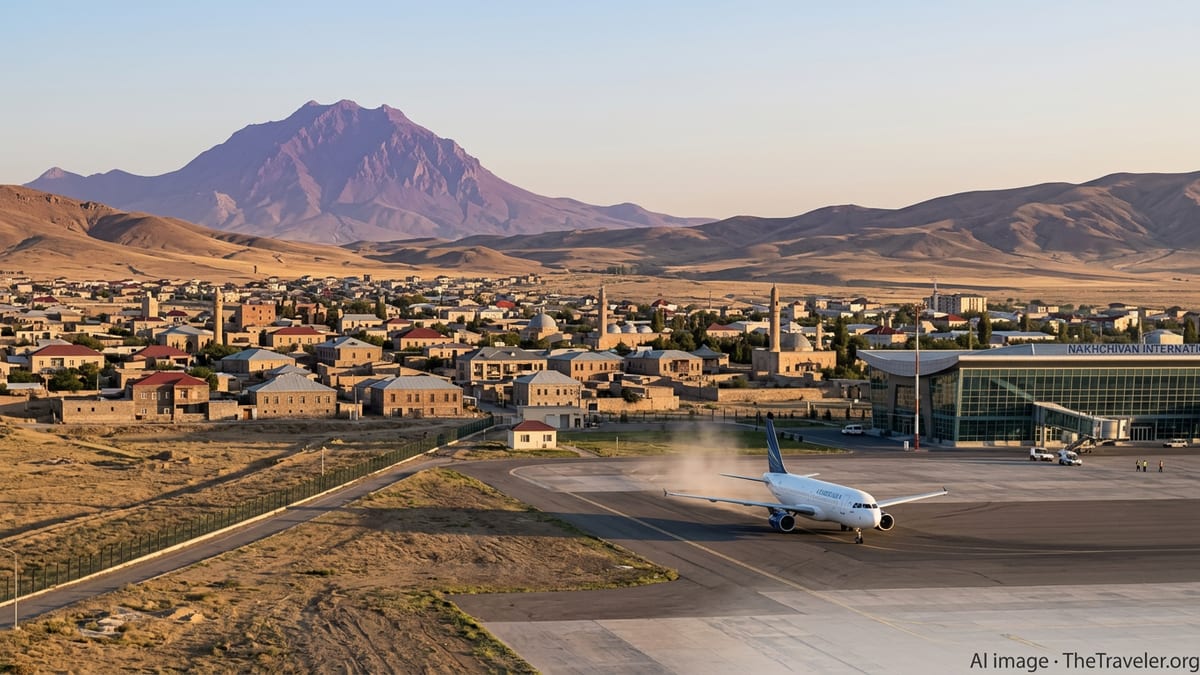
Azerbaijan Airlines has been gradually reshaping how passengers reach Nakhchivan, placing heavier emphasis on its core Baku operations while allowing Turkish partners to shoulder a growing share of direct connectivity from Türkiye. Industry officials in Baku say AZAL’s priority is to consolidate traffic through the capital and align schedules with new regional corridors, rather than duplicate routes that Turkish carriers can operate more efficiently from their own hubs.
The most visible change has been the gradual handover of some Nakhchivan services to Turkish operators, notably the low cost carrier AJet, a subsidiary of Turkish Airlines, which has launched a triangular route linking Istanbul, Ganja and Nakhchivan. The move keeps Nakhchivan closely connected to Türkiye’s largest city while freeing AZAL to redeploy aircraft to higher yielding international markets and domestic trunk routes.
Aviation analysts note that this division of labor reflects a broader trend in the region. Flag carriers increasingly concentrate on strategic long haul and hub based traffic, while short haul cross border links are left to partners that can exploit dense origin and destination demand from cities such as Istanbul and Ankara. For Nakhchivan, that translates into more choice of departure points in Türkiye and better integration with Turkish Airlines’ extensive global network.
Officials in both countries frame the changes not as a loss of sovereignty over a key route, but as a joint optimization of capacity that ultimately increases frequencies, improves aircraft utilization and supports more stable year round operations on a sector that has historically been vulnerable to geopolitical shocks and seasonal swings in demand.
New Air Links Underscore Strategic Partnership
The recalibration of Nakhchivan’s air links comes as Azerbaijan and Türkiye deepen an already close strategic partnership across transport, energy and security. Ankara’s aviation push into Nakhchivan is part of a wider expansion into Turkic markets, with new routes launched to cities in Central Asia and the Caspian basin, reinforcing Türkiye’s ambition to serve as a primary air bridge between Europe and the Turkic world.
For Azerbaijan, closer aviation integration with Türkiye complements formal defense and political agreements and sends a signal that Nakhchivan’s future lies firmly within a shared Turkic infrastructure space. Turkish operated routes from Istanbul to Nakhchivan place the exclave on the same map as major tourist and business destinations that are already familiar to Turkish travelers, from Baku to Almaty, and facilitate seamless connections onward to Europe, the Middle East and North America.
Diplomats in Ankara and Baku see the deepening of travel links as a practical dimension of their oft repeated “one nation, two states” slogan. Every additional seat between Turkish airports and Nakhchivan is also a vote of confidence in the long term stability of the South Caucasus, where the two allies have backed a host of new corridors designed to bypass traditional transit chokepoints.
While aviation officials avoid political language, the timing of these initiatives is significant. As peace talks between Armenia and Azerbaijan inch forward and new ground corridors take shape, both governments are eager to normalize the idea of Nakhchivan as a readily accessible destination for tourists, students and entrepreneurs rather than a remote borderland cut off by conflict.
Railway Projects Promise Game Changing Connectivity
Beyond aviation, Türkiye has broken ground on a new railway connecting its northeastern Kars province with Nakhchivan, a project framed by officials as a cornerstone of a wider Southern Caucasus transit corridor. The line is designed to plug Nakhchivan directly into Türkiye’s rail network, reducing dependence on circuitous routes via Iran and creating a continuous overland chain that can eventually stretch from Anatolia to the Caspian Sea and Central Asia.
The Kars Nakhchivan railway is being developed in tandem with Azerbaijan’s internal road and rail upgrades aimed at knitting together the country’s western districts, the autonomous republic and its coastal ports. Once operational, the route will allow both passengers and freight to move between Türkiye and Nakhchivan in a matter of hours, with customs and border procedures streamlined under recently signed bilateral agreements.
For travelers, the impact could be profound. A rail journey from eastern Türkiye into Nakhchivan would offer an alternative to flying, especially for budget conscious visitors and regional residents, and create new opportunities for multi stop itineraries that combine eastern Anatolia, Nakhchivan’s mountain landscapes and onward trips to Baku. Tourism operators are already sketching out potential packages that leverage overnight trains and scenic daytime segments along the Aras River valley.
Economists argue that the biggest gains will accrue to trade and logistics. By closing the gap between the Baku Tbilisi Kars railway and Nakhchivan, the new line will help complete a missing link in the so called Middle Corridor, the trans Eurasian route that runs from China through Central Asia and the Caspian basin to Europe via Türkiye. In that context, Nakhchivan shifts from being an isolated exclave to a key junction on an emerging east west axis.
Tourism, Diaspora and Business Eye New Opportunities
Improved air and rail links are expected to unlock substantial tourism potential in Nakhchivan, which has long been overshadowed by Baku and the Caspian coast. The region offers a mix of rugged mountain scenery, historic caravanserais and religious sites, including shrines and medieval mausoleums that resonate strongly with visitors from Türkiye. Direct flights from Istanbul and easier overland entry are likely to stimulate short breaks, pilgrimage trips and combined cultural itineraries.
The Azerbaijani and Turkish diasporas also stand to benefit. Families split between Nakhchivan, Baku, eastern Türkiye and Istanbul have traditionally relied on indirect or multi leg journeys that can be costly and time consuming. A greater choice of direct services and the prospect of future rail links will make it easier to maintain cross border family ties, attend weddings and holidays, and shuttle students between universities in the two countries.
Business travelers are watching closely too. Nakhchivan’s position on the emerging corridors gives it potential as a niche logistics and light manufacturing hub, particularly for companies that want to serve both Turkish and Caspian markets. Officials in the exclave have talked about special economic zones and simplified customs regimes that would leverage the improved transport infrastructure to attract investment in warehousing, food processing and tourism services.
Local authorities emphasize that increased connectivity must be paired with careful planning to ensure that tourism growth is sustainable and that historic sites and fragile mountain ecosystems are protected. Partnerships with Turkish tour operators and hotel chains are seen as a way to import expertise in destination management while maintaining Azerbaijani cultural and environmental priorities.
Regional Stability and Future Travel Prospects
The reshaping of Nakhchivan’s travel links is unfolding against a complex geopolitical backdrop. Progress on the Armenia Azerbaijan peace track, the phased opening of new corridors across the South Caucasus and broader competition among regional powers all influence how quickly and smoothly new routes can be brought online. For now, both Baku and Ankara view aviation and rail projects as practical confidence building measures that deliver immediate benefits to ordinary travelers.
In the near term, travelers can expect a more diversified mix of carriers and modes on routes touching Nakhchivan. Turkish operators are likely to add frequencies as demand matures, while AZAL continues to refine its schedule to maintain reliable connectivity with Baku and beyond. When the Kars Nakhchivan railway moves from construction to operations, it will add a slower but scenic option that could appeal strongly to leisure travelers.
Looking further ahead, policymakers in both countries speak of Nakhchivan as a future regional gateway rather than a cul de sac. If planned corridors linking mainland Azerbaijan, Nakhchivan and eastern Türkiye are fully realized, the exclave could become a natural stop on overland journeys between Europe, the Caucasus and Central Asia, much as border cities in Central Europe transformed once new highways and rail lines came on stream.
For now, the decision to shift key air routes toward Turkish operators and the parallel push on rail connectivity send a clear message: Nakhchivan’s era of isolation is ending, and its future will be defined by movement, exchange and an ever denser web of travel links across a rapidly changing region.