

More news on this day
In Namsai, a rapidly developing district in eastern Arunachal Pradesh often described as part of India’s “Land of the Rising Sun,” community-driven tourism is emerging as a central plank of local development, tying together cultural revival, rural livelihoods and new infrastructure along the lush plains of the Lohit River.
Get the latest news straight to your inbox!
From Quiet District to Emerging Tourism Hub
Once a relatively quiet corner of Arunachal Pradesh, Namsai is now drawing growing attention as a model for culturally rooted and community-focused tourism. Official district information highlights a strategy built around rural, religious and eco-tourism, leveraging the area’s mix of forest fringes, river islands, pagodas and pilgrimage routes to create new income streams while keeping local communities at the core of planning and delivery.
Namsai’s location on the Assam border, with improving road connectivity and access from hubs such as Tinsukia and Dibrugarh, has helped shift it from a transit point into a destination in its own right. Publicly available documents on regional biodiversity and infrastructure planning describe the district as a key cultural tourism node, with links stretching further east toward border areas such as Kibithoo and Walong.
Observers note that this wider transition reflects a broader policy shift in Arunachal Pradesh, where recent discussions on tourism have emphasised “saturation-based” development and homestay-led growth in rural areas. Reports indicate that Namsai’s experience is increasingly cited in conversations about how tourism can support livelihoods in frontier districts without replicating high-volume, low-value models seen elsewhere in the Himalayas.
Golden Pagoda and Festivals Anchor Cultural Tourism
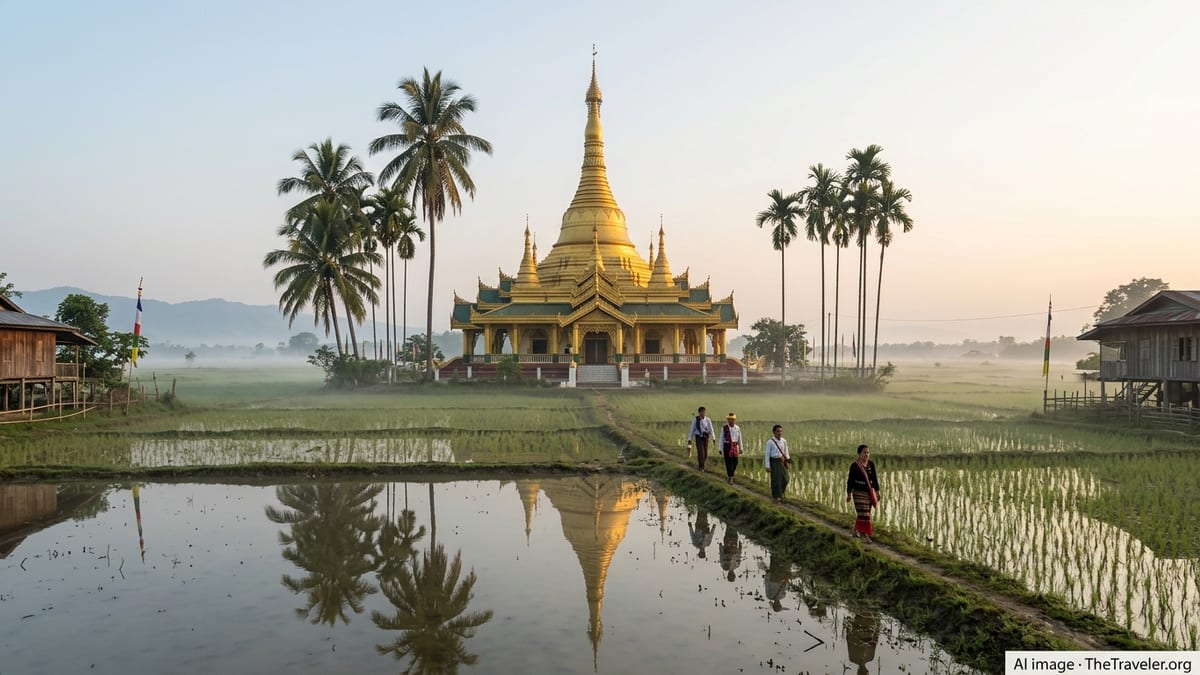
At the heart of Namsai’s tourism story is the Golden Pagoda, or Kongmu Kham, a Burmese-style Theravada Buddhist monastery set amid landscaped grounds at Tengapani. Opened in 2010 on a large temple complex, the gleaming structure has become one of the most recognisable images of Arunachal Pradesh, frequently featured in regional media coverage of the state’s cultural heritage and travel potential.
The monastery’s role has expanded beyond a religious landmark into a year-round cultural hub. Coverage in regional newspapers describes how the complex now hosts international editions of the Maha Sangken festival, a water-splashing new year celebration associated with the Tai Khamti community. The festival, upgraded in recent years to attract visitors from beyond India’s Northeast, blends processions, rituals, food stalls and performances, positioning Namsai as a niche center for Theravada Buddhist and Tai cultural tourism.
Other events, including Tai Khamti New Year celebrations and planned activities such as the Golden Pagoda Marathon, have been promoted as tools to raise the district’s tourism profile while encouraging youth participation. Public information from cultural commentaries notes that the pagoda complex also houses educational and heritage initiatives, reinforcing its image as a living campus rather than a single monument.
District tourism materials present these festivals as anchor experiences within a broader “Land of Pagodas” narrative, in which monasteries, traditional villages and riverside retreats are marketed together. This approach aims to lengthen visitor stays and distribute spending across homestays, local eateries and craft producers in surrounding communities.
Homestays, River Tourism and Community Enterprises
Beyond headline cultural sites, Namsai’s growth strategy leans heavily on small-scale, community-run tourism infrastructure. An official district tourism overview highlights the potential of village-based stays, handloom and handicraft experiences, and nature excursions along the Lohit and other rivers, with communities positioned as direct beneficiaries.
A project launched with support from national development finance institutions in late 2022, documented by local media, focused on promoting tribal ecotourism around Namsai through riverside eco-huts and interpretive nature activities. The initiative brought together an umbrella organisation of stakeholders to manage bookings, guides and maintenance, reflecting a shift toward more organised community enterprises rather than ad hoc resort construction.
Riverside retreats and day-use resorts around Namsai and nearby Chongkham have since grown in popularity, according to travel commentary and social media discussions. Visitors are increasingly drawn to low-rise cottages on stilts, bamboo walkways, and open dining decks overlooking the braided channels and sandbars of the Lohit. Many of these properties are either owned by local families or rely on village-level supply chains for food, transport and cultural performances.
Homestays are another key pillar. While state-level coverage often highlights other districts where homestay licensing is just beginning, Namsai’s own plans, as described in regional tourism meetings, point to an integrated approach where basic hospitality training, digital promotion and responsible tourism guidelines are introduced together. This model is intended to keep visitor experiences authentic while setting shared standards for quality and environmental care.
Linking Tourism to Inclusive, Sustainable Growth
Namsai’s tourism push is unfolding alongside broader development programmes that seek to improve living standards and public services. National coverage of “aspirational district” initiatives has noted that Namsai and neighbouring Chongkham have received recognition for progress on key indicators, from health and education to basic infrastructure. Local commentators argue that tourism, handled carefully, can help consolidate these gains by providing non-farm employment and adding value to traditional skills.
Policy discussions in Arunachal Pradesh increasingly frame tourism as a tool not only for revenue, but also for social objectives such as tackling youth unemployment and reducing drug dependency in vulnerable communities. Earlier reports from the region describe how adventure activities, guiding and hospitality work were explored as alternatives for at-risk young people, with Namsai mentioned as a district where such ideas could be scaled up around river, forest and cultural assets.
At the same time, voices from civil society and online forums caution against unregulated resort growth, pointing to environmental pressures on rivers and forests in parts of the Northeast. Commentators warn that poorly planned construction and waste management could undermine exactly the landscapes that draw visitors in the first place. These concerns have fed into a stronger emphasis on eco-tourism principles and carrying-capacity based planning in recent meetings involving Namsai and neighbouring districts.
State-level biodiversity and planning documents published in 2025 highlight the need for green infrastructure, plastic reduction and careful visitor management across eastern Arunachal. In Namsai, district narratives now routinely reference cleanliness drives, tree-planting efforts and riverbank restoration alongside the promotion of homestays and festivals, signalling a desire to embed sustainability early in the growth curve.
Positioning the “Land of the Rising Sun” for the Future
Geographically, Namsai sits within the belt of eastern Arunachal that has long marketed itself as the “Land of the Rising Sun,” a reference to the first rays of dawn touching India’s easternmost ridges. While nearby locations such as Dong and Walong are often cited as prime sunrise-viewing spots, Namsai’s road links, cultural sites and riverine landscapes give it a complementary role as an accessible base for wider exploration.
Government-approved project notes for new roads in the district describe tourism as a major rationale for investment, particularly in connecting Golden Pagoda and surrounding villages to broader circuits that reach pilgrimage sites such as Parshuram Kund and wildlife-rich areas around Wakro. By improving last-mile access while promoting village-based stays and local guides, planners aim to capture the economic benefits of through-traffic that once bypassed the district entirely.
Commentary in regional newspapers and travel blogs portrays Namsai as a “district on the rise,” with tourism development going hand in hand with advances in agriculture, education and digital connectivity. The district’s branding as a peaceful confluence of pagodas, rivers and paddy fields appeals to travellers seeking slower, more immersive experiences rather than fast-moving sightseeing tours.
As interest in Northeast India grows among domestic and international visitors, Namsai’s experiment with community-driven tourism offers a glimpse of how frontier regions can manage that demand. By foregrounding cultural festivals, homestays, riverside ecotourism and youth engagement, the district is positioning itself not just as a picturesque stop in the Land of the Rising Sun, but as a case study in how tourism can be woven into a broader, locally anchored growth story.