

I have used both Nanaimo and Courtenay as bases while exploring central Vancouver Island, bouncing between ferries, mountain trails, quiet beaches and small-town breweries.
On paper they look similar: mid sized cities on the sheltered east coast, within striking distance of Parksville, Qualicum Beach and Strathcona Provincial Park.
In reality, they feel very different, and the choice between them shaped my trips far more than I expected.
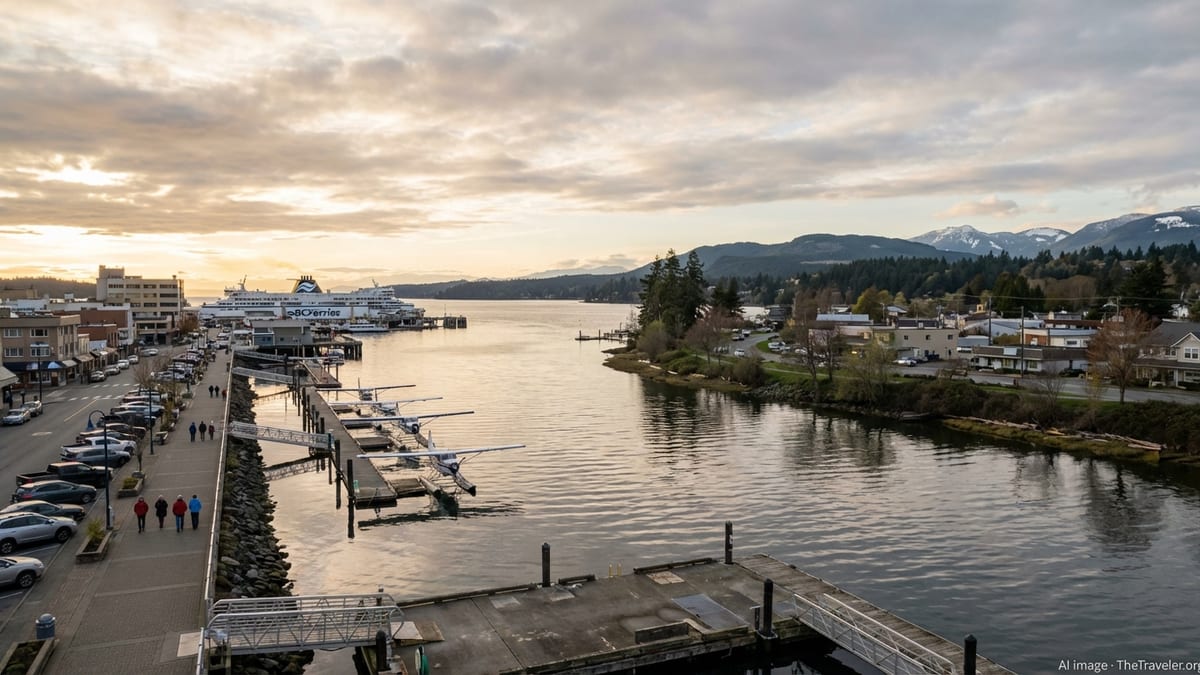
First Impressions and Overall Vibe
Arriving in Nanaimo by ferry feels like stepping straight into the Island’s main transport hub. Departure Bay is only a few kilometres from downtown, and I was in my hotel less than 15 minutes after walking off the ship. My first impression was of a working city wrapped around a pretty harbourfront. The waterfront promenade, the float planes and the cluster of restaurants gave it an almost mini Vancouver feel, but a few blocks inland it quickly shifted to big box stores and practical, everyday life. Nanaimo never tried to charm me; it just got on with things, which can be either refreshing or underwhelming depending on your expectations.
Courtenay, by contrast, felt immediately smaller and more relaxed. Driving in from Highway 19, I crossed the river and rolled into a compact downtown of low rise buildings, local shops and leafy side streets. Within minutes I was walking between a bakery, a gear store and the river walkway. The Comox Valley has a subtle resort energy, with Mount Washington and Comox’s marina close by, but Courtenay itself still feels like a community town first. I noticed more people out walking and cycling, and less traffic stress than in Nanaimo.
In terms of atmosphere, Nanaimo felt like a practical base with some scenic pockets, while Courtenay felt like a lifestyle base for people who prioritise nature and a slower rhythm. I enjoyed both, but I found myself lingering in Courtenay’s cafés longer and using Nanaimo more as a springboard to other places.
Location, Driving Times and Getting Around
On a map, Nanaimo sits closer to the geographic centre of the Island’s populated east coast, and that matters if you plan to do a lot of day trips in different directions. From Nanaimo, I could reach Parksville in about 30 minutes, Qualicum Beach in under 45, and Chemainus and Ladysmith to the south in similar times. Following the main highway north, Campbell River was roughly 1 hour 40 minutes away and the turnoff to Mount Washington about 1 hour 15 minutes, based on current drive estimates. That centrality made it easy to adjust plans based on weather and energy; I did not feel locked into one corridor.
Courtenay sits further north, about an hour and a quarter’s drive from Nanaimo along Highway 19 according to recent travel guidance. Once I based myself there, everything in the Comox Valley suddenly became incredibly close. The road up to Mount Washington Alpine Resort branches off near town and climbs about 25 kilometres into the mountains, which translated to roughly 35 to 40 minutes from my accommodation to the resort parking lot on a clear day. Campbell River was about 40 minutes to the north, and little spots like Miracle Beach and Saratoga Beach were easy half day outings. The tradeoff was that anything south of Qualicum started to feel like a bit of a haul.
My biggest “decision moment” came when planning a week that combined hiking in Strathcona Provincial Park with relaxing beach days. When I mapped it out in detail using current drive times, Courtenay clearly won for mountain access, while Nanaimo was better for hopping between more communities. In the end, I split the week in two bases, but if you prefer not to move hotels, choosing between north focused adventures and a more distributed itinerary will probably decide it for you.
Ferries, Flights and Arrival Logistics
For anyone coming from the Vancouver area or the mainland, Nanaimo is simply unrivaled as a transport hub. Right now there are two main BC Ferries routes connecting Vancouver to Nanaimo: Horseshoe Bay to Departure Bay and Tsawwassen to Duke Point, operating several sailings daily according to current schedules. On my most recent trip, I also made use of a new seasonal direct sailing from Tsawwassen to Departure Bay that runs once daily in summer late afternoons, which added some flexibility but also forced me to pay extra attention when booking because the ship only went one way on that schedule.
The reality on the ground is that Departure Bay and Duke Point feel completely different as foot passenger arrivals. Departure Bay is roughly 3 kilometres from downtown Nanaimo and has regular BC Transit bus service right at the terminal, with a direct route to the city centre currently listed as Route 20. In practice, I was able to hop on a bus within about 20 minutes of disembarking. Duke Point, by contrast, sits around 16 kilometres south of downtown with no public transit service at all according to the latest Island transportation information. When I arrived there without a car on an earlier trip, I had to pre arrange a taxi and still waited longer than I liked because vehicles were limited, which made that arrival feel stressful and expensive.
Courtenay does not have a ferry terminal of its own, so you inevitably pass through Nanaimo by car or bus first. The drive from Nanaimo to the Comox Valley along Highway 19 took me about 1 hour 15 minutes under normal conditions, which matched current guidance reasonably well. There is a regional airport at Comox with direct flights from Vancouver and other cities, and on one trip I actually flew into Comox and rented a car there, skipping Nanaimo entirely. That worked smoothly, but for most international visitors who are already routing through Vancouver, Nanaimo remains the more straightforward gateway, especially if you want the flexibility of multiple sailings per day.
Costs, Accommodation and Day to Day Convenience
In terms of accommodation costs, I found both cities more expensive in peak summer than I expected, but Nanaimo was generally a bit more forgiving if I booked last minute. The city has a wider range of mid range chain hotels and motels spread along the highway and near the harbour, and I could still find something in the mid price band a few weeks out, even in July. The tradeoff was character: many Nanaimo options were purely functional, with parking lots for views. When I did splurge on a harbourfront room, the water views and easy access to the seawall were genuinely lovely, but the price jumped enough that I would only do that again for a short stay.
Courtenay’s accommodation scene felt more limited but more curated. There are a few well known riverfront hotels, a scattering of smaller motels and bed and breakfasts, and some resort style stays closer to Comox or along the water. Booking for August, I ran into more “sold out” messages than in Nanaimo, especially for weekends, and prices on what remained were not cheap. That said, the quality of the stays I did manage to book was generally higher in terms of room design and setting. My riverfront hotel in Courtenay cost more per night than a comparable chain in Nanaimo but felt like a place I actually wanted to spend time, not just sleep.
Day to day convenience leans slightly toward Nanaimo. Big supermarkets, outdoor gear stores, hardware chains and medical services are all clustered within easy driving distance, and parking was almost always free and plentiful once I left the very core of downtown. Courtenay has everything I needed, but there were moments, like hunting for a specific piece of camera gear, when I realised I might have to wait until I was back in Nanaimo or Victoria. If you like to keep options open and do not want to pre plan every purchase, Nanaimo’s larger retail footprint is a real plus.
Nature Access, Activities and Seasonality
Both cities give you excellent access to classic central Vancouver Island scenery, but in slightly different flavours. From Nanaimo, I found myself doing more coastal and forest day trips. Parksville and Qualicum Beach were easy drives for long sandy beaches and calmer water. Short hikes to places like Englishman River Falls and Little Qualicum Falls slotted nicely into half day outings. Even longer drives north to Campbell River or south toward Duncan stayed below the two hour mark, which gave me the flexibility to chase better weather when one area was socked in.
Courtenay, on the other hand, is the natural choice if mountains and alpine landscapes are a priority. Mount Washington Alpine Resort sits roughly 25 to 30 kilometres west of town along a steep, winding access road. That translated into just over half an hour of climbing drive for me on dry summer pavement, plus a bit of extra time in winter when conditions were more variable. From there, both the ski hill and Strathcona Provincial Park trailheads are within reach. I used Courtenay as a base for multiple days of hiking in Strathcona, and the ability to return to a real town in the evening instead of a purely resort setting made a big difference to the feel of the trip.
Seasonality plays out differently between the two. Courtenay and the Comox Valley have a typical coastal British Columbia climate with mild but wet winters and pleasantly warm, relatively dry summers, according to recent climate summaries and average temperature data. In July and August I enjoyed comfortable highs in the low 20s Celsius and long daylight hours. Winter brings more rain and some snow at lower elevations, but Mount Washington can see substantial snowfall, turning Courtenay into a genuine ski base. Nanaimo shares similar coastal conditions but without the same immediate alpine access. In deep winter, I would pick Courtenay every time for snow sports, but in shoulder seasons when weather is mixed and I want options, Nanaimo’s more varied day trips win out.
Food, Culture and Crowd Levels
Nanaimo’s food scene surprised me, but not always in the way I hoped. There are a decent number of independent cafés, pubs and a few creative restaurants clustered around the Old City Quarter and harbour, and I had some excellent coffee and solid pub meals. At the same time, I ran into more chain dining and generic bar food than I expected for a city of its size. On busy summer weekends, some of the more interesting spots filled early, and without a booking I ended up defaulting to whatever still had tables. It was convenient but not particularly memorable. For nightlife, Nanaimo has more options, but they are spread out and sometimes felt more oriented around students and locals than visitors.
Courtenay felt smaller but more cohesive in terms of food and drink. Downtown, I found a compact cluster of cafés, bakeries, breweries and casual restaurants within walking distance of each other. The selection is not huge, and places can close earlier than in Nanaimo, but most of the spots I tried were clearly run by people who live in the valley and care about what they are serving. I ended up returning to the same café multiple mornings simply because the atmosphere and coffee were that good. If you need highly varied international dining, you may find Courtenay limited; if you are content with a handful of strong local options, it works very well.
Crowd levels were another contrast. Nanaimo’s waterfront and ferry terminals can feel busy and slightly hectic in peak season, especially when multiple sailings arrive close together. Driving near the terminals around departure times involves a lot of lane changes and quick decisions. Courtenay, even when clearly in its own summer peak, felt less pressured. Parking downtown was easy, trailheads in the Comox Valley region did not feel overrun, and there was usually a quiet corner in any café. If you are sensitive to crowds and want that “small town but not remote” feeling, Courtenay has the edge.
Safety, Transport and Practical Tradeoffs
On both trips I felt generally safe in Nanaimo and Courtenay, walking around during the day and in the early evening. Nanaimo has more visible urban issues, particularly in parts of downtown away from the main harbourfront, including some open substance use and street disorder. It rarely felt threatening, but it did change how comfortable I was walking alone late at night on quieter streets. Courtenay’s downtown, while not perfect, felt calmer and more low key, with fewer of those moments where I instinctively crossed the street or put my camera away.
Public transport is a subtle but important differentiator. Nanaimo’s regional transit network makes it possible to move between downtown, Departure Bay and major shopping areas without a car, and the bus from downtown to the ferry took the stress out of at least one departure for me. Just be aware that the system does not currently serve Duke Point, and evening frequencies can drop, so late sailings will still require private transport. Courtenay’s local transit exists, but it is less intuitive for a visitor, and I found myself relying on a car much more there. If you are traveling without a vehicle, Nanaimo is far more workable as a base.
One key decision moment for me was whether to rent a car for the entire trip or just for the days I left town. In Nanaimo, I experimented with skipping a car for the first couple of days, using buses and walking the waterfront before picking up a rental for day trips. That worked, but it limited my evening range. In Courtenay, I would not repeat the no car experiment. The distance to key hikes, beaches and Mount Washington, combined with more limited regional transit, meant a vehicle felt essential. If your budget only allows a rental for part of the time, spend those days based in Courtenay where you will use the car more intensely, and keep your car free days to Nanaimo.
The Takeaway
Having tested both cities as bases, I no longer see Nanaimo and Courtenay as interchangeable pins on the map. Nanaimo is the pragmatic choice: richer in transport options, slightly easier on last minute costs, and better positioned for travellers who want to sample multiple communities along central Vancouver Island without changing hotels. It is not the Island’s prettiest town once you leave the waterfront, and some parts of downtown can feel rough around the edges, but as a staging point for ferries, buses and road trips, it does its job well.
Courtenay, by contrast, excels as a base for a more focused, outdoors heavy trip. Its proximity to Mount Washington and Strathcona Provincial Park, the manageable drive to Campbell River and the quieter small town atmosphere make it ideal if your priorities are hiking, skiing, biking or paddling rather than ticking off a long list of towns. The downside is higher pressure on availability in peak season, fewer budget beds, and a practical need for a car almost every day.
If I were planning a first time visit to central Vancouver Island, arriving by ferry and wanting maximum flexibility with minimal logistics, I would start with Nanaimo, perhaps adding a night or two in Courtenay as a side trip if the mountains call. For a repeat visit focused squarely on alpine trails, winter sports or a slower pace, I would skip the Nanaimo hotels altogether, drive straight through and settle into Courtenay for the week. Both cities are worth your time, but they shine under different priorities, and being honest about what you actually want out of your days will make the decision much easier.
FAQ
Q1. Which is better as a base for first time visitors to central Vancouver Island, Nanaimo or Courtenay?
Nanaimo generally works better for a first visit because it is directly connected to Vancouver by multiple ferry routes, has more accommodation variety, and sits in a more central position for day trips north and south. Courtenay is excellent, but it shines more once you know the region and want to focus on the Comox Valley and nearby mountains.
Q2. If I want to ski or snowboard at Mount Washington, should I stay in Nanaimo or Courtenay?
For Mount Washington, Courtenay is clearly the better base. The access road to the resort branches off near town and the drive is typically about 35 to 40 minutes in good conditions, rather than over an hour and a quarter from Nanaimo. You can still stay in Nanaimo and day trip, but it means more winter highway driving and earlier starts.
Q3. How do ferry options differ between staying in Nanaimo and staying in Courtenay?
Nanaimo has two BC Ferries terminals, Departure Bay and Duke Point, with regular sailings from the Vancouver area and an additional seasonal sailing to Departure Bay in summer. That makes arriving and leaving straightforward and gives some backup options when sailings sell out. Courtenay has no ferry terminal, so you must pass through Nanaimo by road or use flights into nearby Comox instead.
Q4. Is it realistic to visit without a car if I base in Nanaimo or Courtenay?
In Nanaimo, it is possible but limiting. There is public transit between downtown, Departure Bay and some commercial areas, and you can join tours for certain excursions. In Courtenay, a car is much more important because regional transit is sparse and most hiking, beach and mountain destinations are spread out. I would not personally choose to base in Courtenay without a vehicle.
Q5. Which city feels safer and more comfortable to walk around in the evening?
I felt generally safe in both, but Courtenay’s compact downtown and quieter streets felt more relaxed overall. Parts of Nanaimo’s downtown away from the waterfront have more visible street disorder and can feel a bit edgy at night, especially if you are not used to urban environments. Sticking to the harbourfront and busier areas in Nanaimo made evenings feel comfortable.
Q6. Where should I stay if I want mainly beaches and gentle walks rather than big hikes?
If your priorities are beaches like Parksville and Qualicum and short, easy walks, Nanaimo is usually the more efficient base. You can reach several east coast beaches within 30 to 45 minutes and still have urban conveniences at the end of the day. Courtenay gives access to some great coastline too, but it comes into its own more when you add mountains and longer hikes into the mix.
Q7. How far in advance should I book accommodation in Nanaimo and Courtenay in summer?
In July and August, I would aim to book at least several weeks ahead in both cities, and longer if you are picky about location or style. Nanaimo’s larger hotel inventory means you can sometimes find last minute rooms, although prices may spike. Courtenay has fewer options, and the nicer riverfront and boutique style places can book out early, especially on weekends and during peak times at Mount Washington.
Q8. Which base gives better access to Campbell River and north Island trips?
Courtenay has the edge here. Campbell River is roughly 40 minutes’ drive north of Courtenay, making it an easy half day trip or a simple jumping off point for whale watching and wildlife tours. From Nanaimo, the drive is closer to 1 hour 40 minutes, which is still manageable but more tiring for frequent visits.
Q9. Are there big differences in weather between Nanaimo and Courtenay?
The climates are broadly similar, with mild, wet winters and comfortably warm summers, but Courtenay’s proximity to higher terrain and Mount Washington makes snow in the nearby mountains much more significant in winter. In practical terms, that means more reliable winter sports from Courtenay, while Nanaimo feels more purely coastal year round.
Q10. If I only have four or five days, is it worth splitting time between Nanaimo and Courtenay?
With four or five days, I would usually pick one base to avoid losing time to packing and moving, unless you have very specific goals. If your plans mix beaches, ferries and flexible day trips, base in Nanaimo. If the highlight for you is getting into Strathcona Provincial Park or skiing at Mount Washington, base in Courtenay. I only split my stays once I had a week or more to play with.