

More news on this day
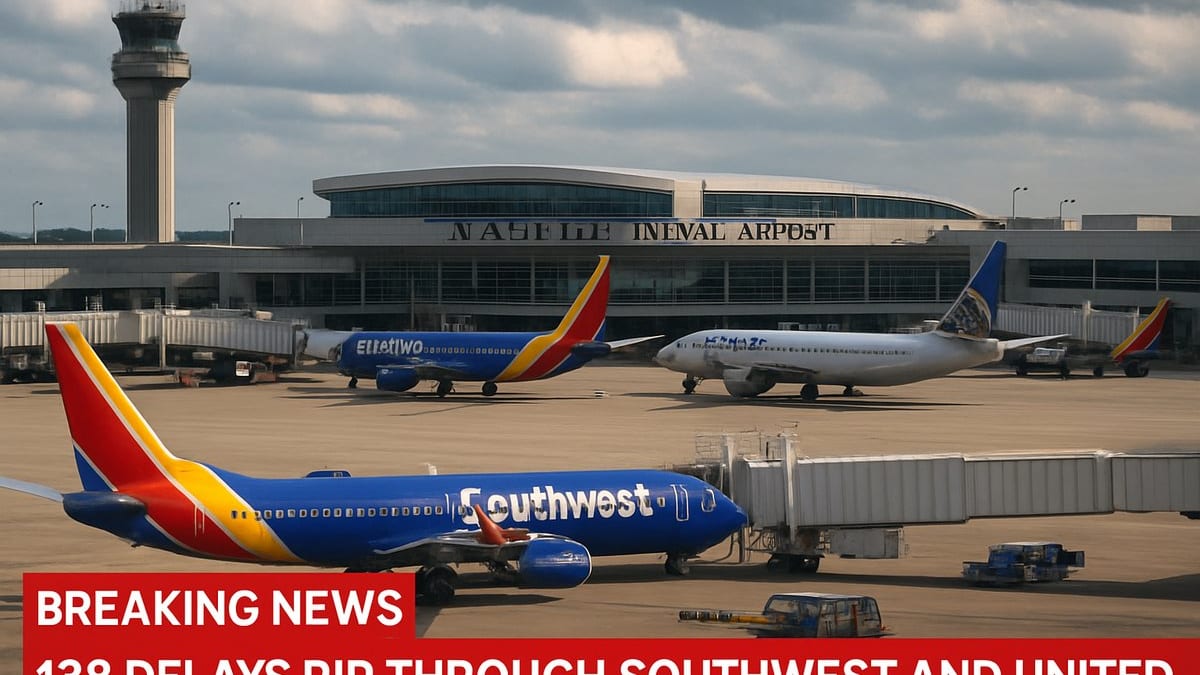
Nashville International Airport is facing another disruptive travel day as publicly available flight-tracking data show 138 delayed departures and arrivals linked to Southwest Airlines and United Airlines, compounding a broader wave of schedule turbulence across U.S. hubs this week.
Get the latest news straight to your inbox!
Spring Disruption Wave Reaches Nashville
The latest disruption comes amid an already fragile spring travel period in the United States, with operational strains and active weather patterns driving elevated delay numbers across multiple airports. Coverage of national flight performance in early April points to widespread slowdowns at major hubs including Chicago, New York, Atlanta and San Francisco, and Nashville has now emerged as one of the secondary hotspots within this pattern.
Data compiled from real time status boards and flight-tracking dashboards on April 3 and April 4 indicate that Southwest and United services at Nashville International Airport have shouldered a significant share of that burden. The 138 delays tied to these two carriers span a mix of point to point and hub connecting routes, affecting both early morning departures and peak afternoon and evening waves.
Analysts who track airline reliability note that Southwest in particular has been under pressure during the 2026 disruption wave, recording elevated delay counts at other key stations such as Chicago Midway, New York LaGuardia and Los Angeles International. United, operating a traditional hub and spoke model, has simultaneously been dealing with knock on effects radiating out of its core hubs in Chicago, Denver, Houston and Newark.
Weather, Congestion and Network Complexity Combine
The disruption at Nashville is unfolding against a backdrop of unsettled weather across the eastern half of the country and lingering operational challenges following the late winter and early spring storm season. Recent severe weather systems, including heavy rain around Nashville and snow and wind further north, have periodically reduced arrival and departure rates at several major airports. When those constraints overlap with peak travel days, ripple effects can spread quickly through airline networks.
Industry research into delay propagation patterns over the last decade has highlighted how security queues, runway capacity, and gate availability can interact with airline scheduling choices to amplify relatively small disruptions. Nashville’s growing role as a mid continent connecting point, along with its construction and expansion activity, places additional stress on ramp space and gate utilization during busy banks, raising the risk that late inbound aircraft will translate into late departures throughout the day.
Southwest’s point to point model, widely used on routes into and out of Nashville, is particularly sensitive to this kind of cascading effect. When one aircraft falls behind schedule on an early segment, subsequent flights using that same airframe can inherit increasing delays as the day progresses. United’s connecting traffic through larger hubs faces a different vulnerability: congestion or ground delays at hubs can strand aircraft and crews that are scheduled to operate later Nashville legs.
Impact on Travelers Moving Through BNA
The immediate impact for travelers at Nashville International Airport has been familiar but frustrating. Reports from the airport describe crowded gate areas, extended lines at concessions, and passengers searching for scarce same day alternatives as delays accumulate. With many flights on both Southwest and United reported as significantly late rather than canceled, passengers are often left waiting for aircraft and crews rather than being fully rebooked.
Travelers connecting through Nashville have been especially exposed. Even short outbound delays from origin cities can cause passengers to miss tightly timed connections, and the current pattern of widespread disruptions across multiple hubs reduces the pool of available backup options. This is particularly challenging on heavily trafficked business routes linking Nashville with Chicago, New York, Washington and Texas cities, where aircraft are already operating near capacity in the spring shoulder season.
Airport level statistics published for recent months underline how such disruption days can skew overall performance metrics. While Nashville has generally maintained solid throughput growth, spikes in delay totals such as those now affecting Southwest and United quickly translate into higher average delay minutes per passenger and increased pressure on airport services, from baggage operations to ground transportation.
Broader Strains on Southwest and United Networks
The situation at Nashville is one localized expression of a broader strain on the networks of Southwest and United during early 2026. Travel and aviation coverage in recent days points to hundreds of delays across both carriers nationwide, driven by a combination of residual staffing tightness, aircraft positioning challenges and intermittent weather constraints at critical hubs.
Southwest’s recent operational history has been characterized by high schedule density at a relatively small number of focus airports, a strategy that supports frequent service but offers limited slack when irregular operations arise. As disruption days accumulate, the airline’s on time performance metrics at stations like Nashville tend to lag their historical norms, even if long term cancellation rates remain comparatively low.
United, meanwhile, continues to balance strong demand at its main hubs with infrastructure and airspace constraints that are slow to resolve. When Chicago O’Hare, Newark or Houston experience air traffic control restrictions or ground stops, the resulting backlog of delayed departures and arrivals can echo into secondary markets such as Nashville for many hours. Flights scheduled to originate or terminate at Nashville may then launch late, further contributing to the 138 delay tally affecting the airport during this disruption window.
What Passengers Can Do on a Disrupted BNA Day
For travelers already booked on Southwest or United itineraries touching Nashville, operational experts emphasize preparation and flexibility on days when disruption indicators are rising. Monitoring flight status through airline channels and independent flight-tracking platforms can provide early warning of mounting delays and help passengers make decisions about rebooking options before alternative flights fill.
Arriving at the airport with additional time, especially for morning departures following a difficult operational evening, can also reduce stress by allowing for slower than usual check in and security processing. Publicly available advice from airlines and aviation consumer advocates continues to recommend that travelers maintain updated contact information in their reservations and consider carrying essential items in hand baggage in case of missed connections or unexpected overnight stays.
As the spring travel season continues, Nashville International Airport’s experience with this wave of 138 delays on Southwest and United flights highlights how quickly conditions can change across the national air system. Even without extensive cancellations, a single day of concentrated delays at one airport can reverberate across multiple states, underscoring the importance for travelers of staying informed and building contingency time into their journeys.