

More news on this day
Hundreds of passengers across the United States and Canada were left confused and stranded on Sunday after a fresh wave of disruptions linked to Nashville International Airport rippled through major hubs from Atlanta and Chicago to Toronto, with 144 flights delayed and 67 canceled at the Tennessee gateway alone.
Chain Reaction From Music City to Major Hubs
The latest disruption centers on Nashville International Airport, where a mix of operational bottlenecks and lingering weather-related constraints pushed the airport to log 144 delayed departures and arrivals alongside 67 outright cancellations, according to live tracking data and airline updates on March 8. Though conditions in Nashville improved through the morning, the knock-on effect quickly spread across the broader US and Canadian network.
Routes connecting Nashville with Atlanta, Chicago, Orlando, Detroit, St. Louis, Charlotte and Toronto were among the hardest hit, as airlines attempted to reset schedules after aircraft and crews fell out of position. Hub airports already grappling with their own weather and capacity pressures were forced to absorb late-arriving jets from Tennessee, leading to rolling gate changes and extended waits on the tarmac.
In Atlanta, one of the world’s busiest passenger hubs, carriers continued to report triple-digit delays and more than a hundred cancellations as operations struggled to recover from a turbulent weekend across the Southeast. Similar patterns emerged in Chicago and Orlando, where thunderstorms and low ceilings earlier in the week had left schedules fragile and highly sensitive to further disruption.
Toronto Pearson and other Canadian gateways also saw the ripple effect. Flights inbound from Nashville and other US cities arrived late or were scrubbed altogether, complicating connections for transborder travelers attempting to reach destinations across Canada or onward to Europe and the Caribbean.
Passengers Confront Confusion and Patchy Information
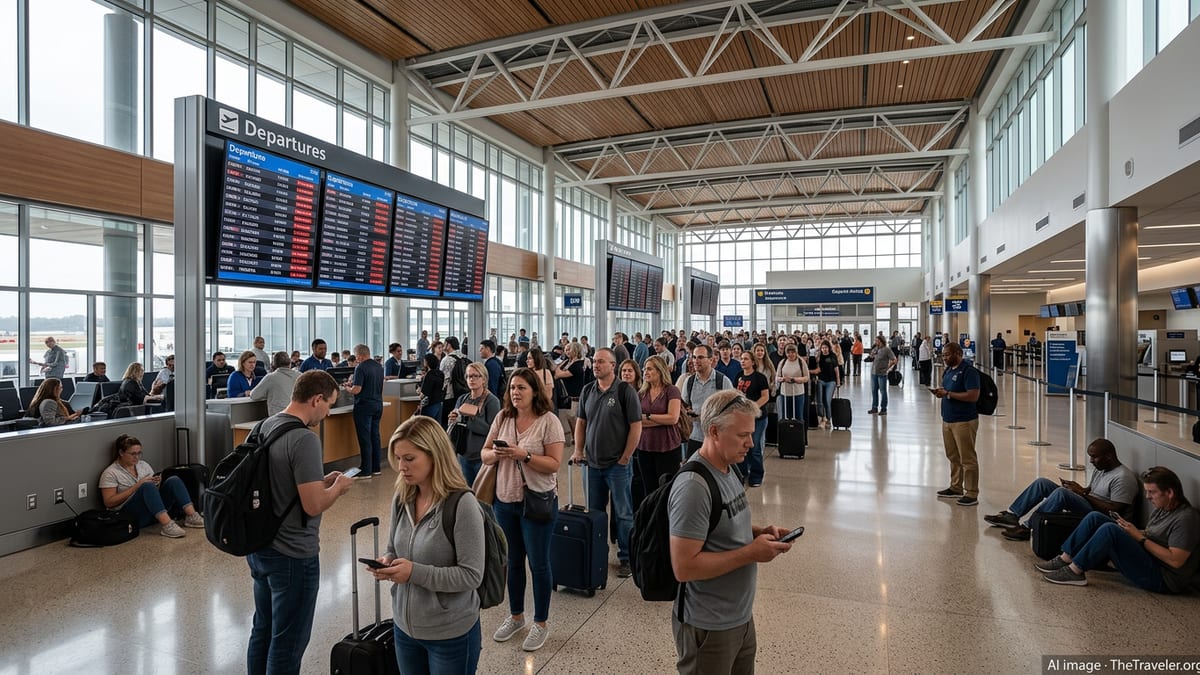
For passengers, the operational story translated into hours of uncertainty. At Nashville, travelers described departure boards that shifted by the minute, with flights cycling from “on time” to “delayed,” then abruptly to “canceled” as airlines reassessed weather windows and crew availability. Long lines formed at rebooking counters while call centers buckled under a surge of change requests.
That confusion extended across the network. In Atlanta and Chicago, passengers arriving from Nashville reported being held on taxiways while gate assignments were reworked to accommodate late aircraft. In some cases, travelers missed onward connections to smaller US cities after arriving more than an hour behind schedule, forcing unexpected overnight stays and last-minute hotel searches.
In Orlando and Detroit, families starting or ending spring getaways found themselves stuck in congested concourses as carriers tried to consolidate lightly booked flights and free up aircraft for busier routes. The frustrations were echoed in Toronto, where travelers coming off delayed US flights were funneled into already busy customs halls, compounding wait times and heightening anxiety about missed connections.
Although airlines urged passengers to rely on mobile apps for real-time updates, many reported that digital information lagged behind on-the-ground decisions, leaving travelers unsure whether to remain at their gates, seek meal vouchers or attempt to switch to alternative routes through other hubs.
Security Diversion Adds to Nashville Travelers’ Frustration
The operational strain coincided with heightened nerves following a security-related diversion of a Southwest Airlines flight that departed Nashville bound for Fort Lauderdale on Friday evening. That flight was forced to land in Atlanta after crew reported a possible security concern involving a passenger, prompting law enforcement to meet the aircraft upon arrival and remove an individual for further questioning.
While authorities later emphasized that the flight landed safely and the situation was contained, the incident contributed to a tense atmosphere for passengers traveling through Nashville and Atlanta over the weekend. Some travelers, already facing long delays, described seeing additional police and security patrols at gates serving Florida-bound routes.
Southwest and other airlines operating in and out of Nashville reiterated that safety remained their top priority, even as they apologized for the cascading delays and cancellations that followed. The diversion temporarily removed an aircraft and crew from the already stretched network, adding another layer of complexity to the schedule recovery at both Nashville and Atlanta.
For passengers caught in the middle, the conflation of security concerns and widespread delays deepened the sense of bafflement, with many questioning why relatively routine schedule disruptions could spiral into a full-day ordeal across multiple hubs.
Why the Delays Spread So Quickly
Aviation analysts note that hubs such as Atlanta, Chicago, Charlotte and Toronto are designed to work as finely tuned systems, where delays at one spoke airport like Nashville can quickly cascade if they coincide with weather, staffing shortages or air traffic control constraints elsewhere. When one element falters, crews and aircraft may arrive minutes or hours late, throwing off banked connections across an entire region.
In this case, the disruptions in Nashville collided with lingering congestion related to recent storms across parts of the Midwest and Southeast, as well as seasonal staffing and runway-capacity pressures at major hubs. Once multiple flights missed their scheduled arrival and departure slots, airlines were forced into a reactive posture, shuffling aircraft, combining lightly booked flights and prioritizing long-haul or high-demand routes.
That interdependence was particularly evident in Detroit and St. Louis, where flights to and from Nashville rely heavily on tight connection windows at larger hubs. Even relatively modest delays of 30 to 40 minutes out of Tennessee were enough to break those connections, stranding passengers or sending them on circuitous routings through secondary airports.
Toronto’s role as a key transborder and international gateway magnified those impacts for Canadian travelers. Late arrivals from Nashville and other US cities translated into missed connections to domestic destinations such as Montreal and Calgary, as well as onward flights to Europe and sun destinations that typically operate with limited daily frequencies.
What Travelers Should Watch for in Updated Schedules
As airlines work to stabilize operations, passengers are being urged to check updated schedules repeatedly on March 8 and into March 9, particularly if they are connecting through the affected hubs. The most vulnerable services continue to be short-haul flights linking Nashville with Atlanta, Chicago, Orlando, Detroit, St. Louis, Charlotte and Toronto, where aircraft and crews remain slightly out of position.
Industry observers say carriers are likely to publish rolling updates throughout the day, canceling some lightly booked flights in advance in order to protect the punctuality of core routes during the evening peak. Travelers who see their flights still listed as “on time” are advised to monitor status closely and consider arriving at the airport earlier than usual in case of last-minute gate or timing changes.
For those already stranded, rebooking options may improve as the day progresses and more aircraft return to their regular rotations. However, with weekend loads high and many services already near capacity, securing alternate seats on direct flights between Nashville and major hubs could remain challenging into Monday.
While conditions at Nashville had begun to show signs of gradual improvement by midday, the events of the weekend underscore how quickly a localized setback in the US can spread across borders to impact Canadian travelers as well. For now, passengers across North America remain watchful for the next round of updated lists from airports and airlines, hoping they bring clarity rather than more confusion.