

More news on this day
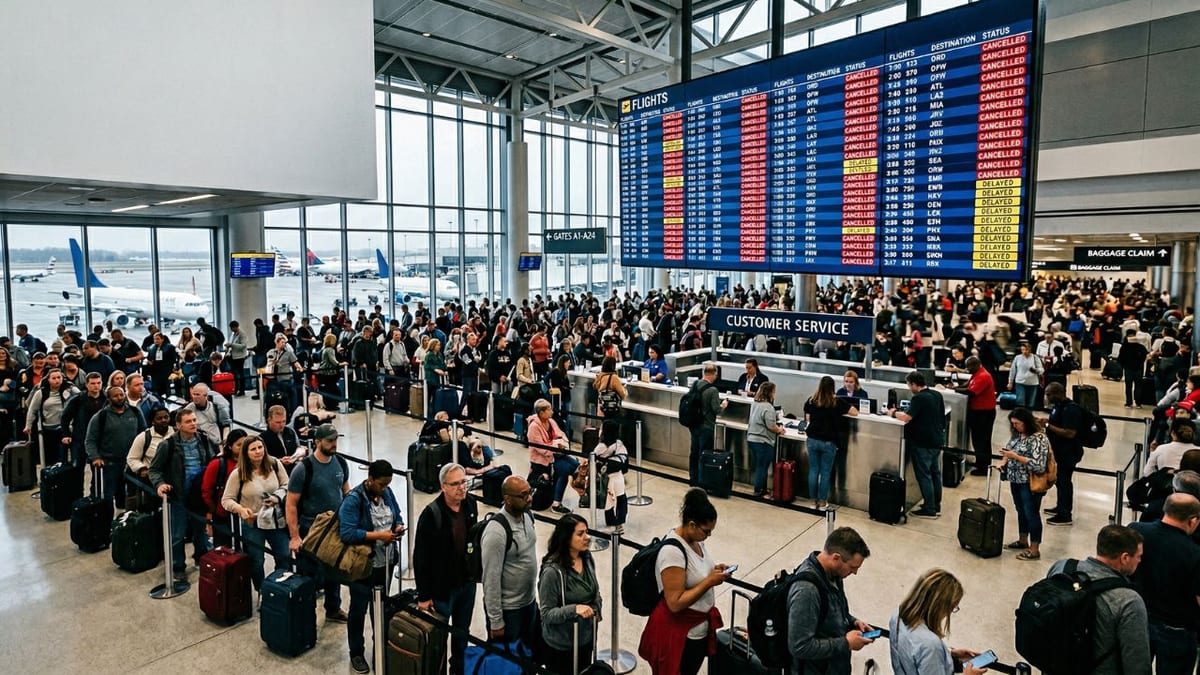
A fresh wave of aviation disruption across the United States has triggered 114 flight cancellations and 3,440 delays at 27 major airports, snarling operations at hubs from New York and Los Angeles to Seattle, Miami, Orlando and Atlanta and upending travel plans for an estimated 50,000 to 70,000 passengers.
Get the latest news straight to your inbox!
Nationwide Disruptions Ripple Across Key Hubs
Publicly available tracking data shows that the latest disruption has cascaded across the country’s busiest aviation corridors, concentrating cancellations and delays at a network of 27 large and mid-sized airports. Major hubs including New York area airports, Los Angeles International, Seattle-Tacoma, Miami International, Orlando International and Atlanta’s Hartsfield-Jackson have all reported elevated levels of operational strain compared with a typical weekday.
The figures of 114 cancellations and 3,440 delays place this event below the most extreme weather or technology-driven meltdowns in recent years, but still firmly in the category of a system-wide shock for passengers. Recent published coverage of similar days of turbulence has shown that a few hundred cancellations and several thousand delays are sufficient to overwhelm customer service channels and saturate available rebooking options during busy travel periods.
In practical terms, the disruption has meant hours-long waits in departure halls, rolling gate changes and a sharp increase in missed connections. Travelers heading through hub airports to smaller regional destinations have been particularly exposed, as even modest schedule tweaks at major nodes quickly deprive them of same-day alternatives.
Operational Strain Exposes System Fragility
Aviation analysts note that the pattern of widespread delays far outnumbering cancellations is consistent with what the US Department of Transportation classifies as national aviation system stress, where airports and airspace remain technically open but congestion, non-extreme weather and traffic management measures slow the entire network. Federal reporting has long highlighted how even relatively routine weather or staffing constraints can trigger knock-on effects across dozens of airports when capacity is already tight.
Recent seasonal data compiled from Bureau of Transportation Statistics records and industry reports indicates that US carriers have been operating close to their limits at many key hubs, with high load factors and densely scheduled banked departures. Under those conditions, any disturbance can force controllers to space out takeoffs and landings, extending taxi queues and airborne holding patterns and creating the kind of widespread delays now being seen.
Separate analyses of 2024 and 2025 performance have also underscored how quickly disruptions can escalate once ground delay programs or flow restrictions are introduced at one or more coastal hubs. When New York, Atlanta or key Florida airports slow down, connecting traffic across the country is pulled into the vortex, a dynamic that appears to be unfolding again as the latest statistics accumulate.
Major Airports Bear the Brunt
Within the latest disruption, large coastal and southern hubs have once again borne a disproportionate share of the impact. New York’s major airports, which already rank among the country’s most delay-prone facilities, have seen swelling departure and arrival queues, with published flight boards showing clusters of flights pushed back by 60 to 120 minutes during peak waves.
On the West Coast, Los Angeles and Seattle have reported mounting delays as congested departure banks and late inbound aircraft compress turnaround times. Industry data has consistently shown that when long-haul and transcontinental operations into these gateways fall out of sync, it becomes increasingly difficult for airlines to reposition aircraft and crews before the next peak of departures.
In the Southeast, Miami and Orlando continue to act as weather-sensitive chokepoints for both domestic and international leisure traffic. Recent travel coverage has documented multiple days this year when Florida hubs experienced hundreds of combined delays tied to storms, air traffic control constraints or residual congestion. Atlanta, the nation’s busiest hub by passenger volume, often serves as a barometer for network health, and elevated disruption there typically reflects broader stress across multiple carriers’ operations.
Passengers Face Missed Connections and Limited Alternatives
For passengers, the numerical tally of cancellations and delays translates into a spectrum of cascading difficulties. With tens of thousands of travelers affected in a single day, rebooking windows narrow quickly, especially on popular routes into and out of the highlighted hubs. Public guidance from airlines and travel insurers in recent months has emphasized the importance of allowing extra connection time and monitoring itineraries closely in this kind of environment.
Travel advocacy groups and consumer platforms that track flight reliability note that even when outright cancellations remain relatively low, large volumes of delays can still generate significant financial and emotional costs through missed connections, disrupted hotel stays and lost vacation time. Recent surveys have indicated that delay-related claims and complaints now rival cancellation grievances in many US markets.
The latest wave of disruption also raises renewed questions about passenger rights and compensation. US rules do not mirror European-style compensation frameworks, but the Department of Transportation has pressed carriers in recent years to expand customer care commitments during disruptions within their control. In complex events where delays stem partly from airspace management and partly from airline scheduling decisions, the lines of responsibility can be difficult for travelers to navigate without careful documentation of what went wrong.
Growing Calls to Strengthen Aviation Infrastructure
The recurrence of nationwide disruption episodes, even on days that fall short of record-breaking chaos, has fueled debate over the resilience of the US aviation system. Policy papers and industry commentary have increasingly pointed to a combination of factors, including aging air traffic control technology, staffing shortfalls, tight airline scheduling practices and mounting exposure to volatile weather patterns.
Federal initiatives are under way to modernize air traffic systems and train additional controllers, while major airports continue to invest in expanded gates, upgraded taxiways and new terminal capacity. However, many of these projects are multi-year efforts, and the benefits may not be fully felt for several peak travel seasons. In the meantime, observers expect intermittent episodes similar to the current one to remain a feature of the landscape rather than an exception.
For now, the figures of 114 cancellations and 3,440 delays across 27 major US airports serve as another reminder of how tightly coupled the nation’s aviation network has become. With passenger volumes continuing to grow and operational buffers stretched thin, even a single day of elevated disruption can ripple across the country, leaving tens of thousands of travelers contending with an increasingly fragile system.