

More news on this day
Thousands of rail passengers were stranded on Thursday across Italy’s main cities and tourist hubs, as a nationwide wave of cancellations and delays involving Trenitalia, Italo and the wider FS Group disrupted travel at the height of the Milano Cortina 2026 winter season.
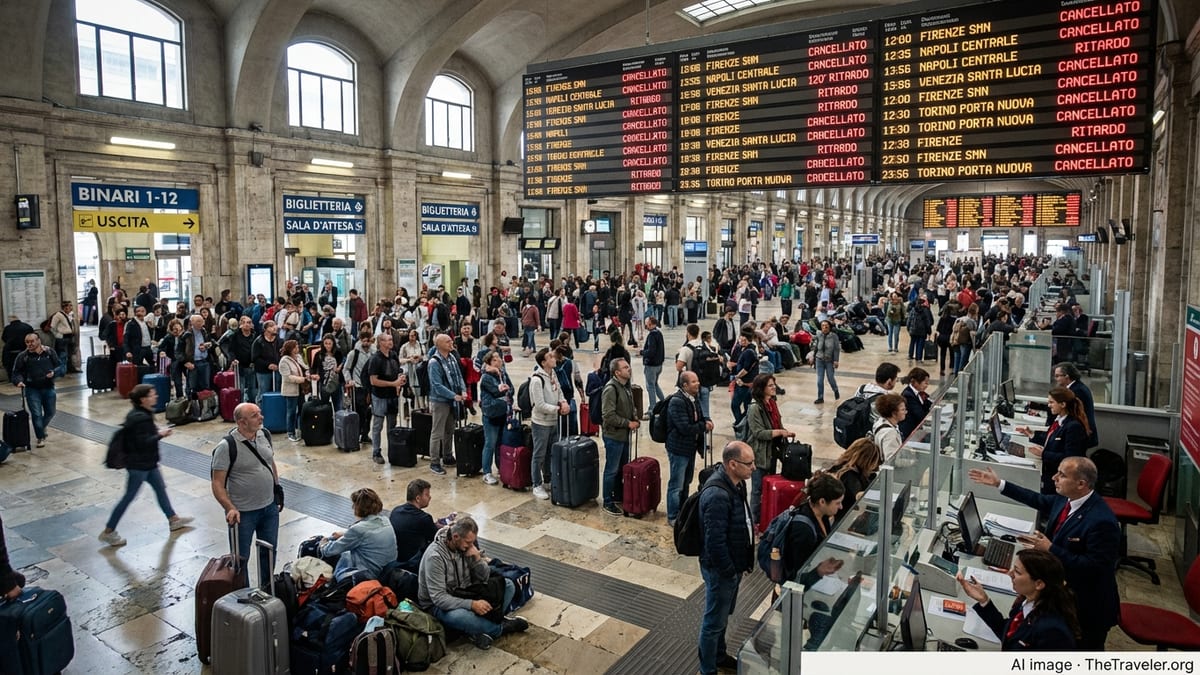
Major Hubs Brought to a Standstill
From Rome Termini to Milan Centrale and Venice’s Mestre and Santa Lucia stations, departure boards on Thursday filled with notices of cancelled and heavily delayed services as rail operators implemented strike schedules. Long queues formed at information desks and ticket offices, with many travelers reporting being unable to rebook until late Friday or Saturday because of limited guaranteed services.
In Venice, where rail links via Mestre and toward Marco Polo Airport are critical for visitor arrivals, passengers described crowded concourses and sporadic announcements in Italian and English, often giving only broad indications of when services might resume. Similar scenes were reported in Bologna and Naples, where high speed connections to the rest of the country were sharply reduced, forcing many passengers to wait for hours or seek last minute accommodation.
The disruption coincides with the build up to events tied to the Milano Cortina 2026 Winter Olympics, amplifying the impact on international visitors using Italy’s rail network to reach mountain venues and gateway airports. Tourism operators in Lombardy and Veneto warned that the cascading delays risked missed hotel stays and pre-paid excursions, adding pressure to an already stretched hospitality sector.
Smaller regional hubs, including cities in central and southern Italy, also reported rolling cancellations as strike participation rippled across the FS Group’s network. With some trains halted en route when the strike window began, passengers were left disembarking at intermediate stations and scrambling for alternative connections.
Coordinated Strike Action Across Trenitalia, Italo and FS Group
The latest disruption stems from a 24 hour national rail strike affecting personnel of Ferrovie dello Stato Italiane, including Trenitalia and infrastructure manager RFI, as well as private high speed operator Italo and other associated companies. The stoppage officially runs from 21:00 on Friday 27 February to 20:59 on Saturday 28 February, but knock on effects were already being felt by Thursday as operators adjusted timetables and positioned rolling stock.
Unions representing onboard and driving staff called the action over long running disputes on working conditions, staffing levels and safety guarantees, arguing that previous negotiations had failed to keep pace with the rapid expansion of high speed services and Olympic related traffic. FS Group, for its part, has emphasized that it will operate a network of guaranteed trains, particularly during commuter peak periods, but has warned that services will be “significantly reduced” nationwide.
Italo has also published a reduced timetable with only a portion of its high speed connections between major cities such as Rome, Milan, Venice and Naples operating. Many of those trains were reported fully booked well in advance, leaving late planners facing the prospect of remaining in place until after the strike or turning to buses and car hire, themselves under pressure from the surge in demand.
Authorities have urged travelers to consult operator channels and avoid heading to stations without confirmed reservations. However, with many tickets purchased weeks or months ago, particularly by international tourists unfamiliar with Italy’s strike procedures, the message has not reached everyone in time, contributing to chaotic scenes in several stations.
Recent Sabotage Heightens Infrastructure Strain
The strike comes less than three weeks after what Italian officials described as coordinated sabotage on key high speed corridors linking Rome with Naples and Florence, incidents that caused cable fires, forced diversions and hours long delays for thousands of passengers. Those attacks, which are under investigation by judicial authorities and were swiftly condemned by the transport minister as criminal acts, exposed vulnerabilities in a system already operating close to capacity during the winter season.
While no injuries were reported in the sabotage incidents, the resulting backlog of trains and rescheduling efforts left operators with limited flexibility heading into the current wave of industrial action. Infrastructure managers have been racing to complete repairs and reinforce monitoring, but many services remain subject to speed restrictions and altered routes, compounding the effect of the strikes on punctuality.
The combination of physical damage to infrastructure and nationwide labor unrest has had a particularly severe impact on long distance high speed routes that connect northern hubs such as Milan and Bologna with Rome and the south. Travelers on Thursday reported journey times stretching far beyond normal schedules, with some trains held outside major stations waiting for scarce platform capacity.
Industry observers note that the timing, coinciding with international attention on Italy as Olympic host, has raised political stakes. Officials have pledged increased vigilance along rail corridors and accelerated investments in resilience, but those measures offer little immediate comfort to passengers currently camped out on station floors or searching for scarce hotel rooms.
Tourists and Commuters Scramble for Alternatives
The sudden reduction in rail capacity has pushed thousands of commuters and tourists onto already busy roads, with rental cars, long distance buses and ride share services in and around Rome, Milan and northern Italy reporting a surge in demand. In some cases, the price of last minute bus tickets between major cities doubled compared with earlier in the week, while vehicle hire outlets at airports and near central stations signaled that they were close to fully booked.
Local public transport networks in Rome, Milan and Naples have also come under strain as stranded rail passengers turned to metro, tram and bus services to complete disrupted journeys. Municipal authorities warned of crowding on key urban routes, particularly those linking central stations to airports such as Rome’s Fiumicino and Venice’s Marco Polo.
At airports, arriving visitors found themselves unexpectedly stuck despite flights operating normally, as onward train connections collapsed. In Venice, some travelers resorted to taxis and private transfers from the airport to Mestre and further afield, while in Milan the shuttle routes between Malpensa, Linate and central rail stations saw heavy usage.
Tour operators and hotel associations have urged flexibility from rail companies on rebooking and refunds, arguing that clear, multilingual communication is essential to preserve Italy’s reputation as an accessible destination during a critical tourism period. Travel agencies are advising clients already in the country to allow far longer transfer times and, where possible, to keep itineraries flexible until normal services resume.
What Passengers Can Expect in the Coming Days
Rail operators have warned that disruption is likely to extend beyond the official end of the strike as they work to reposition trains and crews and clear the backlog of delayed services. Even after 20:59 on Saturday, passengers may face altered or cancelled departures, particularly on regional lines feeding into major hubs such as Bologna, Florence and Turin.
Trenitalia has indicated that essential regional services will be prioritized within protected time bands in the early morning and early evening, aiming to ensure basic mobility for commuters. However, off peak services are expected to be heavily thinned out, and some long distance links may not return to their full schedule until early next week.
Passenger rights rules allow for refunds or free rebooking in the event of strike related cancellations, and both Trenitalia and Italo have invited travelers who choose not to travel to request vouchers or full reimbursement. Consumer associations, however, have called for simplified procedures, noting that passengers stranded in stations with limited internet access or language barriers often struggle to navigate online forms and call centers.
With further transport strikes already announced in the aviation sector and local public transit over the same period, travelers in Italy are being urged to monitor official updates closely, keep digital copies of their tickets and, where possible, arrange flexible accommodation and insurance coverage. For now, though, the immediate challenge remains getting thousands of people in Rome, Milan, Venice, Bologna, Naples and smaller cities moving again on a rail network stretched to its limits.