

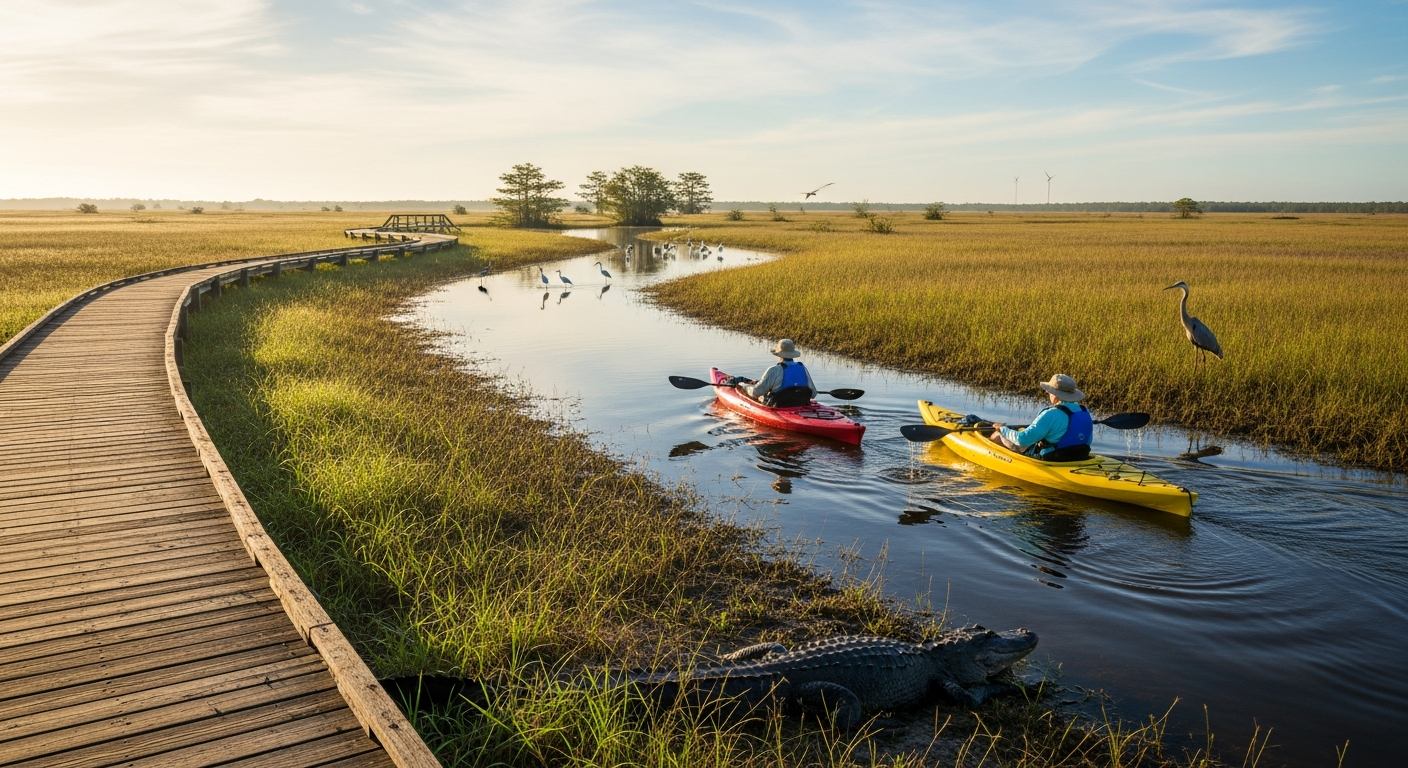
South Florida is often synonymous with beaches and nightlife, yet just beyond the high-rises lies one of North America’s most compelling wild frontiers.
From the broad river of grass that defines Everglades National Park to coastal mangrove forests teeming with life, this subtropical corner of the United States offers nature experiences that feel worlds away from the nearest resort.
Travelers who carve out time to paddle through mangrove tunnels, scan the horizon for roseate spoonbills or glide quietly past basking alligators discover a side of Florida shaped more by water, weather and wildlife than by concrete or crowds.
The Living Landscape of South Florida’s Wild Heart
To understand nature experiences in South Florida, it helps to picture the region not as separate parks but as one vast, interconnected ecosystem. The Everglades, Big Cypress, Biscayne Bay and the Florida Keys form a mosaic of freshwater sawgrass prairies, cypress domes, mangrove swamps and shallow coastal bays.
Water is the unifying thread: it seeps slowly south from the Kissimmee River basin toward Florida Bay, spreading like a sheet and dictating where plants grow, which animals thrive and when migrations occur.
This is also one of the most altered landscapes in the United States. A century of drainage canals, levees and urban expansion shrank and fragmented the Everglades.
Massive restoration projects are now underway to reestablish a more natural flow of water, reverse saltwater intrusion and improve habitat for threatened species.
Visitors today witness not only a functioning wild system, but also one of the world’s largest ecological restoration efforts unfolding in real time.
For travelers, these dynamics translate into a rich mix of experiences. In one day you might wake to the calls of wading birds in Everglades National Park, kayak through mangroves near Biscayne National Park and finish by scanning the night sky from a boardwalk in Big Cypress.
Each landscape tells part of the story of how South Florida’s waters shape its wildlife and how people are grappling with the pressures of climate change, sea level rise and invasive species.
Everglades Essentials: Seasons, Access and First Impressions
Planning an Everglades visit begins with the seasons. From roughly November through April, South Florida enters its dry season. Skies are typically clear, humidity is lower and wildlife congregates around remaining water sources, which makes animals easier to see.
Average daytime highs hover around the upper 70s Fahrenheit and nights can feel surprisingly cool. Mosquitoes are still present, especially around dawn and dusk, but far more manageable than later in the year. Park rangers and local guides widely consider this the best time for first-time visitors.
From May through November, the wet season transforms the landscape. Daily afternoon thunderstorms, frequent downpours and soaring humidity push heat indices into triple digits. Water levels rise, allowing fish and alligators to disperse and spreading wildlife out over a much larger area.
Mosquitoes and biting flies can be intense, and some visitor services and ranger programs scale back. For prepared travelers who embrace the heat and pack serious insect protection, the wet season offers lush greenery, dramatic skies and fewer crowds, but it demands more flexibility and resilience.
Most visitors access the park via three main gateways: the Ernest F. Coe Visitor Center near Homestead for the classic drive to Flamingo, Shark Valley off the Tamiami Trail for iconic views across the sawgrass prairie, and the Gulf Coast Visitor Center in Everglades City for boat-based exploration of the Ten Thousand Islands.
Each entrance reveals a different face of the Everglades, so building an itinerary that samples at least two gives a fuller picture of the ecosystem. Even a short boardwalk stroll can be eye-opening for travelers used to drier landscapes.
On the Water: Airboats, Kayaks and Quiet Marsh Trails
Water-based exploration defines the Everglades and nearby wetland areas. Airboats remain one of the most recognizable symbols of South Florida, with their shallow draft and roaring propellers skimming over sawgrass. While airboats are not permitted in the core of Everglades National Park, they operate extensively on adjacent state and tribal lands.
These tours can be a fast-paced introduction to the broader ecosystem, often featuring close-up views of alligators, wading birds and sawgrass prairies. Travelers who choose this option should look for operators that emphasize wildlife ethics, avoid deliberate harassment of animals and follow speed limits near rookeries.
For a more tranquil experience, paddling trails offer an intimate way to move through marshes and mangrove creeks. Canoe and kayak rentals and guided trips operate from several park and gateway communities, allowing visitors to glide quietly along tannin-stained water that reflects sky and vegetation.
In the Flamingo area, popular routes thread through mangrove channels and open into Florida Bay, while at Gulf Coast, paddlers can weave into the Ten Thousand Islands, a maze of mangrove islets rich in birdlife. Calm mornings are best, with minimal wind and softer light that brings out the colors of herons, egrets and spoonbills.
On land, boardwalks and short trails provide accessible ways to experience the ever-shifting wet and dry worlds. Shark Valley’s 15-mile loop road, which can be biked or explored via a tram tour, leads to a viewing tower with sweeping vistas across the river of grass.
Anhinga Trail near the Homestead entrance is renowned in the dry season for its concentration of wildlife, including alligators basking along the path, anhingas drying their wings and turtles floating near the surface. These developed sites can get busy, but they also showcase just how visible wildlife can be in a healthy wetland.
Mangrove Worlds: From Biscayne to the Ten Thousand Islands
If the sawgrass prairie is the face of the Everglades, mangroves are its protective edge. These salt-tolerant trees form dense forests along much of South Florida’s coastline, anchoring muddy shorelines and providing vital nurseries for fish, crustaceans and countless invertebrates.
For travelers, mangroves are the setting for some of the most atmospheric adventures in the region. Narrow tunnels of interlaced branches create shaded corridors that echo with bird calls and the gentle splash of paddles.
Near Miami, Biscayne National Park protects a largely aquatic landscape of coral reefs, seagrass beds and mangrove shorelines. Unlike many national parks, most of Biscayne is accessible only by boat.
Guided snorkeling trips and glass-bottom boat tours reveal underwater life on the offshore reefs, while kayaking along the fringes of the park offers a closer look at mangrove ecosystems.
Even a short paddle along the bayfront can reveal juvenile fish darting among roots, schools of mullet breaking the surface and glimpses of ospreys and pelicans hunting above.
Farther west, the Ten Thousand Islands region stretches between Everglades City and the Gulf of Mexico as a labyrinth of mangrove islets.
It is a paradise for sea kayakers and anglers, but conditions can be tricky: strong tides, changing winds and the sheer complexity of the waterways can challenge inexperienced navigators.
Many travelers opt for guided trips that blend wildlife viewing with lessons in reading tides, spotting channel markers and understanding how mangroves buffer the coast from storms. Overnight camping on designated chickees or shell mounds adds a sense of expedition to multi-day paddling journeys.
Mangroves also play an increasingly important role in discussions of climate resilience. Their root systems trap sediment and build elevation, helping buffer shorelines against erosion and storm surge.
They store significant amounts of carbon, making them a focus of conservation and restoration projects. As visitors drift through these shadowy corridors, they are also moving through one of the region’s front-line defenses against sea level rise and intensifying hurricanes.
Wildlife Highlights: Alligators, Manatees and Elusive Panthers
For many travelers, the draw of South Florida’s wild areas is the chance to see charismatic animals in their native habitats.
American alligators are the undisputed icons of the Everglades, often visible from roadside pullouts and boardwalks, especially in the dry season. They play a crucial ecological role by creating and maintaining “gator holes,” depressions that hold water longer than surrounding areas and provide refuge for fish, turtles and birds when water levels drop.
Observing these reptiles at a respectful distance offers a tangible connection to the workings of the ecosystem.
In the coastal zones and near power plant outflows during cooler months, manatees gather in warm waters. These gentle herbivores, often called sea cows, graze on seagrass beds and can sometimes be seen from shorelines, piers and slow-moving boats.
Regulations require vessels to reduce speed in posted manatee zones, and travelers should heed these rules both for the animals’ safety and to avoid fines. Guided boat tours frequently incorporate manatee viewing into their itineraries, especially in winter when the animals concentrate in predictable warm-water sites.
Birdlife is another highlight. The Everglades and surrounding wetlands host impressive numbers of wading birds, including great blue herons, snowy egrets, roseate spoonbills and the endangered wood stork. During the dry season, as water recedes and fish are concentrated, large mixed flocks gather at feeding sites.
Binoculars reveal subtle behaviors: spoonbills sweeping their distinctive bills through the water, egrets poised like living sculptures as they stalk prey. Overhead, swallow-tailed kites and bald eagles add to the spectacle during their seasonal appearances.
The Florida panther, a critically endangered subspecies of cougar, represents South Florida’s most elusive predator. Only a small population survives, mostly in and around Big Cypress National Preserve and nearby state lands.
Sightings are rare and should be considered an extraordinary bonus rather than an expectation. However, travelers often see signs of their presence: track imprints on muddy roads, posted panther crossing signs and displays in visitor centers that chronicle efforts to reduce vehicle collisions and restore habitat corridors.
Knowing these animals still roam the landscape adds depth to any visit, reinforcing the stakes of conservation work underway.
Conservation Challenges: Invasive Pythons and Climate Pressures
The same subtropical climate that nurtures mangroves and manatees also provides fertile ground for invasive species.
The most notorious is the Burmese python, a large constrictor snake introduced decades ago through the exotic pet trade.
These snakes have established breeding populations in and around the Everglades and prey heavily on native mammals and birds, contributing to steep declines in species such as marsh rabbits and raccoons.
Researchers and managers now describe them as one of the most destructive invasive reptiles in North America.
In recent years, Florida agencies and partners have expanded their python control efforts. Programs like the Python Action Team and regional elimination initiatives pay trained hunters to locate and humanely remove the snakes from public lands.
Seasonal events such as the Florida Python Challenge invite the public to compete in python removal after completing mandatory training.
Recent competitions have drawn hundreds of participants and removed record numbers of snakes, reflecting both the scale of the problem and growing public engagement in the issue.
Innovative tools are also emerging. Researchers and water management agencies have tested technologies that include radio-tagged “scout” snakes, improved thermal imaging, and even realistic animal decoys designed to lure pythons for capture.
While such methods have increased removal numbers, scientists acknowledge that eradication is unlikely. Instead, the goal is to suppress populations enough to give native species a better chance to recover.
For visitors, this reality underscores the importance of preventing new introductions of nonnative animals and plants, whether through released pets, aquarium species or contaminated boat equipment.
Overlaying the invasive species challenge is the broader pressure of climate change. Rising seas threaten low-lying coastal wetlands and mangroves, while stronger storms and shifting rainfall patterns test the resilience of restoration projects designed for a different baseline climate.
Saltwater intrusion into freshwater marshes alters plant communities and pushes wildlife to adapt or relocate. Travelers who return over a span of years may notice changes in shoreline profiles, vegetation patterns and seasonal water levels.
These visible shifts serve as reminders that South Florida’s wild places are dynamic, and that today’s conservation decisions will shape tomorrow’s visitor experiences.
Planning an Ethical and Rewarding Nature-Focused Itinerary
Designing a nature-focused trip to South Florida begins with honest assessment of interests and comfort levels. Families with young children and first-time visitors often do well focusing on short boardwalks, tram tours and half-day guided boat trips that provide structure and interpretation.
Independent travelers seeking a deeper immersion can build itineraries around sunrise photography sessions, full-day kayaking excursions or multi-day backcountry paddling and camping.
Regardless of style, allowing extra time around activities reduces stress and leaves space for unplanned wildlife encounters.
Responsible tour selection is key. Look for operators who limit group sizes, follow wildlife viewing guidelines, avoid feeding animals and are transparent about their environmental practices.
In mangrove and seagrass areas, companies that emphasize low-wake travel help protect fragile habitats from propeller scars and erosion.
When evaluating airboat tours on lands outside the national park, travelers can ask how operators manage noise and speed near bird nesting sites and whether they support local restoration initiatives.
Personal preparation makes a profound difference in comfort and impact. Long-sleeved, lightweight clothing, broad-brimmed hats and reef-safe sunscreen help protect against intense sun.
Quality insect repellent, and in wetter months head nets or bug-proof jackets, can turn a challenging outing into an enjoyable one. Refillable water bottles reduce plastic waste and keep visitors hydrated in the subtropical heat.
Sturdy footwear suited to wet conditions allows for boardwalks, short hikes and the occasional splash through shallow water without worry.
Travelers can also contribute positively by supporting conservation organizations, respecting closures that protect nesting sites or restoration areas, and reporting sightings of nonnative species to appropriate agencies where requested.
Choosing locally owned outfitters, lodges and restaurants in gateway towns spreads tourism benefits to communities that, in turn, have a strong stake in keeping surrounding ecosystems healthy.
Over time, such choices help ensure that the Everglades, mangroves and coastal wildlife remain vibrant for future generations.
The Takeaway
Nature experiences in South Florida defy the stereotype of the state as a purely beach and theme-park destination. In the Everglades, visitors step into a living river of grass where alligators engineer habitats, wading birds trace ancient migration patterns and water levels quietly choreograph seasonal change.
Along the coasts, mangrove forests stitch land to sea, sheltering juvenile fish and buffering communities from storms. Offshore, seagrass beds and shallow bays harbor manatees, dolphins and an array of birdlife that rewards patient observation.
These landscapes are not pristine in a nostalgic sense. They are working ecosystems, shaped by canals and levees, restoration projects, climate pressures and the constant tension between development and preservation.
Travelers who approach South Florida with curiosity and humility find that experiencing its wild places is as much about understanding these human influences as it is about spotting charismatic wildlife.
Each boardwalk, kayak route and lookout tower becomes a vantage point on one of the most ambitious ecological restoration stories in the world.
For visitors willing to slow down, travel in tune with the seasons and respect the rhythms of water and wildlife, South Florida offers a depth of experience that lingers long after the trip ends.
The call of a limpkin at dawn, the quiet glide of a manatee beneath a paddleboard or the sight of a distant panther crossing a road at dusk all weave into a narrative of resilience and interconnection.
In a region better known for its glittering coastline, these moments of wildness are a reminder that Florida’s greatest riches still lie in the subtle workings of its native landscapes.
FAQ
Q1: When is the best time of year to visit the Everglades for wildlife viewing?
Dry season from roughly November to April is generally the best time. Water levels are lower, wildlife concentrates near remaining wetlands, temperatures and humidity are more comfortable and insects are less overwhelming than in the wet season.
Q2: Do I need a car to explore South Florida’s nature areas?
A car is highly helpful, especially for reaching trailheads, visitor centers and boat ramps that are not well served by public transit. Some guided tours offer transportation from major cities such as Miami or Fort Lauderdale, but independent exploration is much easier with a vehicle.
Q3: Are airboat tours safe for wildlife and the environment?
Airboat tours can be conducted responsibly if operators follow speed limits, avoid disturbing birds and alligators and stay out of restricted zones. Because regulations differ inside and outside protected areas, travelers should choose companies that emphasize environmental education and comply with local rules.
Q4: How worried should I be about mosquitoes and biting insects?
Insects are part of the South Florida experience, especially from late spring through early fall and around dawn and dusk. With effective repellent, appropriate clothing and, in peak wet season, possible use of head nets in certain areas, most visitors manage them without major problems.
Q5: Can I see manatees and dolphins on the same trip?
Yes. Manatees are often visible in warmer coastal waters, springs and power plant outflows during cooler months, while dolphins can be seen year-round in bays and nearshore Gulf and Atlantic waters. Boat and kayak tours in areas like Biscayne Bay or the Ten Thousand Islands sometimes encounter both species.
Q6: Is it realistic to see a Florida panther during a short visit?
Panther sightings are rare even for locals and biologists. Most visitors should not expect to see one, though traveling at dawn or dusk on designated roads in panther country slightly increases the chances. Exhibits and ranger talks often provide the best way to learn about these cats.
Q7: What should I wear for kayaking in mangroves and coastal areas?
Lightweight, quick-drying clothing, sun-protective shirts, a hat with a brim, polarized sunglasses and sturdy sandals or water shoes work well. In colder months, a light layer for early mornings may be useful, while in warmer months extra attention to sun and insect protection is essential.
Q8: Are children welcome on Everglades and mangrove tours?
Many tours are family-friendly and welcome children, often with age-appropriate life jackets and shorter itineraries. When booking, families should ask about minimum ages, safety considerations and whether the pace and duration match their children’s attention spans and comfort levels.
Q9: How can travelers help with conservation while visiting?
Visitors can support conservation by staying on designated trails, respecting wildlife viewing distances, not feeding animals, choosing responsible tour operators, packing out trash and supporting local organizations involved in restoration and environmental education.
Q10: Do I need special permits for backcountry or overnight adventures?
Certain activities such as backcountry camping, overnight paddling routes or use of designated chickee platforms require permits or reservations, which can be limited and seasonally regulated. Travelers should check current requirements with the managing agency and secure necessary permissions well in advance of their trip.