

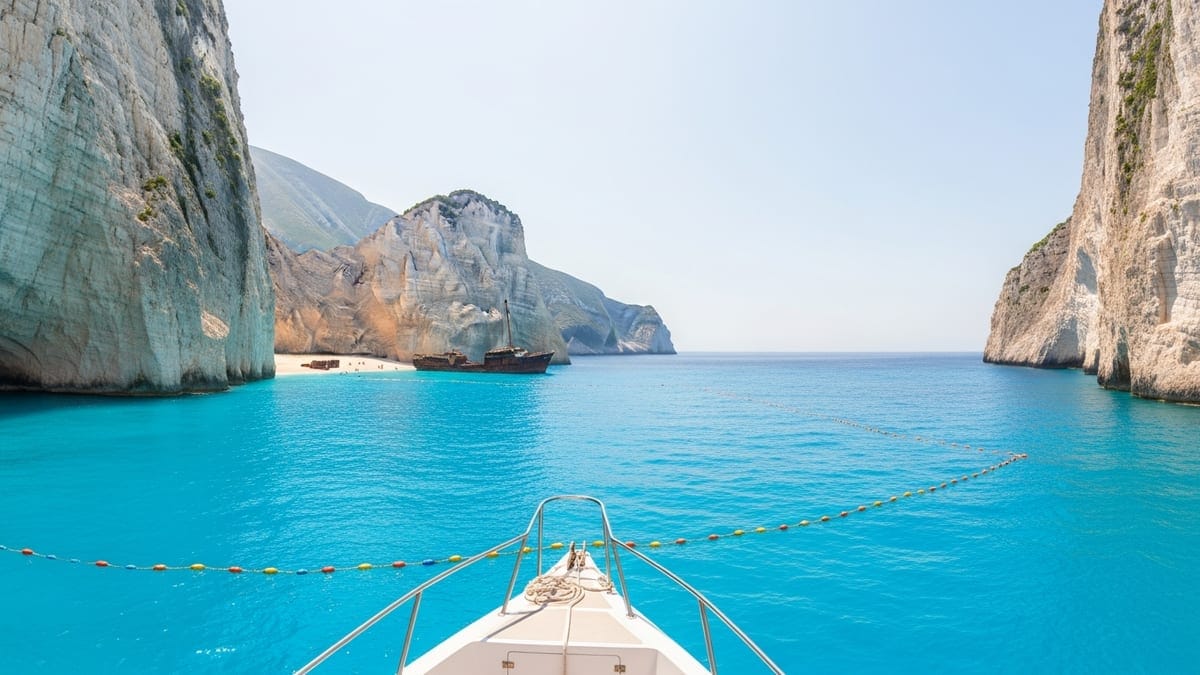
Navagio Beach, better known as Shipwreck Beach, has become an icon of the Greek islands and a dream image for travelers planning a holiday to Zakynthos, often called Zante. Turquoise water, a dramatic amphitheater of cliffs and the rusting hull of the MV Panagiotis combine to create one of the most photographed coves in Europe. Yet in recent years, landslide risks have transformed how visitors can experience this famous bay.
If you are hoping to see Navagio from Zante now, it is essential to understand the latest access rules, how boat tours work under safety restrictions and how to make the most of your visit while respecting both nature and local regulations.
Current Access Rules and Safety Restrictions at Navagio Beach
Before booking any trip to Navagio, travelers need to be aware that direct access to the beach itself is currently prohibited by Greek authorities due to ongoing landslide risks from the surrounding cliffs. A series of expert assessments and ministerial decisions, most recently renewed in May 2024, confirmed that visitors are not allowed to land on the sand, swim inside the cove or approach close to the cliffs. Vessels are barred from dropping anchor or entering beyond an imaginary line between the northern and southern ends of the bay, while approaching the beach from the cliffs above is also restricted to a controlled viewing area behind barriers.
These measures were introduced after a history of rockfalls, including a landslide in 2018 that injured visitors and another triggered by an earthquake in 2022. Experts from Greece’s seismic and civil protection authorities have concluded that erosion on the sheer limestone walls makes the risk of further collapse too high to allow crowds on the sand. For 2023 and again in 2024, the government extended a full closure zone that prioritizes human safety over tourism revenue. For travelers, this means that the classic experience of sunbathing beside the shipwreck or swimming ashore from a tour boat is, for now, off the table.
However, the closure does not mean Navagio has disappeared from the visitor map entirely. Regulations typically allow sightseeing boats to approach only up to the designated safe limit, where they may pause briefly so passengers can admire and photograph the bay from the water. Operators have had to adapt their itineraries, focusing more on blue caves, sea arches and nearby coves where swimming is permitted. Until further official announcements, visitors should plan around the assumption that any contact with the sand at Navagio remains prohibited and build their expectations accordingly.
The situation is dynamic, with Greek authorities considering long term management plans that include reinforced viewing platforms, managed visitor flows and, potentially, ticketed access overseen by the local municipality. Restoration and infrastructure works are expected to progress in the coming years. For now, the key for travelers is to treat any claim of “landing at Navagio” with skepticism, check that the tour description reflects current restrictions and understand that responsible operators will abide by safety rules even if that means staying offshore.
How Boat Tours to Navagio Work Today
Boat tours remain the main way to see Shipwreck Beach from Zante, even under the tighter safety regime. Instead of dropping passengers directly on the sand, reputable operators now offer coastal cruises that include a close, but legally compliant, approach to the bay. The boat usually slows or stops within the permitted safe zone just outside the closed area, giving everyone time to take photographs of the iconic panorama and learn about the history of the MV Panagiotis. Captains are careful to respect the imaginary line that defines the prohibited zone, and they avoid lingering too long in one place to prevent crowding.
Most tours combine the Navagio viewpoint with stops at other attractions, such as a network of blue caves, sea grottos and small pebble beaches along the rugged northwest coast of Zakynthos. Because guests can no longer disembark at Navagio itself, operators emphasize swimming and snorkeling opportunities in nearby coves where the sea is just as intensely blue, but the cliffs are considered stable. A typical shared boat excursion from a port like Porto Vromi Maries may last around three hours, with the Navagio photo stop forming just one part of a broader coastal experience.
Departure times tend to run throughout the day during the main season from late spring to early autumn, roughly from April or May through October, with more frequent sailings in the peak summer months. Smaller local boats and semi private or private charters often operate on a flexible schedule agreed directly with guests, while larger cruisers run on fixed timetables. In all cases, itineraries can change or be cancelled at short notice if the sea state is rough or visibility is poor, since the northwest coastline is exposed to swell and winds.
For visitors, the key practical point is that “Navagio tour” is now a shorthand for a scenic coastal cruise with an offshore view of the shipwreck, not a landing on the sand. When comparing offers online or in Zante’s resort towns, read descriptions carefully. Look for clear wording that reflects current rules, mentions swimming stops at alternative coves and highlights compliance with coast guard directives. Responsible operators typically mention that they will take you “close to Navagio for photos” rather than promising beach time.
Main Departure Ports: Where to Start Your Trip
The choice of departure port shapes not only the logistics of your day but also how you experience the coastline on the way to Navagio. The closest boat launches to Shipwreck Beach are found on the rugged northwest side of Zakynthos, especially Porto Vromi Maries and the small harbor area around Skinari and Agios Nikolaos in the north. From these points, boats reach the bay relatively quickly, allowing more time for exploring caves and swimming in nearby coves.
Porto Vromi Maries, tucked into a narrow fjord like inlet on the west coast, has become one of the most popular starting points for small and mid sized boats. The ride from here to the Navagio viewpoint can be as short as 15 to 20 minutes, depending on sea conditions, and many companies operate frequent departures throughout the day in high season. Facilities at Porto Vromi Maries are basic but practical, typically including parking areas, shaded waiting zones, simple snack kiosks and toilets. Because the harbor is compact and the surroundings are steep, it can feel crowded at busy times, but the closeness to the shipwreck area is a major advantage.
Further north, the harbor of Agios Nikolaos and the cape at Skinari serve as alternative departure points. Tours from this side often include the well known Blue Caves of northern Zakynthos as a major highlight, with Navagio as an additional scenic stop. The sailing time to the bay is longer than from Porto Vromi Maries, but the sea caves, arches and cliffs along this route are impressive, and it can be a good choice for those staying in the northeastern resorts. Facilities in these ports are slightly more developed, with tavernas, cafes and ticket booths lining the waterfront.
It is also possible to join larger all day cruises that depart from Zakynthos Town or the popular resort of Laganas. These vessels typically circumnavigate much of the island, calling at several swimming spots and making a distant approach to Navagio. Travel times are significantly longer, and the experience is more about a full day at sea than about extended time near the shipwreck. Travelers who prefer fewer hours on the boat and more intimate coastal scenery generally opt for departures from the island’s northwest instead.
Choosing the Right Boat Tour for Your Travel Style
With dozens of operators promoting Navagio excursions, it is important to choose a tour that matches your travel style, budget and expectations. Options range from large, multi deck cruisers carrying hundreds of passengers to small speedboats or traditional kaikia that take only a few people at a time. Each format has strengths and trade offs, especially now that actual beach landings are not possible.
Larger boats are often the most economical choice and can be convenient for families with small children or travelers who like more space to move around on deck. These excursions usually include commentary in several languages, on board snack bars and toilets, and plenty of shade. On the other hand, they cannot maneuver as nimbly in narrow caves or get quite as close to sea arches, and the atmosphere can feel more like a mini cruise ship outing than a secluded nature escape.
Smaller boats departing from ports like Porto Vromi Maries or Agios Nikolaos provide a more intimate experience, often with a captain who doubles as guide and storyteller. They are better suited to ducking into narrow caves, stopping in tiny coves and adjusting the itinerary slightly if sea conditions or crowding at a particular spot make a change desirable. Many travelers feel that on a small boat, the impact of seeing Navagio’s sheer cliffs and the color of the water is more intense. The trade off is less shade, fewer facilities and sometimes more motion from waves, which can be tiring for those prone to seasickness.
Private and semi private charters occupy a middle ground, offering flexibility and comfort at a higher price. These can be a good option for groups of friends, couples celebrating a special occasion or travelers who value control over timing, such as leaving very early in the morning or later in the afternoon to avoid the mid day heat and crowds. Under the current safety regime, even private boats must obey the same restrictions on approaching Navagio, but they can choose quieter swim stops and spend longer at favorite spots elsewhere along the coast.
What to Expect on the Day: Practical Tips and Sea Conditions
A typical Navagio boat trip from Zante begins with a drive from your accommodation to the departure port, often along winding mountain roads with scenic viewpoints. It is wise to allow extra time for this transfer, especially in high season when traffic and parking congestion can cause delays. Many tour companies offer optional hotel pickup and drop off, which can ease the logistics if you are unfamiliar with the island’s roads or prefer not to drive.
Upon arrival at the port, you usually check in at the company’s kiosk or office, then wait in a shaded area until boarding. Boats frequently depart on a rolling schedule, especially from smaller ports where vessels shuttle back and forth all day. Flexibility is important, as the exact timing or route may shift in response to changing winds, swell or coast guard instructions. Captains and crews receive updates on safety rules and weather, and they may shorten or skip certain sections if waves make them unsafe.
Sea conditions along the northwest coast can vary significantly. On calm days the water can feel like glass, and the approach to Navagio is smooth and gentle, ideal for photography. On days with strong northwesterly winds or residual swell from distant storms, waves can be choppy, especially when boats round exposed headlands. Those prone to seasickness should consider taking appropriate precautions before boarding, choosing seats toward the center of the boat and keeping eyes on the horizon.
Most tours include at least one or two swimming stops in coves where the water is calm and clear. Passengers usually enter the water via ladders at the stern or by carefully stepping down a few steps. Buoyancy aids may be available, but it is wise to confirm this in advance if you are not a confident swimmer. Crew members typically brief guests about staying close to the boat, avoiding rocky sections and being aware of other vessels in the vicinity.
What to Bring and How to Prepare
Even if you are only planning a half day tour, being well prepared can significantly enhance your experience of visiting Navagio by boat. Sun exposure is intense on the open water, especially from late spring through early autumn, and the white cliffs around the bay reflect light back onto the boat. High protection sunscreen, a wide brimmed hat, polarized sunglasses and light, long sleeved clothing are essential for comfort and safety. Applying sunscreen at least 20 minutes before you board helps avoid slippery decks and handrails.
The minimal facilities on board mean you should bring your own water bottle and snacks, even if your chosen company sells drinks or light refreshments. Hydration is particularly important if you plan to swim at multiple stops. A quick drying towel, swimsuit worn under your clothes and a change of dry clothing for the return journey all make the day more pleasant, especially if there is a breeze on the way back.
For photography, a camera or smartphone with a waterproof case is strongly recommended. Salt spray is common near cliffs and caves, and small splashes are hard to avoid even on calm days. Polarizing filters can help bring out the intense blue of the water in your shots. If you plan to use a drone, be aware that local regulations and safety rules may restrict or forbid drone flights around Navagio and other sensitive coastal areas, and heavy fines can apply for violations.
Finally, bring a patient mindset. The popularity of Navagio means boats often cluster in the wider vicinity of the bay, and captains must navigate carefully among other vessels while staying outside the prohibited zone. Wait your turn at the prime photo angle, follow crew instructions when moving around on deck and respect that safety considerations always come before the perfect selfie.
Looking Ahead: Future Plans and Sustainable Visitation
The long term future of visitor access to Navagio Beach remains a subject of active discussion in Greece. On one side, the shipwreck cove is a vital symbol in the tourism marketing of Zakynthos and a significant draw for local businesses. On the other, the combination of steep, unstable cliffs and increasing visitor numbers has made unmanaged access untenable. Recent proposals from national and local authorities envisage a more controlled model, with improvements to viewing platforms above the bay, reinforced safety barriers and a managed ticketing system.
Under one draft framework, the area surrounding Navagio would be formally entrusted to the municipality of Zakynthos, which would be responsible for setting ticket prices and overseeing infrastructure such as pathways, retaining walls and public facilities. Part of the ticket revenue would support environmental protection and maintenance, while another portion would go to national coffers. Importantly, the plan emphasizes that any use of the area must not undermine public access or safety and that all works must be completed before full reopening to mass tourism.
For travelers, this likely means that the experience of Navagio will continue to evolve over the coming years. It is possible that controlled land based access to designated safe zones on the beach may eventually resume under strict limits on numbers and behavior, while the popular cliff top viewpoint will be reengineered to protect both visitors and the fragile landscape. Boat approaches may be further refined with clearer zoning, time slots or caps on daily visitor numbers to reduce crowding and wake damage.
In the meantime, the most responsible way to visit is to support operators who prioritize safety and environmental stewardship, respect all barriers and signs, and treat the bay as a dramatic natural amphitheater to be admired from a respectful distance. Navagio’s beauty is inseparable from the geological forces that created it, and a sustainable future depends on accepting and working within that reality rather than trying to bend it to mass tourism’s demands.
The Takeaway
Visiting Navagio Beach from Zante today is a very different experience from the carefree landings of a decade ago, but it remains a powerful highlight of a trip to Zakynthos when approached with informed expectations. Travelers can still marvel at the rust stained hull of the MV Panagiotis framed by towering white cliffs and electric blue water, capture unforgettable images from an offshore vantage point and enjoy swimming in nearby coves where the sea is equally inviting.
The key to a rewarding visit lies in respecting the current closure of the beach itself, choosing reputable boat operators who follow safety rules, and seeing Navagio as part of a wider exploration of Zakynthos’s rugged northwest coastline. Prepare carefully for sun and sea conditions, allow flexibility for weather and operational changes, and embrace the slower, more contemplative way of experiencing this famous bay that recent years have made necessary.
In the coming seasons, management plans and infrastructure upgrades may gradually reshape how the world visits Shipwreck Beach, perhaps introducing controlled tickets, improved viewing platforms and new safety measures. Until then, a boat tour from Zante offers a safe and responsible way to witness one of Greece’s most iconic coastal landscapes, proving that even with restrictions in place, the magic of Navagio still endures.
FAQ
Q1: Can I currently walk on the sand at Navagio Beach or swim there?
As of early 2026, authorities prohibit all access to the sand and water inside the Navagio cove due to landslide risk. Visitors cannot land on the beach, swim there or approach close to the cliffs, and boats must stay outside a defined safety line.
Q2: Do boat tours from Zante still go to Navagio if the beach is closed?
Yes, most tours still include Navagio as a highlight, but they now stop only in the permitted offshore zone for viewing and photography rather than dropping passengers on the sand. Operators have adapted routes to focus more on sea caves and alternative swimming coves nearby.
Q3: Where is the best place on Zakynthos to join a Navagio boat tour?
The closest departure points are on the northwest and north coasts, especially Porto Vromi Maries, Agios Nikolaos and the Skinari area. These ports offer relatively short sailing times to the bay and good access to nearby caves and coves.
Q4: How long does a typical Navagio boat trip take?
Shared boat excursions that focus on Navagio and surrounding caves usually last about three hours. Longer full day cruises from Zakynthos Town or resort areas may take six to eight hours as they include more extensive coastal touring and swimming stops.
Q5: Is it safe to visit Navagio by boat given the landslide issues?
Current restrictions are designed to keep visitors in zones assessed as safe by experts, away from the unstable cliff base. When you travel with a licensed operator who follows coast guard rules and avoids the prohibited zone, the experience is considered safe under normal sea conditions.
Q6: What should I bring with me on a Navagio boat tour?
Essential items include high protection sunscreen, a hat, sunglasses, a swimsuit, a quick drying towel, water and snacks, and a waterproof case for your phone or camera. If you are prone to motion sickness, consider taking medication in advance, and always wear appropriate footwear for wet decks.
Q7: Are there toilets and shade on the boats and at the ports?
Larger cruise style boats almost always have toilets and shaded deck areas. Smaller boats often rely on simple shore facilities at ports such as Porto Vromi Maries, where you will usually find basic toilets, some shade structures and small kiosks, but less in the way of full services.
Q8: Can I visit the famous cliff top viewpoint above Navagio?
Authorities have restricted access to the cliff edge and viewing platforms to maintain safety, limiting visitors to specific fenced areas set back from the precipice. You should follow all signs, barriers and instructions and never cross safety lines or climb over railings for photographs.
Q9: Are there plans to reopen Navagio Beach for swimming in the future?
Greek officials are working on long term management plans that include stabilizing infrastructure and controlled visitor access, but no firm date has been set for reopening the beach for swimming. Any future access is likely to be tightly managed, with caps on visitor numbers and strict safety rules.
Q10: Is a Navagio boat tour still worth it if I cannot step on the beach?
Many travelers find that the offshore view of the shipwreck framed by towering cliffs, combined with swimming in nearby turquoise coves and exploring blue caves, still makes the tour highly worthwhile. If you approach it as a scenic coastal cruise rather than a beach day, Navagio remains one of Zakynthos’s most memorable experiences.