

More news on this day
China’s rapid expansion of visa-free entry and long-stay transit options is transforming how visitors plan trips in 2026, but the patchwork of rules means careful preparation is still essential.
Get the latest news straight to your inbox!
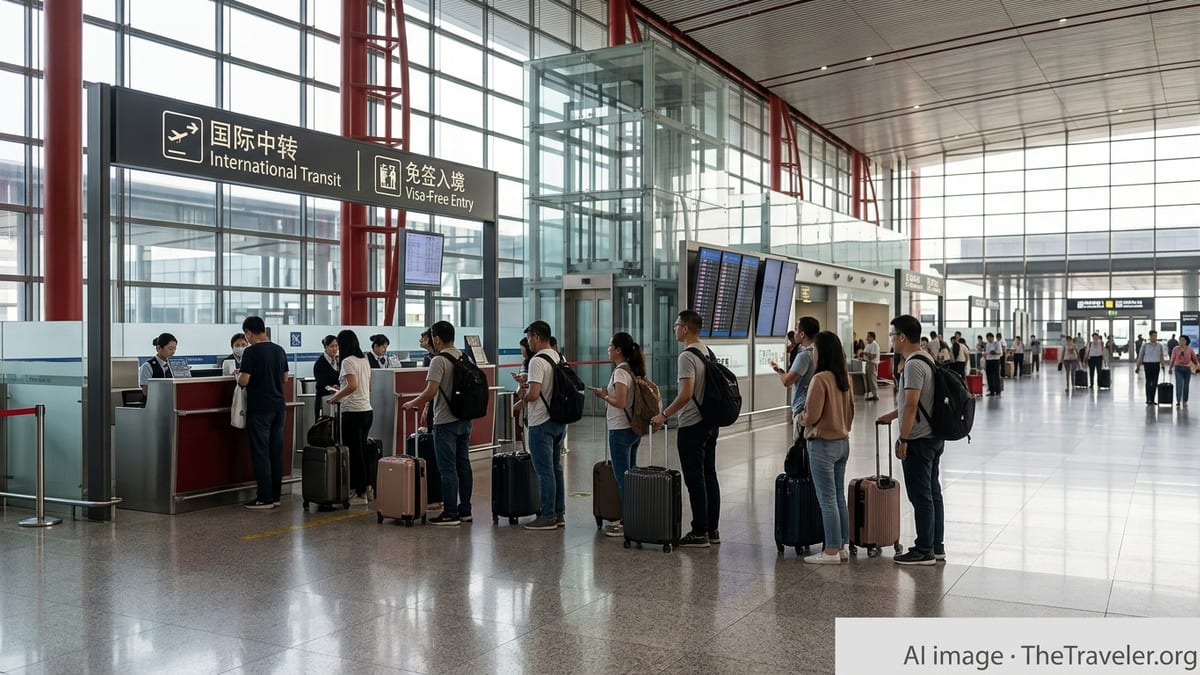
China’s 30-Day Visa-Free Push in 2026
China has turned short-term visa-free entry into a centerpiece of its tourism strategy, extending and consolidating a 30-day stay regime for many countries through the end of 2026. Publicly available policy summaries indicate that ordinary passport holders from dozens of nations in Europe, Asia, Oceania, the Americas and the Middle East can now enter mainland China without a visa for up to 30 days per visit. The move builds on successive trial programs introduced since late 2023 and expanded through 2024 and 2025.
Reports from international news outlets describe a sharp rise in inbound numbers following these changes, with millions of travelers entering under visa-free schemes in 2024 and 2025. Chinese immigration data cited in recent coverage points to double-digit growth in foreign arrivals, suggesting that the simplified entry is succeeding in drawing back tour groups, independent travelers and business visitors after the pandemic slump.
The 30-day limit is notably longer than the early waves of pilot programs, which often capped stays at 15 days. The increase to one full month gives visitors more flexibility to combine major city breaks with additional destinations such as secondary coastal cities, mountain regions or historical inland hubs. It also makes visa-free entry more practical for conferences, trade fairs and academic exchanges, which frequently run for one to two weeks and require buffer days for transit.
For 2026, travelers are being advised by consular information services to treat the 30-day window as a hard cap per entry. Overstays, even by a small margin, can trigger fines or further scrutiny on subsequent trips. Those planning long itineraries that edge close to 30 days are encouraged to build in contingency time for domestic flight disruptions or weather-related delays.
Who Qualifies for 30 Days Visa-Free and on What Terms
According to recent compilations of Chinese government announcements, around 70 to 80 countries now benefit from some form of 30-day visa-free access, though the specifics vary. A large share of this group is made up of European Union and Schengen-area states, alongside the United Kingdom, several Nordic countries, and partners in Oceania such as Australia and New Zealand. Mutual or unilateral exemptions are also in place with a number of Asian neighbors and Latin American states, and further expansions were announced through early 2026.
The general pattern in published policy documents is that eligible ordinary passport holders may enter visa-free for up to 30 days for tourism, business, family visits, cultural exchanges and short-term transit. Work, long-term study or media activities typically still require a traditional visa. Immigration guidance stresses that travelers must hold a passport valid for at least six months, proof of onward or return travel, and in some cases evidence of accommodation and sufficient funds, even though a formal visa is not required.
One feature that has caused confusion is the relationship between mutual visa-free agreements and China’s unilateral 30-day waiver. Mutual arrangements arise from bilateral treaties and generally apply indefinitely unless revised, while the unilateral scheme is a limited-time policy that China can extend or adjust on its own. As of early 2026, official notices and international analyses indicate that the unilateral 30-day framework has been prolonged through December 31, 2026, with some countries added during 2025 and early 2026.
Travelers are urged to verify which category their nationality falls into shortly before departure, using up-to-date consular resources. In several cases, coverage began as one-year trials and was later extended, occasionally with changes to the list of eligible countries. Relying on outdated summaries from early in the rollout has already led to cases of denied boarding or re-routing when airlines applied the current rules at check-in.
Understanding China’s 240-Hour Transit Without Visa
Alongside full visa-free entry, China operates an expanded transit-without-visa regime that now allows qualifying travelers to remain in the country for up to 240 hours, or 10 days, between international flights. The scheme evolved from earlier 72-hour and 144-hour arrangements and was unified and lengthened in late 2024, according to official announcements summarized by regional tourism boards and immigration advisory firms.
The 240-hour option is generally available only to citizens of a defined list of countries transiting between two different foreign destinations via China. The classic pattern is a routing such as Paris to Shanghai to Tokyo, or Los Angeles to Guangzhou to Bangkok, with China as the intermediate stop. Public guidance stresses that the arrival and departure airports must both be located in mainland China, and the final destination must be a different country from the origin.
Transit travelers using this scheme can typically leave the airport and travel within a designated region, often encompassing one or several provinces linked to the port of entry. In some areas, such as the Beijing–Tianjin–Hebei region or the Yangtze River Delta, the permitted zone includes multiple major cities and surrounding provinces. In others, movement is confined to a single province. Recent updates have extended eligibility to more international airports and, in some cases, major rail hubs connected to cross-border routes.
Unlike the 30-day visa-free entry, which is aimed at full visits, the 240-hour transit policy is designed for true through-journeys and is assessed on an itinerary basis. Travelers must be able to present a confirmed onward ticket to a third country within the 240-hour period. Immigration information services caution that separate tickets on different airlines are often acceptable, but they must show a continuous route that leaves China before the time limit expires.
Key Practical Differences Between 30-Day Entry and 240-Hour Transit
For many travelers planning China travel in 2026, the central decision is whether to enter under the 30-day visa-free regime or the 240-hour transit policy. While both eliminate the need to secure a traditional visa in advance, they differ significantly in scope, eligibility and flexibility. The 30-day regime functions as a standard short-stay visit: visitors can start and end their trip in China, move freely across the country within the allowed time, and return home directly afterward.
By contrast, the 240-hour transit scheme is only available to those passing through China on the way to another country. A traveler flying from their home country to China and back to the same country without a third-country stop would not qualify under the standard conditions for transit without a visa, but might be eligible for 30-day visa-free entry if their nationality is on the relevant list.
There are also important differences in regional mobility. Under the 30-day visa-free policy, eligible visitors may normally travel throughout mainland China, including multiple provinces and cities, as long as they comply with registration requirements at hotels or local police bureaus where applicable. Under the 240-hour scheme, movement is restricted to the approved region associated with the port of entry, and onward domestic flights to destinations outside that region may void the transit status.
Duration management is another practical issue. The 30-day clock is usually counted in calendar days from the day after arrival, whereas the 240-hour period is calculated in hours from entry at immigration to the scheduled departure time. Travelers using transit privileges are encouraged by airline and immigration advisories to leave a safety margin, booking departure flights well before the 240-hour limit to avoid problems in the event of rescheduling or minor delays.
Planning 2026 Itineraries: Common Pitfalls and Best Practices
As China’s visa-free landscape becomes more generous, it has also become more complex, and planning a 2026 trip now requires careful reading of the fine print. One recurring pitfall involves assumptions based on earlier 15-day schemes or partial rollouts. Some travelers still plan itineraries of just over two weeks on the expectation that only a short stay is permitted, missing out on the extra flexibility that the full 30 days provide. Others, relying on old lists of eligible countries, discover late in the process that they now qualify for a longer visa-free visit and could have simplified their planning.
Another common issue involves mixing policy types without realizing it. For instance, a traveler might qualify for both 30-day visa-free entry and 240-hour transit but structures the tickets as a simple round trip instead of a through-journey, inadvertently disqualifying themselves from the transit scheme. Travel advisors recommend first deciding whether the trip is primarily a visit to China or a multi-stop international journey, then choosing the regime that best matches that structure.
Experts who track immigration trends highlight that airline check-in is often the first real test of an itinerary under China’s visa-free rules. Carriers must ensure passengers meet entry requirements, and they rely on the most recent policy databases available to them. Travelers are therefore advised to bring printed or offline copies of the latest consular or immigration guidance in case a route or policy change has not yet been widely communicated.
Looking ahead through 2026, analysts expect China to continue fine-tuning both its 30-day visa-free list and the 240-hour transit program in response to tourism flows and diplomatic developments. For travelers, the opportunity is clear: it has become markedly easier to visit or transit through some of the country’s major hubs without lengthy visa procedures. The trade-off is a need for precise, up-to-date information and a willingness to adjust routes or dates if the evolving rules shift again.