

More news on this day
Holidaymakers heading to Spain this spring face a turbulent airport landscape, as fresh strike action by ground handling staff and potential air traffic control walkouts coincide with one of the busiest travel periods of the year.
Get the latest news straight to your inbox!
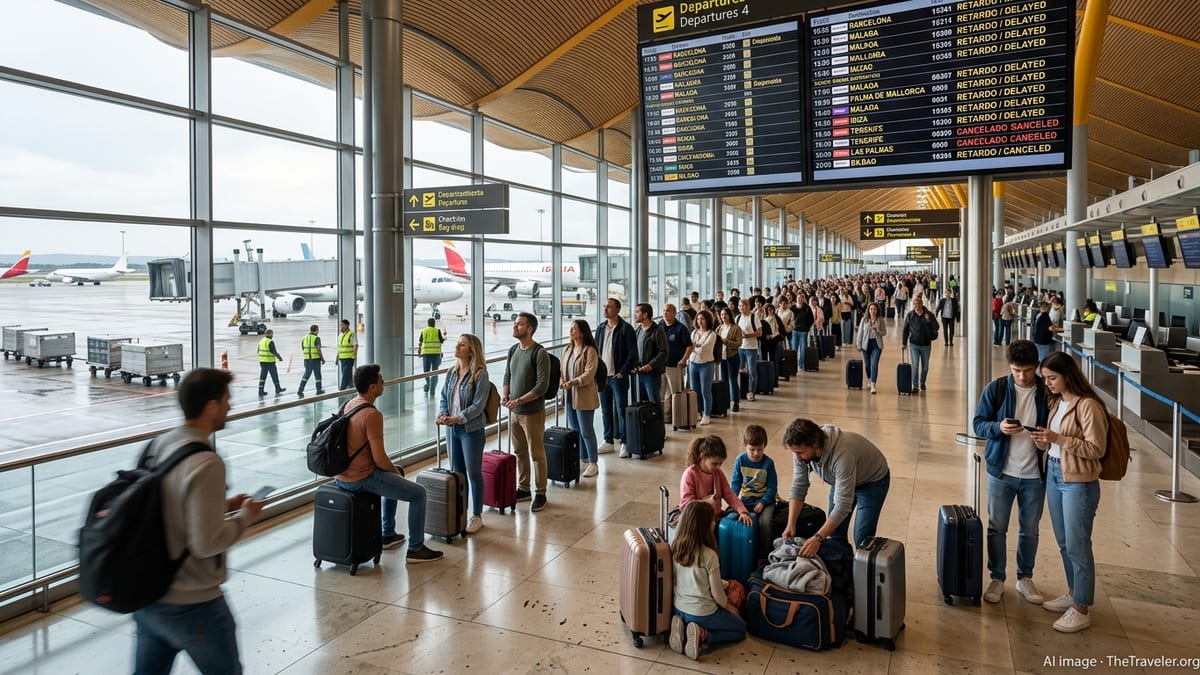
Where and when Spanish airport strikes are hitting
Across Spain, a new wave of industrial action is converging on the Easter holiday window in late March and early April 2026. Publicly available information shows that ground handling workers at Groundforce, part of the Globalia group, have called an open-ended strike from Monday 30 March, timed to overlap with peak Semana Santa traffic. The stoppages are structured as partial walkouts in three daily blocks that hit early morning departures, the midday peak and late evening operations.
Reports indicate that the Groundforce strike affects some of the busiest airports in the Aena network, including Madrid Barajas, Barcelona El Prat, Alicante, Valencia, Málaga, Bilbao, Palma de Mallorca, Ibiza, Las Palmas, Tenerife, Lanzarote and Fuerteventura. Local coverage from regions such as Andalusia and the Balearic Islands highlights that these hubs collectively handle thousands of flights over the Easter period, placing large numbers of holiday travelers at risk of queues, delays and baggage disruption.
At the same time, separate handling disputes at other providers, including Menzies and Azul Handling, have kept pressure on operations since mid 2025, particularly for low cost carriers and leisure routes. In the Balearic Islands, several hundred Groundforce workers at Palma de Mallorca are beginning indefinite partial stoppages aligned with the national call. Taken together, the overlapping actions create a patchwork of disruption that may vary by airport and day, but adds up to a challenging environment for anyone flying in or out of Spain.
Compounding the strain, recent reporting points to a possible air traffic control strike centered on A Coruña, with unions warning that broader action cannot be ruled out if staffing disputes are not resolved. Although no nationwide shutdown has been confirmed, the possibility of ATC walkouts alongside ground staff strikes raises the risk of knock-on delays well beyond the airports directly involved.
How strikes affect your journey from check in to baggage claim
Most of the current Spanish airport strikes involve ground handling staff rather than airline crews. That distinction matters because these workers are responsible for a wide range of tasks that passengers often only notice when something goes wrong. Their roles include check in support, boarding gate assistance, aircraft loading and unloading, baggage sorting, pushback operations on the ramp and certain aspects of aircraft turnaround.
When these teams walk out, even on a partial basis, bottlenecks can appear at multiple points in the passenger journey. Check in and bag drop desks may open later or operate with fewer staff. Boarding can become slower as reduced ramp teams juggle several flights at once. Once on the ground, arriving passengers may face longer waits at baggage carousels as luggage is processed in smaller batches or delayed while aircraft are parked away from the terminal.
Airlines and airport operators are obliged to maintain minimum service levels during officially registered strikes, and contingency plans often include reallocating tasks, drafting in managers or shifting some functions to alternative providers. However, industry observers note that ground handling is a specialized and safety critical activity that cannot be fully replaced at short notice. When strike windows coincide with peak holiday waves, the result can be a mix of delayed departures, missed connections and occasional cancellations, even when the published flight schedule initially appears normal.
The potential air traffic control dispute adds a further layer. If ATC staff were to reduce capacity or stage stoppages, aircraft could be held on the ground, rerouted or subjected to flow restrictions across Spanish airspace. In such a scenario, knock on delays could affect passengers whose airports are not directly served by the striking ground handlers, as congestion elsewhere cascades through the network.
Practical strategies to reduce disruption
For travelers who cannot or do not wish to postpone their trips, careful preparation can significantly reduce the impact of strike related disruption. Recent travel seasons in Spain and elsewhere in Europe have shown that building generous buffers into every stage of the journey is one of the most effective tactics. That means arriving at the airport earlier than usual, avoiding tight connections and allowing extra time to reclaim bags and clear passport control.
Carrying more essentials in hand luggage is another critical step. When ground staff are striking, baggage systems are among the first areas to slow down. Keeping medications, an extra change of clothes, basic toiletries within local regulations, chargers and any items needed for the first 24 to 48 hours in carry on bags can turn a long wait at the carousel into a manageable inconvenience rather than a full blown crisis.
Publicly available guidance from consumer organizations and airline advisories consistently encourages passengers to monitor their flight status closely in the days leading up to departure, especially when strikes are announced as rolling or partial. Travelers should check both airline apps and departure boards on the morning of travel, as some schedule changes are only finalized within 24 to 48 hours. It can also help to keep a mental shortlist of alternative routings or departure times, in case rebooking becomes necessary.
Finally, travelers booking new tickets for affected dates may wish to prioritize flexibility. Fares that include free date changes or low change fees, as well as accommodation reservations with lenient cancellation policies, can provide useful breathing room if strike action escalates or spreads to additional airports.
Choosing airports, routes and travel days wisely
Because the current Spanish strikes are concentrated in specific companies and airports, disruption is unlikely to be uniform across the country. Information from union announcements and media reports suggests that major hubs such as Madrid and Barcelona, along with coastal leisure gateways like Málaga, Palma de Mallorca, Ibiza and the Canary Islands, face the highest immediate risk over the Easter period due to their reliance on the affected handlers and their heavy holiday traffic.
Travelers with flexibility may therefore wish to consider alternative airports or routings where feasible. In some cases, flying into a secondary airport with less exposure to the striking provider and continuing by rail or coach can reduce the chance of long delays, even if the overall journey time is slightly longer. Spain’s high speed rail network links cities such as Madrid, Barcelona, Valencia, Málaga and Seville, providing viable back up options for domestic segments that might otherwise rely on short haul flights.
The choice of travel day can also make a difference. Previous rounds of industrial action in Spain and elsewhere in Europe have shown that weekends, particularly Fridays and Sundays, tend to be more vulnerable due to higher leisure demand. When strike calls cover extended periods, midweek departures sometimes experience fewer bottlenecks. Early morning flights can be affected by residual disruption from the previous day, while late night services may be caught by strike windows that begin in the evening.
Passengers should also pay attention to which company provides ground services for their specific airline at their departure airport. While this information is not always prominently advertised, it can often be inferred from local media coverage or airport information releases. If a carrier uses its own in house staff at a hub, it may be somewhat less exposed to third party handling strikes, although wider airport wide slowdowns can still have an impact.
What to watch in the days ahead
As the Easter travel period unfolds, the situation at Spanish airports remains fluid. Negotiations between unions and handling companies such as Groundforce and Menzies may still yield last minute agreements that scale back or suspend action at certain locations. Conversely, stalled talks could lead to extended stoppages or additional strike dates, particularly if early days of action generate significant disruption but do not unlock concessions.
Travel and aviation industry coverage points out that Spain has experienced repeated labor disputes in airport services over recent years, often clustering around peak holiday periods. This pattern suggests that industrial relations in the sector remain fragile, and that further episodes cannot be ruled out later in 2026, including during the summer season. For international tourists, this makes it increasingly important to track labor developments alongside traditional concerns such as weather and demand surges when planning trips.
In the short term, travelers with imminent departures during the strike window should maintain close contact with their airline through official channels, sign up for notifications and have key booking references easily to hand in case of changes. Keeping electronic copies of boarding passes, hotel confirmations and travel insurance documents can speed up any rebooking or claims process if flights are delayed or canceled.
While the prospect of strikes at both ground level and potentially in air traffic control is unwelcome for holidaymakers, most flights in previous episodes of Spanish airport unrest have ultimately operated, albeit with delays. With realistic expectations, flexible planning and a focus on essentials, passengers can improve their chances of starting and ending their holidays in Spain with only minor turbulence on the ground.