

More news on this day
A brief but disruptive outage at airline technology provider Navitaire on February 19 triggered check-in failures for IndiGo, Batik Air and Akasa Air, causing at least 27 flight cancellations and 79 delays across India, Indonesia and Malaysia, stranding hundreds of passengers and snarling key regional routes just as the morning rush peaked.
What Triggered the Sudden Wave of Cancellations and Delays
The disruption stemmed from a technical glitch in Navitaire, the reservation, check-in and departure control system used by low-cost carriers including IndiGo, Akasa Air and several affiliates of Indonesia’s Lion Air Group such as Batik Air. The fault surfaced during the morning peak of Thursday, February 19, when airports across Asia were ramping up departures for business and regional leisure traffic.
According to airline and airport sources, the system failure lasted for roughly 40 to 45 minutes, during which carriers were unable to process bookings, issue boarding passes or tag checked baggage. While the underlying cause has not yet been fully detailed publicly, airline technology specialists described it as a widespread platform outage affecting multiple markets in the Asia Pacific region before rippling into other parts of the world.
IndiGo and Akasa Air both reported that their own systems were restored within about half an hour, but by then the impact was baked into the morning schedule. Ground handling teams were forced to revert to manual processes, significantly slowing check-in and security flows. Even after the Navitaire platform came back online, aircraft were out of position and crews were off-roster, leading to a cascade of downstream delays and flight cancellations.
Initial internal tallies across the three carriers suggest that at least 27 flights were scrapped outright and 79 were delayed beyond an hour on the day, with the heaviest concentration in and out of major hubs such as Delhi, Mumbai, Jakarta and Kuala Lumpur. Industry observers warn that the final numbers may rise as airlines reconcile their operations reports.
How India’s Busy Hubs Were Hit by IndiGo and Akasa Air Disruptions
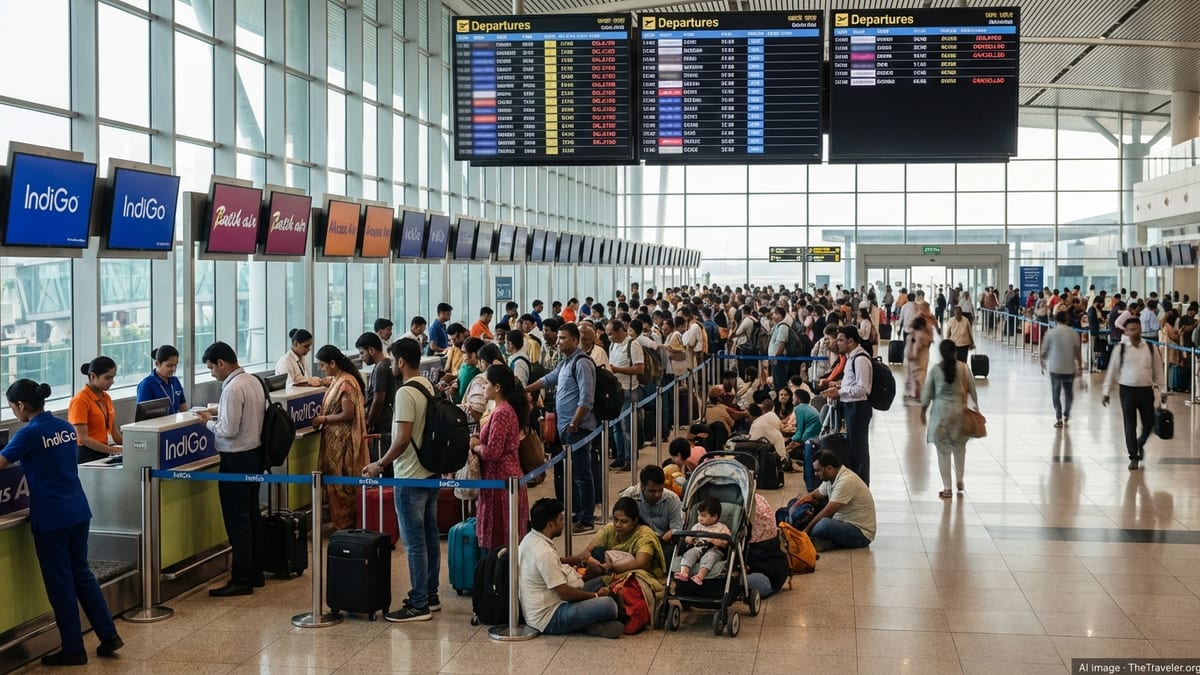
In India, the most visible disruption unfolded at Delhi’s Indira Gandhi International Airport and Mumbai’s Chhatrapati Shivaji Maharaj International Airport, where dense morning wave departures by low-cost carriers are built on rapid turnarounds and tightly sequenced slot timings. With check-in counters suddenly unable to issue boarding passes, long queues quickly formed at domestic terminals.
IndiGo, which carries well over half of India’s domestic passengers, was particularly exposed. While the airline stressed that the outage window for its operations was around 25 minutes, passengers at both Delhi and Mumbai reported waiting for over an hour to check in as staff shifted to manual documentation and baggage tagging. Several early-morning departures to Bengaluru, Hyderabad, Chennai and Kolkata were held at the gate, pushing knock-on delays into mid-morning rotations.
Akasa Air, a smaller but fast-growing budget carrier, also reported disruptions to its check-in systems on affected routes. At some airports, Akasa staff resorted to handwritten boarding passes for passengers who had already cleared security, a move that further slowed boarding and triggered additional document checks at the aircraft door. Flights linking secondary cities such as Ahmedabad, Kochi and Lucknow saw revised departure times as the airline worked to stabilise its network.
For India’s aviation sector, the Navitaire outage landed on top of lingering fragility from IndiGo’s separate scheduling crisis in late 2025, when thousands of flights were cancelled after the airline struggled to adapt to tighter crew duty rules. While Thursday’s disruption was far smaller in scale, passenger frustration was magnified by recent memories of missed connections, last-minute cancellations and shaky on-time performance.
Impact Across Indonesia and Malaysia as Batik Air Feels the Strain
Beyond India, the outage also reverberated across Indonesia and Malaysia through Batik Air, the full-service offshoot of Lion Air Group that relies on Navitaire technology for its reservations and check-in systems. With early-morning departures from Jakarta’s Soekarno Hatta International Airport and Kuala Lumpur International Airport heavily used by commuters, business travellers and regional tourists, even brief disruptions created significant bottlenecks.
At Jakarta, passengers queued in snaking lines as airline staff attempted to verify bookings manually using printed manifests and offline records. Several domestic flights to Surabaya, Denpasar and Makassar were delayed, while at least a handful of departures to Kuala Lumpur and Singapore were either consolidated or cancelled outright to ease congestion and reset aircraft rotations.
In Malaysia, travellers departing from Kuala Lumpur reported a similar pattern of confusion. Airports and airlines are accustomed to weather or air traffic disruptions, but a digital system outage affecting multiple carriers at once is rarer and more difficult to manage. Gate changes, rolling delay announcements and last-minute cancellations left many passengers scrambling to rebook same-day departures or secure overnight accommodation when onward connections became unviable.
Regional tourism operators in Bali, Penang and Langkawi said the immediate impact was limited to missed check-ins and some shortened weekend breaks, but warned that repeated technology-related disruptions could erode traveller confidence in low-cost regional connections that are critical for the cross-border tourism economy in Southeast Asia.
Stranded Passengers: Long Queues, Confusion and Limited Information
For passengers caught in the middle of the disruption, the most common complaints were long queues, slow manual processing and a lack of timely information about flight status. With digital displays and mobile apps reliant on the same underlying systems, status boards in some terminals lagged reality by an hour or more, showing flights as “on time” even as boarding was indefinitely paused at the gate.
At several airports in India, Indonesia and Malaysia, travellers described scenes of overcrowded check-in halls and ad-hoc cordons as staff tried to manage flow. Families with young children and elderly passengers in particular struggled with extended standing times and uncertainty over whether flights would eventually depart. For those booked on tight domestic-to-international connections, the outage quickly turned a routine transfer into an overnight ordeal.
Some travellers reported that frontline staff were helpful but clearly overwhelmed, relaying only minimal information as they juggled manual documentation, baggage handling and crowd control duties. Others said that attempts to reach airline call centres or chatbots were largely unsuccessful during the peak of the disruption, with long hold times and generic scripted responses that offered little clarity on rerouting or refunds.
At major hubs, airport authorities deployed additional security and customer-service personnel to manage queues and answer basic questions about the cause of the disruption. However, as the outage originated with an external technology provider rather than airport infrastructure or air traffic control, local authorities had limited ability to directly influence resolution times, leaving passengers to wait until Navitaire systems were fully restored.
Key Routes and Connections Most Affected
The pattern of cancellations and delays underscored how dependent regional connectivity has become on a handful of technology platforms and low-cost carriers. In India, the heaviest disruptions were recorded on trunk routes linking Delhi and Mumbai with Bengaluru, Hyderabad, Chennai and Kolkata, where IndiGo in particular operates dense schedules with back-to-back aircraft rotations throughout the morning.
Secondary city pairs such as Delhi to Patna, Mumbai to Goa and Bengaluru to Kochi also saw notable delays as aircraft and crews were shuffled to protect higher-demand business routes. For Akasa Air, impacts were most visible on newer sectors where the airline has thinner frequencies, meaning a single delayed or cancelled flight could leave passengers with limited same-day alternatives.
In Indonesia, domestic links from Jakarta to Surabaya, Denpasar and Medan bore much of the brunt, while in Malaysia, Kuala Lumpur’s connections to Jakarta, Bali and key domestic destinations such as Kota Kinabalu and Penang experienced disruptions. Passengers with multi-leg itineraries spanning India, Indonesia and Malaysia on separate tickets were particularly vulnerable, as missing a low-cost carrier leg often meant forfeiting onward bookings without recourse to through-ticket protections.
Travel agents in the region reported a spike in last-minute rebooking requests as corporate travellers sought to salvage meetings in financial and industrial hubs. Some corporate travel managers said they were already reviewing contingency plans, including building longer connection buffers into itineraries and diversifying carriers used on critical business routes.
What Passengers Are Entitled to When Flights Are Cancelled or Delayed
The disruption has renewed questions about what rights passengers actually have when flights are cancelled or severely delayed due to technology failures at third-party providers. In India, aviation regulations require airlines to offer refunds or alternative travel in cases of significant cancellations, along with specified compensation or facilities such as meals and hotel accommodation depending on the length of delay and reason for disruption.
Airlines typically classify large-scale technology outages as operational issues within their responsibility, even when the root cause lies with an external vendor, which means passengers should generally qualify for standard protections rather than being left to absorb the cost of missed trips. However, in practice, the speed and generosity of remedies can vary widely from carrier to carrier and even airport to airport.
In Southeast Asia, passenger rights frameworks are more fragmented. Indonesia and Malaysia both have consumer protection and aviation safety rules that address cancellations and long delays, but enforcement and clarity can lag behind European-style regimes. Travellers are often advised to document all communications, retain receipts for meals and accommodation, and follow up in writing with airlines if frontline staff are unable to immediately process compensation or refunds during the heat of a disruption.
Travel experts also recommend that passengers check the terms of their travel insurance, as many policies now explicitly cover disruptions caused by airline system failures or infrastructural breakdowns. Where flights are part of complex multi-leg itineraries, especially on separate tickets, insurance can sometimes be the only realistic avenue to recover costs associated with missed connections and additional nights of accommodation.
Lessons for Airlines and Tech Providers After Another System Shock
For airlines and technology providers, the incident is a stark reminder of the operational risks that come with heavy reliance on a single digital backbone. Low-cost carriers such as IndiGo, Batik Air and Akasa Air run lean operations with tight turnarounds and minimal slack in schedules, which magnifies the impact when core systems fail even briefly.
Aviation IT specialists say the latest outage is likely to intensify scrutiny of redundancy and disaster-recovery protocols at Navitaire and similar platforms. Key questions include how quickly airlines can switch to backup systems, whether critical functions such as check-in and boarding can be partially decoupled from centralised servers, and how real-time data can continue to flow to mobile apps and airport displays during partial outages.
For IndiGo in particular, the episode comes at a sensitive moment. The airline is still working to rebuild trust after a major scheduling crisis in late 2025 that saw thousands of flights cancelled over several weeks due to crew rostering failures under new duty-time rules. Any further perception of unreliability, even when caused by an external vendor, could further test customer loyalty in a competitive market where new entrants and full-service rivals are vying for share.
Industry analysts note that regulators may also take a keener interest in how airlines audit their technology suppliers and stress-test critical systems. As more of the passenger journey moves online, from booking to biometric boarding, resilience in the digital layer is increasingly as important as airframe maintenance or pilot training when it comes to protecting travellers from sudden, large-scale disruption.
How Travellers Can Prepare for Future Technology-Driven Disruptions
While passengers cannot prevent a global technology outage, there are steps they can take to reduce the risk of being stranded when systems fail. Aviation advisers suggest building in more generous connection windows, especially when travelling on separate tickets or mixing low-cost carriers with full-service airlines, to allow room for unexpected delays at check-in or security.
Keeping digital and printed copies of itineraries, e-tickets and identification can also help when airlines switch to manual processes. During the latest outage, travellers who had offline access to their booking references and prior seat confirmations were generally processed faster than those relying solely on mobile apps that could not refresh in real time.
Experts further recommend registering contact details with airlines and enabling flight-status alerts via SMS or email, as these channels can sometimes update more reliably than mobile apps linked to overloaded servers. When disruptions hit, approaching airline staff early, before queues become unmanageable, and calmly exploring options for rerouting or later departures can also improve outcomes.
Finally, choosing comprehensive travel insurance that explicitly covers carrier system failures, missed onward connections and forced overnight stays can make a critical difference. As Thursday’s outage showed, even a 45-minute digital failure can cascade into a day of cancellations, delays and missed plans across multiple countries, leaving unprotected travellers to shoulder much of the cost and stress.