

Naxos is the quiet achiever of the Cyclades. Larger and greener than many of its neighbors, it mixes long sandy beaches, whitewashed villages, ancient ruins, and fertile valleys where life still feels rooted in tradition.
Whether you are plotting a quick island hop from Mykonos or planning a week of slow travel, Naxos rewards those who linger.
Why Naxos Belongs on Your Greece Itinerary
Naxos sits in the center of the Cyclades and is the largest island in the group. That size matters. It means you get both the classic Aegean picture of white alleys and turquoise water and a surprisingly substantial interior of mountains, farms, and traditional villages.
Travelers often describe Naxos as having a more lived-in, less staged feel than some neighboring islands, with tourism layered over a still-active agricultural economy rather than replacing it outright.
For beach lovers, the west coast alone could fill a week, with a near-continuous run of wide, sandy beaches from Agios Georgios outside Naxos Town down through Agios Prokopios, Agia Anna, Plaka, and beyond. Inland, a road and trail network leads to stone-built villages, Byzantine chapels, and viewpoints across the Aegean. You can spend a morning on a mountain hike and be back in the sea for an afternoon swim, something that is less realistic on smaller islands.
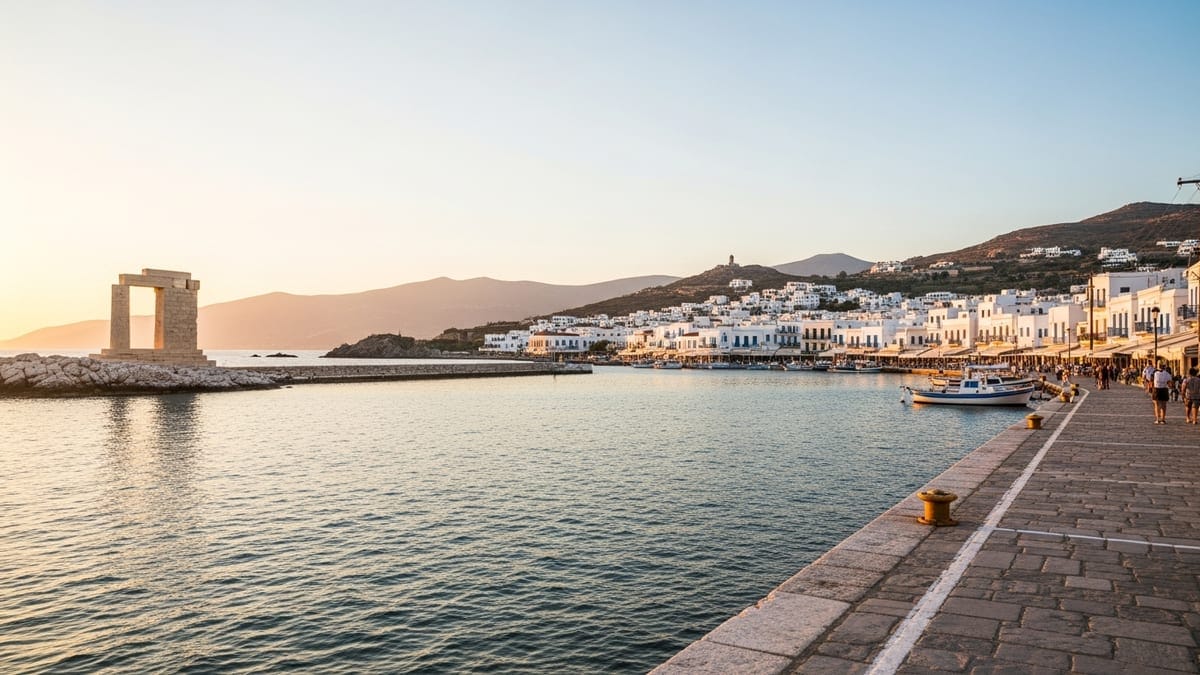
Naxos also offers a strong sense of history. Mythology links the island to Dionysus and Ariadne, and archaeologists have traced human activity here back thousands of years. The Portara, the enormous marble doorway that greets ferries arriving at the port, is only the most obvious of many ancient remnants.
Combine that with comparatively reasonable prices, a well-developed bus network, and more Greek families than influencers, and you have an island that appeals to both first-time visitors and seasoned Greece travelers.
Crucially, Naxos remains accessible without feeling overrun for much of the year. The ferry connections are excellent, and the small airport, currently undergoing expansion through 2025, maintains regular links with Athens and seasonal domestic routes.
This balance of connectivity and calm makes Naxos particularly attractive to travelers who want the Cyclades experience without the intensity and pricing of marquee islands in peak season.
Unmissable Sights and Experiences
Virtually every visit to Naxos starts with the Portara, the colossal marble doorway of an unfinished 6th century BC temple on the islet of Palatia, connected to Naxos Town by a short causeway.
The site is open at all hours and free to visit, which means you can walk up at sunrise, mid-afternoon, or as the sun sinks behind Paros. Sunset is the most famous and the most crowded time, so consider visiting early morning for gentler light and more space to yourself.
Naxos Town, often called Chora, is the island’s main settlement and a highlight in its own right. At sea level, a waterfront promenade lines the harbor with cafes, tavernas, and pastry shops.
Above the port, an atmospheric maze of alleys climbs toward the medieval Kastro, a Venetian fortress district of arched passages and old mansions. Wandering this area, ducking into small shops and tiny churches, gives you a sense of the island’s layered history from classical antiquity through the period of Latin rule.
Beyond town, a full-day or half-day exploration of the interior villages offers a different side to Naxos. Mountain villages such as Filoti and Apeiranthos cling to the slopes of Mount Zas, with stone houses, small squares, and traditional cafes where older residents gather.
These spots are natural bases for hikes, but even a simple stroll and a long lunch will give you a feel for rural island life that many visitors never experience if they stay only on the coast.
If time allows, seek out one of Naxos’s famous unfinished kouroi, enormous archaic statues left abandoned in ancient quarries. The best known are near Melanes and Apollonas. Reaching them usually involves a short walk along a marked path, and standing next to these partly carved giants in situ connects you very directly with the craftsmen who worked here more than 2,500 years ago.
Beaches: From Family-Friendly Sands to Wild Coves
Naxos is widely regarded as one of the best beach islands in Greece, and much of that reputation rests on the long ribbon of sand along its western flank. Closest to town is Agios Georgios, a shallow, gently shelving beach that is effectively Naxos Town’s urban shoreline.
It is heavily serviced with sunbeds, umbrellas, and watersports and is ideal for families with smaller children or travelers who want to stay in town without sacrificing easy daily swims.
A short hop south brings you to Agios Prokopios, a long, pale sandy bay with clear turquoise water and a mix of organized sections and more relaxed stretches. Regular buses from Chora make it one of the easiest beaches to reach without a car, and a parallel strip of eateries and simple hotels means you can base yourself here for a holiday that revolves around the sea.
Continuing along the coast you reach Agia Anna, where a smaller port and slightly quieter atmosphere appeal to travelers seeking a softer version of the same formula.
Farther down, Plaka Beach runs for several kilometers, with dunes behind and a mostly low-rise, spaced-out line of accommodation. Parts of the beach remain relatively undeveloped, and naturists frequent some sections, especially further from the main access points. Plaka combines enough infrastructure to be comfortable with enough space to feel uncrowded, particularly away from the peak of July and August.
For a wilder feel, head toward Alyko Beach on the southwest coast, about 17 kilometers from Naxos Town. Here, small sandy coves are interspersed with low cliffs and a protected cedar forest behind the dunes, giving the landscape a distinctive character for the Cyclades.
The beach is unorganized, there is little shade, and public transport options are limited, so you will need to bring what you need and likely arrive by rental car or taxi. Kitesurfers and windsurfers often gravitate toward Mikri Vigla farther north, where reliable winds make for ideal conditions but can be intense for those just looking to sunbathe.
Exploring the Villages and Mountains
While many visitors are content to shuttle between Naxos Town and the beaches, the island’s interior rewards anyone willing to trade sun loungers for stone lanes for at least one day.
Mount Zas, at over 1,000 meters, is the highest point in the Cyclades, and the region around it is dotted with appealing villages connected by roads and walking paths. The air is cooler, the pace slower, and the menus often more rooted in local produce and recipes.
Filoti is one of the largest and most accessible mountain villages, built amphitheatrically on the slopes of Mount Zas. A plane tree shades the main square, and a network of lanes branches out past churches and family homes.
From here, you can follow signposted trails toward the Cave of Zas or higher viewpoints, or simply linger in a café, watching local life between bus arrivals. Because of its size and services, Filoti works well as a lunch stop on an island-driving loop.
Apeiranthos, farther along the main interior road, is often cited as Naxos’s most photogenic village. Many of its houses and alleyways are built from local stone, giving it a subtly different feel to the plastered white of the coastal settlements.
Small folk museums, traditional cafes, and well-placed viewpoints make it worth at least a few unhurried hours. Plan on some climbing; the village is built into the hillside and rewards curiosity with hidden corners and small squares.
Other interior settlements, such as Halki (also known as Chalkio), offer a mixture of neoclassical houses and tiny shops, sometimes including distilleries producing kitron, a traditional Naxian liqueur made from citron leaves. Linking several of these villages in a single day, either by car or local bus supplemented with walking, gives you a rounded view of Naxos as a working island rather than a purely seasonal resort.
Getting To and Around Naxos
Reaching Naxos is straightforward from Athens and other Cycladic islands. Ferries connect Naxos Town’s port with Piraeus and Rafina near Athens, with journey times generally ranging from about three and a half hours on high-speed services to around six hours on conventional ferries, depending on the exact route and company.
In summer, frequent sailings make it easy to incorporate Naxos into a wider island-hopping itinerary including islands such as Paros, Mykonos, and Santorini, as well as some less visited neighbors.
Naxos Island National Airport lies roughly three kilometers from Naxos Town and is currently undergoing a multi-year expansion aimed at lengthening the runway, improving safety infrastructure, and increasing capacity.
For travelers, this translates into short domestic flights of around one hour from Athens with several daily options in season, plus additional domestic routes that have been introduced in recent years. Because aircraft sizes are relatively small and demand spikes in summer, flights can sell out early, so advance booking is strongly advised.
Once on the island, you can choose from rental cars, public buses, taxis, bicycles, and organized boat trips. The local KTEL bus network links Naxos Town with major beach areas on the west coast and inland villages.
In peak season, some routes, particularly those serving Agios Prokopios, Agia Anna, Plaka, and Mikri Vigla, run at short intervals, while services to smaller villages and winter timetables are more limited. It is best to check the most current schedule at the bus station opposite the port or through official channels on arrival.
Taxis are concentrated around the port, airport, and central points in Chora and provide relatively fast, flexible transfers, especially if you are arriving late, carrying large luggage, or staying somewhere not well served by buses.
For maximum independence, especially if you want to explore remote beaches or multiple interior villages in a day, renting a car or scooter remains the most efficient option. Road conditions on main routes are generally good, but narrow village streets and summer traffic in Naxos Town call for patience and cautious driving.
Where to Stay and How Long to Spend
Naxos’s accommodation scene ranges from simple rooms and family-run pensions to boutique hotels and a handful of higher-end properties. Naxos Town is the most practical base for first-time visitors, offering the widest choice of eateries, evening activity, and public transport connections.
Staying within walking distance of both the port and Agios Georgios Beach allows you to divide your time easily between sightseeing and swimming without needing a vehicle every day.
If your priority is the sea and you prefer a quieter atmosphere after dark, basing yourself along the west-coast beaches can be appealing. Agios Prokopios and Agia Anna offer a full spectrum of mid-range hotels, apartments, and studios, with enough tavernas and beach bars to make going into town every night optional.
Plaka has a more spaced-out feel, with properties strung along the road behind the dunes, so check distance to the water and nearby facilities when booking if you prefer not to walk much.
For travelers seeking immersion in village life, a stay in an interior settlement such as Halki, Filoti, or Apeiranthos can be rewarding, particularly outside high summer when temperatures are more comfortable inland.
These bases work best for those who plan to rent a car or are comfortable with the bus timetables, as returning from the coast at night without your own wheels can be complicated. In exchange, you gain early-morning quiet in stone-paved alleys and night skies darker than anywhere on the coast.
In terms of trip length, Naxos deserves at least three full days, which is enough time to sample Naxos Town, spend a couple of beach days, and make a short foray inland. A stay of five to seven days allows you to slow the pace, add hikes, boat trips to nearby islands or remote coves, and perhaps revisit a favorite beach in different light or conditions.
Longer stays are increasingly popular with remote workers and long-term travelers who appreciate Naxos’s balance of amenities and relative calm outside peak holiday weeks.
Local Food, Culture, and Practical Tips
Naxos has a well-earned reputation for its agricultural products. The fertile island plains support potato fields, vineyards, olive groves, and citrus orchards. On menus, this translates into hearty dishes centered on local cheeses, meats, and vegetables rather than relying solely on seafood.
Look out for graviera and arseniko cheeses, lamb and goat dishes, and stews flavored with island herbs. Even simple plates such as baked eggplant or chickpea soups tend to be deeply satisfying thanks to the quality of ingredients.
Kitron, the Naxian liqueur made from citron leaves, is a distinctive local specialty you are likely to encounter served after meals or sold in bottles in village shops. It comes in different strengths and levels of sweetness.
Sampling it in or around Halki, where some of the traditional distilleries are based, can be part of a rewarding day inland. As always, if you are driving, treat alcohol tasting conservatively and arrange for someone else to be at the wheel when you return to the coast.
From a cultural perspective, Naxos hosts small-scale festivals and religious celebrations throughout the year, with a concentration in summer. Even if you do not time your visit to a specific event, you may encounter live music or dancing in village squares, especially on weekends and local name days.
Dress codes are generally relaxed, but modest attire is appreciated in churches and monasteries. As in the rest of Greece, a few words of Greek and a friendly attitude go a long way in everyday interactions.
On the practical side, note that tap water in Naxos Town is not generally recommended for drinking, and many residents and hotels rely on bottled water or filtration systems.
Pharmacies exist in main settlements, but it is wise to bring any specific medications you need, plus high-factor sunscreen and basic first aid supplies. Temperatures in July and August can be intense, particularly in the middle of the day, so plan hikes and extended outdoor activity for mornings or late afternoons and take heat and hydration seriously.
When to Go and How to Avoid Crowds
Naxos is technically a year-round destination, but the character of the island changes significantly with the seasons. Summer, from late June through early September, brings the most dependable swimming weather, the fullest ferry and bus schedules, and the liveliest atmosphere in Naxos Town and along the beaches. It also brings the highest prices and the largest crowds, particularly in August when many Greeks take their own holidays.
For many travelers, the shoulder months of May, early June, late September, and early October offer the best compromise. Sea temperatures are usually swimmable by late spring and remain pleasant into autumn, but the island is quieter, accommodation is easier to find, and the sun is less punishing for hiking or village wandering. During these times, some beach businesses may operate on shorter hours, yet enough remain open to anchor an enjoyable stay.
Winter and early spring reveal a much quieter, more local Naxos. Some hotels, tavernas, and beach facilities close, ferry schedules thin, and certain excursions and water-based activities become less practical.
On the other hand, the island’s interior turns vividly green, and village life proceeds at its own pace without the overlay of seasonal tourism. If you choose to visit at this time, plan for flexibility, check transport options carefully in advance, and embrace a slower, more reflective style of travel.
Regardless of season, you can ease crowd pressure on your experience with a few simple strategies. Visit headline sights such as the Portara, popular beaches, and the Kastro either early in the day or closer to sunset, and consider exploring less publicized spots during peak midday hours. Booking accommodation and any desired rental vehicles well ahead of arrival, especially for stays in late July and August, will also help avoid last-minute compromises.
The Takeaway
Naxos combines the images many people carry of the Greek islands with a depth and breadth that only a larger, more varied landscape can offer. Long beaches, an authentic main town anchored by a striking ancient monument, and a living interior of working villages and mountain paths together create a destination that can hold your attention for far longer than a quick island hop.
Planning your visit around how you like to travel will shape your experience. Base yourself in Naxos Town if you want easy access to ferries, buses, and evening promenades. Choose a west-coast beach if your perfect day centers on sand and sea with short walks to dinner. Look inland for an immersive stay in traditional villages. In all cases, budgeting time for both the coast and the mountains will give you a more rounded sense of the island.
A bit of preparation goes a long way: book transport early in high season, check current bus timetables, treat the sun and heat with respect, and remember that tap water may not be suitable for drinking everywhere. Beyond these basics, Naxos rewards curiosity and a willingness to slow down. Linger over a village lunch, pause at a roadside chapel, or watch the light change on the Portara twice rather than once.
For travelers looking for a Cycladic island that still feels solid underfoot, Naxos is an excellent choice. Arrive with realistic expectations, an open schedule, and a readiness to explore beyond the obvious, and you are likely to leave with the sense that this is an island you could return to again and again without exhausting what it has to offer.
FAQ
Q1: How do I get to Naxos from Athens?
Most travelers reach Naxos by ferry from Piraeus or Rafina, with journey times typically between about three and six hours depending on the vessel, or by a domestic flight of around one hour from Athens International Airport into Naxos Island National Airport.
Q2: How many days should I spend on Naxos?
A minimum of three full days allows you to explore Naxos Town, visit at least one interior village, and enjoy some beach time, while five to seven days give you scope for hikes, multiple beaches, and perhaps a boat excursion to nearby islands.
Q3: Do I need a car on Naxos?
You can manage without a car if you stay in Naxos Town or along the main west-coast beaches and use the local bus network, but renting a car or scooter offers much greater flexibility for reaching remote beaches and multiple mountain villages in a single day.
Q4: When is the best time of year to visit Naxos?
The most popular period is late June through early September for guaranteed beach weather, but many visitors prefer May, early June, late September, or early October for fewer crowds, comfortable temperatures, and still pleasant sea conditions.
Q5: Is Naxos suitable for families with children?
Yes, Naxos is very family friendly, with shallow sandy beaches such as Agios Georgios, Agios Prokopios, and Agia Anna, a relaxed atmosphere, and a good mix of casual eateries and accommodations that work well for families.
Q6: Can I drink the tap water on Naxos?
In many parts of Naxos, including Naxos Town, tap water is not generally recommended for drinking, so most visitors and locals rely on bottled water or filtered supplies for drinking while using tap water for washing and brushing teeth.
Q7: Are the beaches on Naxos organized with facilities?
Several main beaches, particularly along the west coast near Naxos Town, offer organized sections with sunbeds, umbrellas, and nearby tavernas, while more remote spots such as parts of Plaka or Alyko remain largely unorganized and require you to bring your own shade and supplies.
Q8: Is Naxos windy?
Like much of the Cyclades, Naxos can be quite windy in summer when the Meltemi blows, which brings welcome cooling on hot days but can make certain exposed beaches feel blustery and is a key reason spots like Mikri Vigla are popular with kitesurfers and windsurfers.
Q9: What should I pack for a trip to Naxos?
Pack light, breathable clothing, swimwear, a hat, high-factor sunscreen, sturdy sandals or shoes for walking on uneven surfaces, a light jacket for breezy evenings, and any essential medications, plus a reusable water bottle you can refill with safe drinking water.
Q10: Is Naxos a good base for island hopping?
Yes, Naxos’s central location and busy port make it an excellent hub for visiting other Cycladic islands, with regular ferries to destinations such as Paros, Mykonos, and Santorini and additional seasonal connections to smaller or more remote islands.