

More news on this day
As near-space tourism evolves from speculative concept to early reality, Space Perspective’s MS Voyager, a converted marine spaceport ship, is emerging as one of the most striking experiments in how travelers might one day access the stratosphere and glimpse Earth from the edge of space.
Get the latest news straight to your inbox!
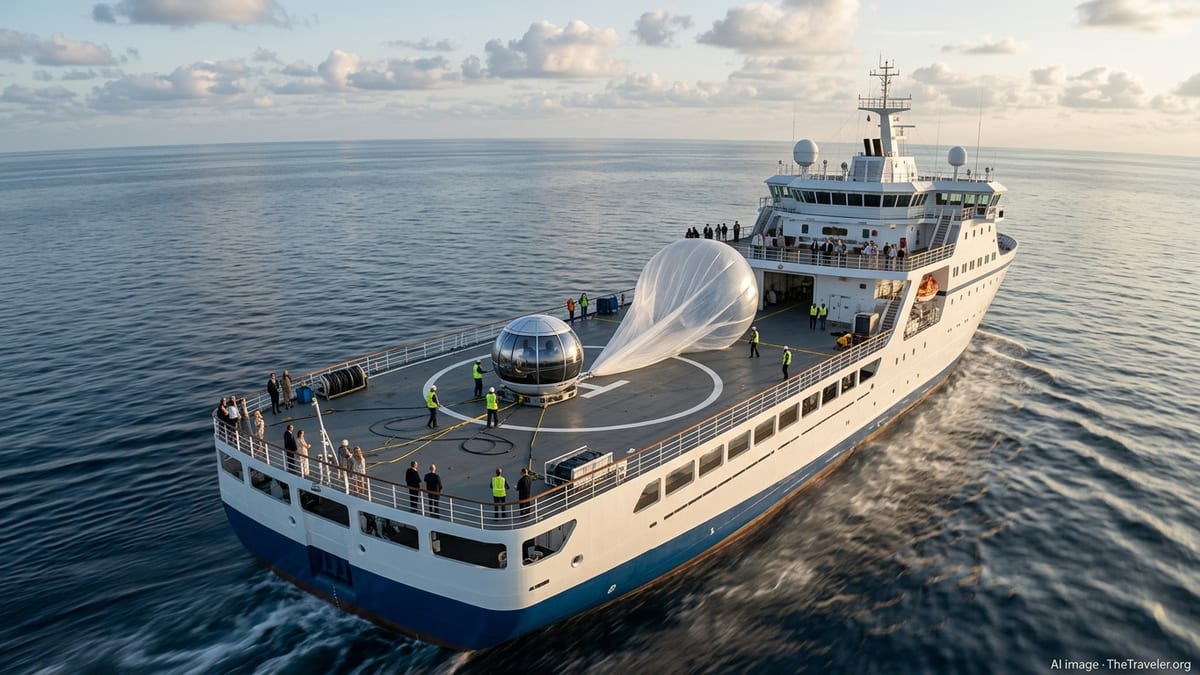
A Marine Spaceport for the Stratosphere
MS Voyager began life as an offshore support vessel before being reimagined as a “marine spaceport,” designed to launch Space Perspective’s pressurized Neptune capsule beneath a giant stratospheric balloon. Publicly available technical specifications describe an approximately 89-meter vessel equipped with dynamic positioning systems, reinforced decks and specialized handling gear so that it can serve as both launch and recovery platform on open water rather than at a fixed land site.
Industry reports indicate that the conversion work, carried out at a U.S. Gulf Coast shipyard, has focused on transforming Voyager from a conventional workboat into a passenger-facing platform. That includes additional accommodations, observation areas and mission control spaces that allow guests to embark, wait for their ascent and return to the ship after splashdown. The ship’s name, an explicit nod to the Voyager 1 probe, signals the company’s ambition to link ocean travel, space heritage and a new form of high-altitude tourism.
By basing a stratospheric launch system at sea, Space Perspective has aligned itself with a broader shift in the space industry toward flexible, mobile infrastructure. Similar trends can be seen in sea-based rocket landing platforms and emerging offshore launch concepts. Voyager’s role is to give near-space balloon flights the same kind of geographic agility, following suitable weather and opening up access points beyond traditional spaceport regions.
How MS Voyager Changes the Journey to Near Space
The Neptune capsule carried by Space Perspective’s high-altitude balloon is designed to ascend to around 30 kilometers, high enough for passengers to see the curvature of the planet and the darkness of space while still remaining within Earth’s atmosphere. Reports on company materials describe a slow, approximately two-hour ascent, several hours at peak altitude and a gentle descent ending with an ocean splashdown close to Voyager, which then retrieves capsule and passengers.
Positioning Voyager at sea is intended to reshape the full travel experience. Rather than driving to a remote desert spaceport or airfield, guests board what is effectively a small cruise vessel, sailing to a pre-cleared launch zone. During the transit, they receive briefings, relax in lounge spaces and watch ground crews prepare the balloon and capsule on deck. The transition from ship to sky is framed as seamless: instead of a vertical rocket blast, the balloon lifts the capsule gradually, more like a luxury observation tower that happens to rise above 99 percent of the atmosphere.
Operational flexibility is central to this approach. A marine spaceport can reposition for optimal weather windows, a critical factor for large balloons that are more sensitive to winds than rockets. It also allows operators to choose flight corridors that minimize overflight of populated areas and simplify recovery logistics. For travelers, this means itineraries that may combine time at sea with the near-space ascent, blending elements of a cruise, an expedition and an aviation experience.
Designing a Slower, Gentler Kind of Space Tourism
Space Perspective has consistently framed its concept as an alternative to rocket-based tourism, prioritizing comfort, atmospheric views and environmental positioning over high G-forces and brief suborbital weightlessness. Public information on the Neptune capsule highlights a spacious cabin configured for eight passengers and a pilot, panoramic windows, reclining seats and social areas more reminiscent of a lounge than a cockpit.
Voyager is a key part of that narrative. The vessel has reportedly been adapted to run on biofuel, reflecting the company’s emphasis on a lower-emissions profile than conventional cruise or launch operations. The balloon flights themselves rely on buoyancy rather than high-energy propellants, with materials that can be recovered and recycled after each mission. While external analyses caution that any large-scale tourism operation carries some environmental footprint, the combination of slower ascent, limited passenger counts and reuse of core hardware is being positioned as a more measured way to open near space to civilian travelers.
Inside the capsule, design details such as a dedicated restroom “space spa,” mood lighting and integrated camera systems underscore the focus on a curated, multi-hour experience rather than a brief thrill ride. From Voyager’s decks, guests and accompanying crew can watch balloon inflation against the open ocean horizon, adding an additional layer of theater that distinguishes these flights from land-based launches.
Market Momentum and Financial Headwinds
The vision behind MS Voyager and Neptune has attracted significant early interest. Prior to recent turbulence, published coverage reported that Space Perspective had taken more than 1,600, and later over 1,800, seat reservations at a listed price of about 125,000 dollars per person. That placed the offering below the cost of rocket-based suborbital flights while still firmly in the ultra-luxury travel category, aimed at affluent early adopters seeking the “overview effect” from near space.
At the same time, the company’s trajectory has underscored the financial and operational challenges of pioneering a new segment of tourism. Reports in 2024 and 2025 detailed how Space Perspective faced mounting financial strain, including furloughs, eviction from facilities and uncertainty over its ability to maintain schedules. Some industry analyses now describe the firm as having effectively ceased operations, even as its online booking channels remained visible.
For MS Voyager, these developments raise questions about how and when the vessel will see sustained commercial use. Aerospace and maritime trade publications noted that construction and outfitting milestones for the marine spaceport were achieved, but the broader business environment has become more complex. Any future operator using Voyager for near-space tourism would need not only regulatory approvals and technical readiness, but also robust capital to weather long development cycles and market fluctuations.
What MS Voyager Means for the Future of Near-Space Travel
Regardless of Space Perspective’s corporate fortunes, MS Voyager has already influenced thinking about how humans might routinely access near space. The ship embodies a hybrid model that merges elements of cruise travel, offshore energy infrastructure and spaceflight operations into a single platform. For coastal regions with existing port capabilities but no major spaceports, similar vessels could eventually offer a way to plug into the emerging stratospheric tourism market without building new launch complexes on land.
Analysts assessing the broader industry suggest that balloon-based near-space travel could complement, rather than compete directly with, rocket operators. By offering quieter, more gradual ascents and longer dwell times at altitude, marine spaceports like Voyager point toward itineraries that feel closer to slow travel or expedition cruising, but with a view that until now has been mostly reserved for astronauts and high-altitude pilots.
In that sense, MS Voyager represents more than a single company’s hardware asset. It is a test case for whether travelers will embrace a new category of journey that begins at a harbor, continues across a calm sea and culminates with an hours-long look back at Earth from the thin blue edge of the atmosphere. As near-space tourism works through its early financial and technical hurdles, the ship’s design and concept are likely to inform whatever comes next for travelers seeking a different way to see the planet they call home.