

More news on this day
Air travel across Europe faced another day of severe disruption as close to 1,000 flights were delayed and more than 50 were cancelled at major hubs including Copenhagen, Paris, Reykjavík, Dublin and Rome, affecting services operated by Air France, Icelandair, United Airlines, Gulf Air, KLM and other carriers, according to aggregated flight-tracking and airport operations data.
Get the latest news straight to your inbox!
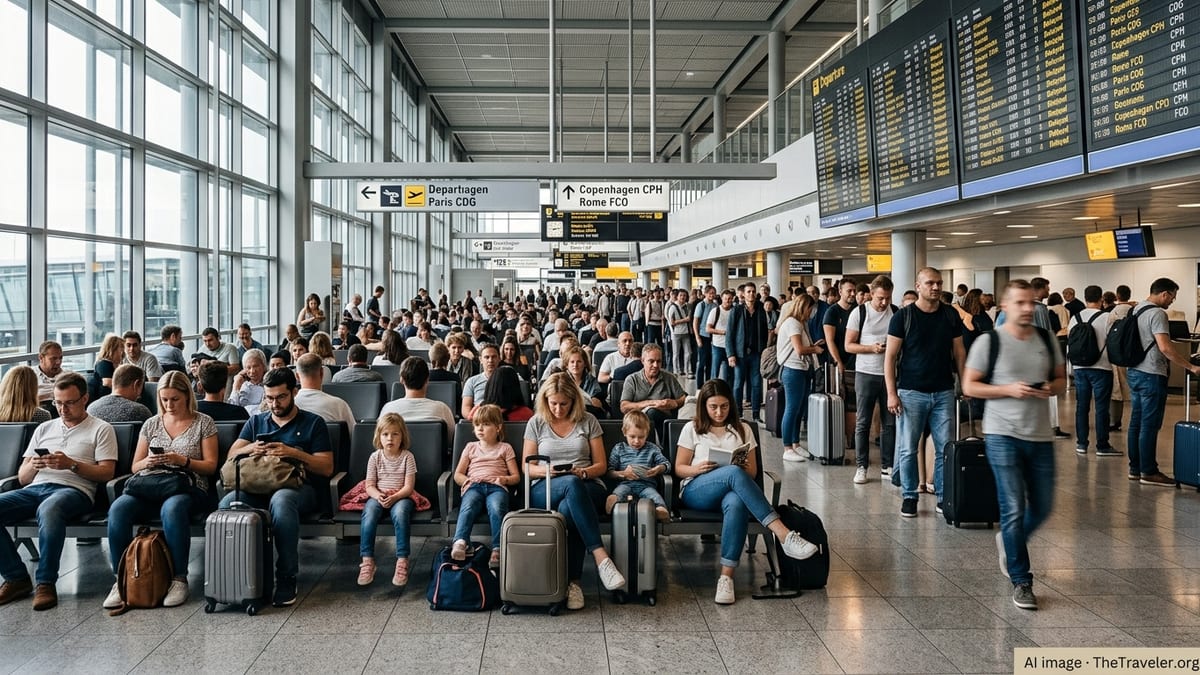
Widespread Disruption From Scandinavia to the Mediterranean
Publicly available flight-tracking dashboards and airport movement logs show a combined 989 delayed flights and 55 cancellations across multiple European airports over the latest 24 hour reporting period. The disruption has hit several of the region’s most important international gateways, notably Copenhagen in Denmark, Paris in France, Reykjavík in Iceland, Dublin in Ireland and Rome in Italy, with knock-on effects across wider airline networks.
Air France and KLM services through Paris and other European capitals recorded clusters of delays as aircraft and crews fell out of position. Data indicates that transatlantic and intra-European routes for United Airlines were also affected, particularly where connections relied on tightly timed transfers at European hubs. Gulf Air flights linking Europe with the Middle East experienced schedule pressure as slots and turnaround times tightened.
In northern Europe, Icelandair operations through Reykjavík saw holding patterns and revised departure times as congestion built through the day. At the same time, Scandinavian and continental European carriers operating to and from Copenhagen reported rolling delays that gradually spread into afternoon and evening banks of departures.
Across the network, the pattern mirrored previous disruption spikes seen in recent seasons in Europe, where a combination of weather, congested airspace and tight airline scheduling has left little slack for recovery once delays begin to accumulate.
Key Hubs Under Strain in Denmark, France, Iceland, Ireland and Italy
Copenhagen Airport in Denmark, one of the Nordic region’s main hubs, experienced a significant share of the delays, with departures to major European cities and long haul destinations pushed back by varying margins. Historical punctuality reports for Copenhagen normally show relatively strong on time performance, so a spike of this magnitude represents a clear departure from typical operations and quickly reverberates across connecting routes.
In France, Paris Charles de Gaulle and Paris Orly together handled a substantial portion of the impacted flights. Air France and partner airlines rely heavily on tightly banked waves of arrivals and departures in Paris to feed long haul services to North America, Africa, Asia and the Indian Ocean. When inbound flights arrive late, outbound waves are forced to wait for aircraft, crews and passengers, compounding delays into later parts of the day.
Reykjavík’s Keflavík Airport, which functions as a key transatlantic bridge, also reported elevated delays. The hub structure used by Icelandair and other operators means that when one arrival bank is disrupted, onward flights to both Europe and North America can quickly slide off schedule, leaving passengers facing missed connections and extended layovers in the terminal.
Dublin and Rome, both vital for short haul European links and long haul services, saw pressure on early morning and late evening departures. In Ireland, delays at Dublin have a cascading effect on services to the United Kingdom, continental Europe and North America. In Italy, Rome Fiumicino’s role as a primary gateway means that disruptions there can ripple through domestic routes as well as flights to the Americas, the Middle East and Africa.
Impact on Airlines and Travellers
The disruption has touched a broad range of airlines, with Air France, KLM, Icelandair, United Airlines and Gulf Air among those recording noticeable schedule changes on public timetables. Other European and international carriers using the same airports have also been caught in the congestion simply by sharing runways, taxiways and limited terminal resources at peak times.
For travellers, the immediate effect has been long queues at check in, security and customer service desks, along with rebookings onto later flights. Passengers on tightly timed connections have been particularly vulnerable, with many itineraries requiring same day adjustments or overnight stays when onward flights departed before delayed inbound services could arrive.
Irregular operations of this scale also create operational and financial challenges for airlines. Crews can run up against duty time limitations, forcing last minute changes or cancellations. Aircraft stranded in one city are unavailable in another, affecting flights that would otherwise have departed on time. Additional costs arise from providing meal vouchers, accommodation and ground transport when overnight delays occur.
Travel industry observers note that similar episodes over the past two years have highlighted structural constraints in Europe’s aviation system, where strong demand, staffing pressures and weather events frequently coincide to push airports and airlines close to capacity limits.
Weather, Congested Airspace and System Vulnerabilities
While precise causes vary by airport and individual flight, operational reporting points to a familiar set of factors behind the latest wave of disruption. Seasonal weather, including low cloud, strong winds and intermittent precipitation across parts of northern and western Europe, has at times reduced runway capacity and required greater spacing between aircraft for safety, slowing both arrivals and departures.
At the same time, European airspace remains highly congested, especially around major hubs in France, Germany, the Benelux countries, the United Kingdom and the Nordic region. When traffic levels are high, relatively minor issues such as temporary ground holds, minor technical inspections or late inbound aircraft can have outsized impacts, as there are few spare slots in the system to absorb knock on effects.
Recent analyses by aviation performance bodies have highlighted how closely European airlines now schedule aircraft to maximise utilisation. This strategy can improve efficiency in normal conditions but leaves limited margin for recovery after a disruption. A single delayed rotation early in the day may cascade across several subsequent flights if turnaround times are too tight to make up lost minutes.
These vulnerabilities have been visible during previous episodes involving winter storms, industrial actions or technology outages, and the latest figures on delays and cancellations suggest that the broader system remains sensitive to even modest upsets in day to day operations.
What Travellers Can Expect in the Coming Days
Published timetables and airport advisories indicate that airlines are working to restore schedules, but residual delays are likely to persist as carriers reposition aircraft and crews. Even after the headline numbers on delayed and cancelled flights begin to fall, some services may continue to depart slightly behind schedule while operations gradually realign.
Passengers due to travel through Copenhagen, Paris, Reykjavík, Dublin and Rome in the short term may encounter longer queues and busier terminals than usual, particularly during morning and evening peaks. Travellers with onward connections, especially those involving different airlines or separate tickets, remain at higher risk of missed links if any leg of their journey experiences additional delay.
Consumer information platforms and passenger rights organisations continue to remind travellers that flights departing from airports in the European Union, as well as flights into the EU on qualifying carriers, may fall under established air passenger protection rules when long delays or cancellations occur. Under these frameworks, travellers can in some cases claim assistance such as meals, accommodation and, in specific circumstances, financial compensation.
For now, the latest tally of 989 delayed flights and 55 cancellations underscores how quickly conditions can change in Europe’s crowded skies, and why travellers moving through the continent’s busiest hubs are being urged by information services to monitor their flight status closely and allow extra time for their journeys.