

More news on this day
Nepal is accelerating its push toward cashless tourism, with new cross-border payment options now being rolled out in Kathmandu’s Thamel district to make it easier for international visitors to pay in shops, restaurants, and hotels using their home-country wallets and cards.
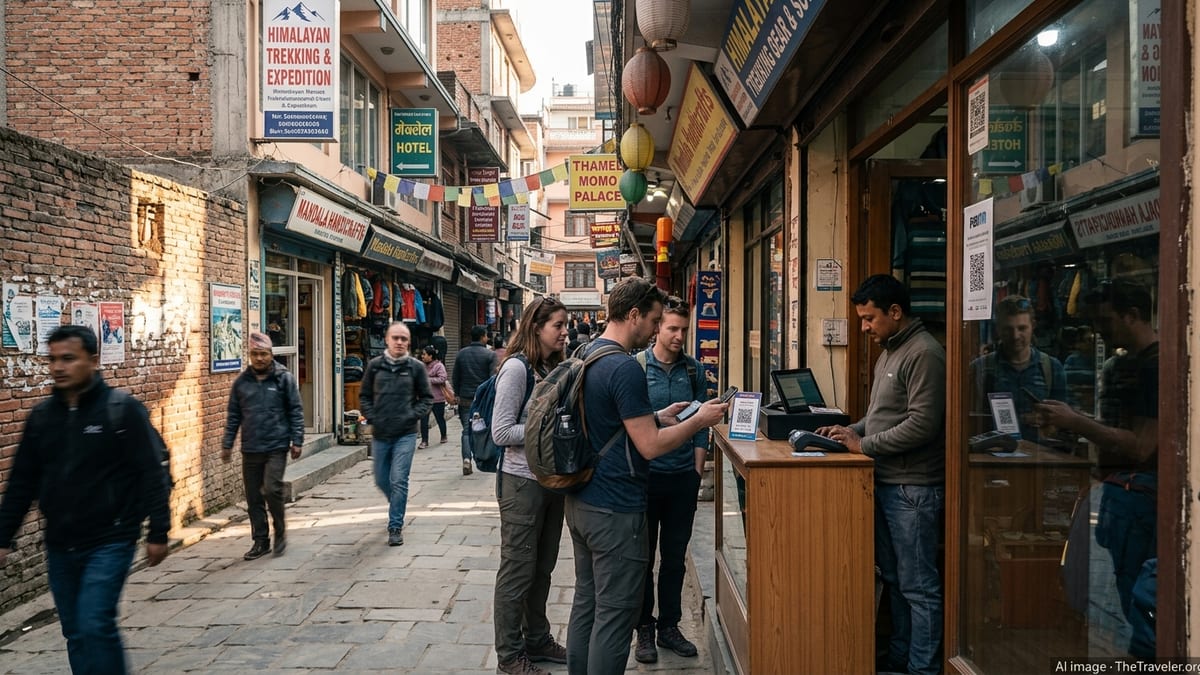
Thamel Emerges as a Testbed for Seamless Tourist Spending
Thamel, the dense warren of guesthouses, trekking agencies, bars, and handicraft shops in central Kathmandu, is emerging as a focal point for Nepal’s latest cross-border payments drive. Publicly available information shows that Thamel has already been one of the country’s busiest corridors for QR-based payments by Indian visitors, and new measures are now extending that digital infrastructure to a wider pool of international tourists.
Recent coverage of Nepal’s payment landscape highlights that foreign visitors are increasingly using QR codes and digital wallets at key tourism hotspots, with Thamel listed alongside Pashupatinath Temple and Pokhara’s Lakeside as leading locations for cross-border QR transactions. In this context, payment companies and local banks have been concentrating merchant onboarding, training, and signage campaigns in Thamel’s streets to normalize cashless payments for both visitors and businesses.
The new push in Thamel aligns with Nepal’s broader effort to position itself as a digitally ready destination for post-pandemic travelers, who are often accustomed to paying with their phones rather than carrying thick bundles of currency. For operators that survive on tight margins and seasonal flows, the ability to accept small-value, instant digital payments from a diverse tourist base is being framed as a way to stabilize revenue and reduce the risks associated with handling cash.
Stakeholders in the tourism and payments sectors also view Thamel as an ideal pilot zone because of its high merchant density and short feedback loops. If cross-border QR and card solutions prove reliable and popular in Thamel’s cafes and trekking shops, industry observers expect the model to be scaled more aggressively into other tourist centers such as Pokhara, Chitwan, and Lumbini.
Expansion of QR-Based Cross-Border Wallet Acceptance
Nepal’s national QR infrastructure, centered on networks such as NEPALPAY and Fonepay, has been steadily opened to international wallets over the past two years, and Thamel is one of the first neighborhoods where those connections are being felt on the ground. According to published coverage, visitors from multiple Asian and European markets can now scan interoperable QR codes in Nepal using their existing mobile wallets, with payments routed through cross-border partners.
Reports on recent partnerships indicate that Nepalese payment system operators have integrated with India’s Unified Payments Interface for person-to-merchant QR transactions, as well as with Alipay+ and other international schemes that aggregate wallets from markets including China, Hong Kong, South Korea, Malaysia, the Philippines, Singapore, Thailand, Mongolia, and parts of Europe. This means that a visitor may be able to pay in Thamel using a familiar home-country wallet, while the Nepali merchant settles in local currency.
Regulatory updates from Nepal Rastra Bank and clearing houses describe these QR connections as part of a broader policy to allow digital retail payments in foreign currencies under controlled conditions. Published documents show that the cross-border QR framework is designed to sit on top of existing domestic standards, so that a single merchant QR in Thamel can, in principle, accept a range of international wallets without requiring different codes at the counter.
Local media accounts suggest that payment operators have been concentrating their earliest cross-border deployments in tourism-facing merchants, from souvenir shops and trekking outfitters to mid-range hotels, where average ticket sizes are manageable and demand for frictionless payments is high. Over time, observers expect QR acceptance to expand outward from Thamel into transport, entertainment, and even small neighborhood stores that cater to longer-stay visitors.
New Card and Gateway Options Target Foreign Nationals
Alongside QR wallets, Nepal is also introducing new card payment facilities that aim to reduce friction for foreign nationals spending in tourism corridors like Thamel. Sector-specific outlets report that the government has begun rolling out card acceptance for certain public payments, while banks and gateways are upgrading point-of-sale terminals and e-commerce capabilities to handle a wider variety of international cards.
Tourism-focused publications note that the initial government card initiative is centered on immigration-related fees, but there are plans to extend coverage to agencies such as the Nepal Tourism Board. For travelers, that would mean more opportunities to pay official charges and tourism services with international debit or credit cards instead of cash. While these card facilities are not confined to Thamel, operators in the district see them as complementary to private-sector initiatives that are equipping hotels, restaurants, and tour agencies with modern terminals.
Banks that are part of the NEPALPAY ecosystem have also signed agreements to support cross-border QR and card payments for tourists from a growing list of countries, using merchant QR codes and interoperable acquiring solutions. According to publicly available agreements, this includes arrangements that allow tourists to pay via their existing wallets linked to international card rails, with Nepali acquirers handling settlement and foreign exchange on the back end.
Industry observers say that these developments collectively reduce the reliance on cash advances from ATMs, which have long been a pain point for visitors due to withdrawal limits, outage risks, and uncertainty over fees. For businesses in Thamel, the shift toward card and wallet-based spending also promises more predictable reconciliation and reduced exposure to counterfeit notes.
Tourism Strategy and Business Impact in Kathmandu’s Core
The focus on cross-border payments in Thamel is closely tied to Nepal’s bid to lift annual visitor numbers and increase average tourist spending. Policy documents and economic briefings frame digital payments as part of a package of reforms that also include easier road access for foreign vehicles and simplified fee structures for neighboring-country tourists, all of which are aimed at making travel to Nepal more convenient.
For Thamel’s thousands of small and micro businesses, the new payment options arrive against a backdrop of rising operational costs and changing traveler expectations. Hotel and restaurant operators are navigating a clientele that is more likely to compare destinations based on how seamlessly they can pay, whether for a last-minute room, a trekking permit, or a coffee between flights. Accepting international QR and card payments is increasingly seen as an entry-level requirement rather than a bonus service.
Observers point out that digital payments also produce transaction data that can help businesses and policymakers better understand tourist behavior. Aggregated statistics on spending patterns in Thamel could, over time, influence decisions about infrastructure investment, urban management, and destination marketing, as authorities and private stakeholders look for ways to spread visitor flows beyond a few congested streets.
However, commentators also highlight challenges, including the need for reliable internet connectivity, merchant education on chargebacks and fraud, and clear communication about any foreign exchange or service fees borne by travelers. How effectively these issues are managed in Thamel’s rollout is expected to shape perceptions of Nepal’s broader digital tourism push.
What the New Systems Mean for Visiting Tourists
For tourists planning a stay in Thamel, the expanding network of cross-border payment options is likely to translate into more flexibility and less reliance on cash, though experiences may vary by country and provider. Public information from payment companies suggests that not every foreign wallet or card will be accepted everywhere, and that travelers should still carry some cash and a backup card.
Travel advisories and industry commentary encourage visitors to check with their home-country banks or wallet providers about compatibility with Nepali merchants before departure, particularly in relation to QR-based payments that ride on regional schemes such as UPI or Alipay-linked networks. Some services may only function for specific card issuers or in certain merchant categories, while others might impose limits on transaction size or total daily spending.
Despite these caveats, the direction of travel is clear. With Thamel as a showcase, Nepal is working to position itself among the growing number of destinations where international visitors can pay for everyday travel needs using familiar digital tools. Over the coming seasons, travelers can expect to see more QR stickers on shopfronts, more card terminals at hotel receptions, and more signage indicating that cross-border payments are welcomed.
For a district that has long been a gateway for treks to the Himalaya and a meeting point for travelers from around the world, the move toward interoperable digital payments marks another step in Thamel’s evolution from a backpacker enclave into a more diversified, digitally enabled tourism hub.