

More news on this day
Kenya Airways is drawing growing passenger traffic from the Netherlands as part of a wider shift in its long-haul network, using new and adjusted services via Amsterdam to capture demand reshaped by geopolitical tensions and evolving global travel patterns.
Get the latest news straight to your inbox!
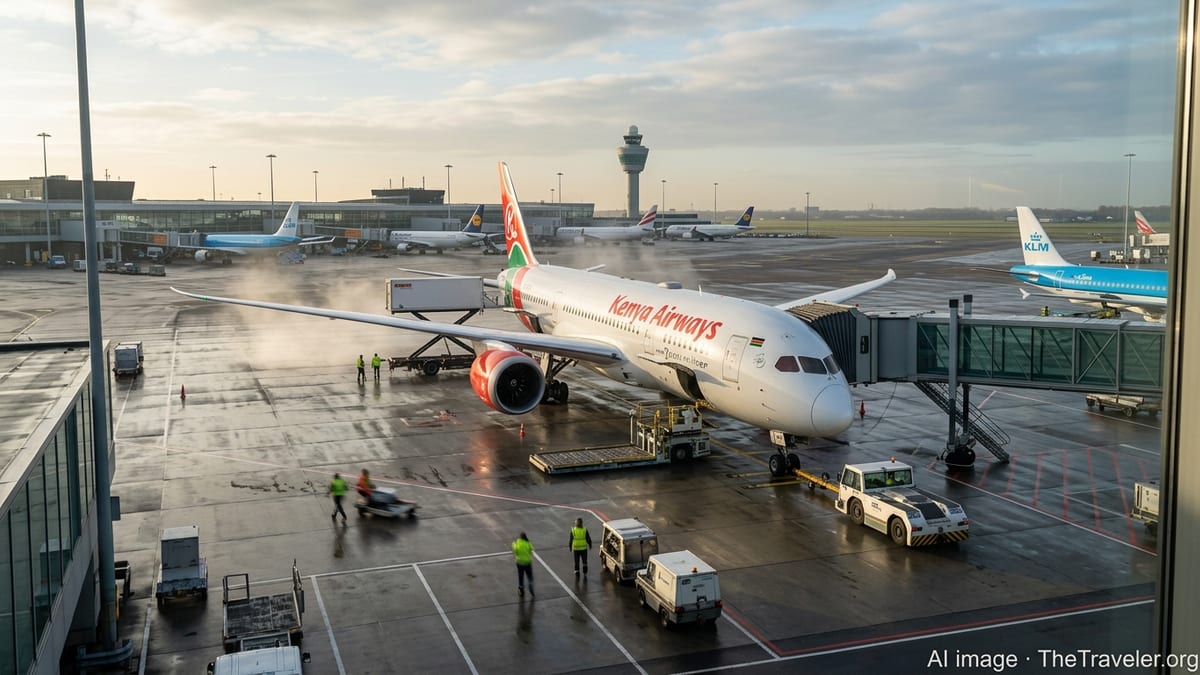
Amsterdam Strengthens Kenya Airways’ European Gateway Strategy
Publicly available schedule data and airline announcements show that the Netherlands is becoming increasingly important in Kenya Airways’ European strategy. Amsterdam Airport Schiphol already serves as a key gateway for the carrier’s partnership with KLM, and Kenya Airways is now layering additional connectivity that links Nairobi, Paris and Amsterdam in a triangular pattern effective September 1, 2025. The routing is designed to complement existing nonstop services, giving passengers more options between East Africa and continental Europe.
Industry route trackers and airline communications indicate that, from late 2025, Nairobi to Amsterdam frequencies will be partially restructured, with a mix of nonstop and one-stop services via Paris. While some nonstop frequencies are reduced on certain days, the overall network around Amsterdam is being reshaped to balance aircraft availability, seasonal demand and connecting flows through the wider SkyTeam alliance. This allows Kenya Airways to keep a strong presence in the Dutch market while tapping additional traffic from France and beyond.
Amsterdam’s position as one of Europe’s busiest and most connected hubs further supports this strategy. Recent traffic figures show Schiphol recovering strongly, with passenger numbers and cargo volumes up on pre-pandemic comparisons, reinforcing its role as a preferred transfer point for travelers heading between Africa, Europe, North America and Asia. For Kenya Airways, this means that maintaining and fine-tuning its Dutch footprint is central to growing premium leisure and business passengers.
Geopolitical Tensions Reshape Long-Haul Travel Flows
Global geopolitical tensions and changing risk profiles are reshaping how passengers move across continents, and Kenya Airways is positioning its network to capture some of this diverted traffic. Restrictions and overflight challenges linked to conflicts in Eastern Europe and the Middle East have complicated routings on traditional Europe–Asia and Europe–Middle East corridors. Industry economic reports point to robust growth on Africa–Asia markets even as some other long-haul flows face capacity constraints and operational challenges.
Kenya’s location on the eastern edge of Africa gives Nairobi a natural advantage as a midway hub linking markets such as Japan, India and Southeast Asia to Europe and North America. While Kenya Airways does not operate nonstop flights to Japan, it benefits from connecting passengers traveling via European and Middle Eastern partners, including through Amsterdam and other major hubs. As airlines adjust their schedules to avoid certain airspaces, routings via East Africa and the western Indian Ocean have become more attractive in schedules and alliance planning.
Available analysis from aviation associations shows African airlines growing international capacity, particularly on routes connecting Africa to Europe, North America and Asia. Kenya Airways, which has faced fleet and financial challenges in recent years, is attempting to harness that growth by concentrating scarce widebody capacity on corridors where geopolitical disruptions have tightened supply yet left underlying demand resilient. This helps explain why services touching the Netherlands, Germany, Spain, the United States and other key origin markets are being prioritized and recalibrated rather than cut.
Transatlantic and European Markets Drive Passenger Growth
Kenya Airways’ decisions in Europe are closely linked to its performance on transatlantic and intercontinental routes. Public information from the airline’s recent network updates highlights added flights between Nairobi and New York during peak travel periods, confirming that the US market remains one of its strongest long-haul performers. The carrier has also secured landing slots at London Gatwick to complement its existing London Heathrow service, strengthening access from the UK, one of Kenya’s top tourism and trade partners.
Beyond the Netherlands and the UK, Kenya Airways maintains or develops links that channel passengers from Germany, Spain and other European countries into its Nairobi hub, often via alliance partners. German and Spanish travelers, along with passengers from France and the Nordic region, increasingly use Amsterdam and other European hubs as gateways to East Africa, safaris and Indian Ocean resorts. Kenya Airways benefits when these flows are funneled through SkyTeam partner networks that offer coordinated schedules and through-ticketing onto its Nairobi services.
Industry commentary suggests that intercontinental routes now contribute a growing share of revenue for many African carriers, offsetting weaker intra-African demand. For Kenya Airways, passenger growth from Europe and North America is especially critical as it works through aircraft groundings and supply chain issues that have constrained capacity. Concentrating on high-yield flows from the Netherlands, Germany, Spain, the US and similar markets allows the airline to maximize the utilization of its Boeing 787 fleet while maintaining its role as a regional connector.
Partnerships, Sustainability and Network Resilience
The Netherlands’ rising importance to Kenya Airways is not limited to passenger volumes. The longstanding partnership between Kenya Airways and KLM, which dates to the 1990s, continues to shape how both carriers coordinate schedules and share traffic between Amsterdam and Nairobi. Joint venture arrangements, codeshares and aligned timetables help smooth connections from Dutch, German, Scandinavian and other European cities onto Kenya Airways’ African network, while also offering African travelers one-stop access to major European and transatlantic destinations.
The collaboration has recently extended into sustainability initiatives. A jointly backed roadmap on sustainable aviation fuels, developed through meetings in Nairobi, outlines how Kenya Airways and partners based in the Netherlands aim to accelerate the use of cleaner fuels in African aviation. Public documents describe Kenya Airways as carrying more than five million passengers a year, underscoring why gradual adoption of sustainable aviation fuels is viewed as essential to balancing growth with environmental responsibilities.
At the same time, Kenya Airways has acknowledged that engine availability constraints and grounded aircraft have weighed on its financial results. Company disclosures describe a period in which three Boeing 787s were out of service, forcing adjustments across the long-haul network. Nevertheless, the carrier reports that international passenger demand remains robust, particularly on key European and North American routes. The ability to lean on partners in the Netherlands and elsewhere for connectivity and marketing support has become a central element of Kenya Airways’ strategy to weather such disruptions.
Seizing a Strategic Window for East Africa
Broader industry data from African and global aviation bodies indicates that passenger traffic on African carriers is expected to continue rising through 2025, even as economic and geopolitical uncertainties persist. International capacity on African airlines has increased, with growth especially strong on routes linking the continent with Asia and relatively solid demand on Africa–Europe and Africa–North America sectors. Kenya Airways is attempting to use this window to reinforce Nairobi’s position as an East African hub, focusing on markets where competitive pressure is manageable and partnerships can amplify its reach.
By tightening its links with the Netherlands and other mature source markets such as Japan, Mexico, Germany, Spain and the United States, the airline is effectively aligning itself with shifting travel patterns. Leisure travelers are seeking new routings to avoid congested or politically sensitive corridors, while business travelers and diaspora communities look for reliable one-stop options between emerging African economies and established global centers. Routes that combine Nairobi with Amsterdam, Paris, London and New York are well placed to address those needs.
Kenya Airways’ next phase of growth will depend on how successfully it can restore its fleet, manage costs and deepen collaboration with European partners anchored in the Netherlands. For now, adjustments to Amsterdam services, new slot wins in the UK and targeted capacity on the US route network all point to a strategy that treats geopolitical disruption not just as a risk, but as an opening to secure a larger share of intercontinental passenger traffic flowing through East Africa.