

More news on this day
The Netherlands has joined the United Kingdom, Germany, Thailand, Spain, Japan, China and several other countries in coordinating emergency travel measures after Qatar Airways extended widespread flight cancellations until late March, deepening disruption across one of the world’s key long-haul transit hubs.
Get the latest news straight to your inbox!
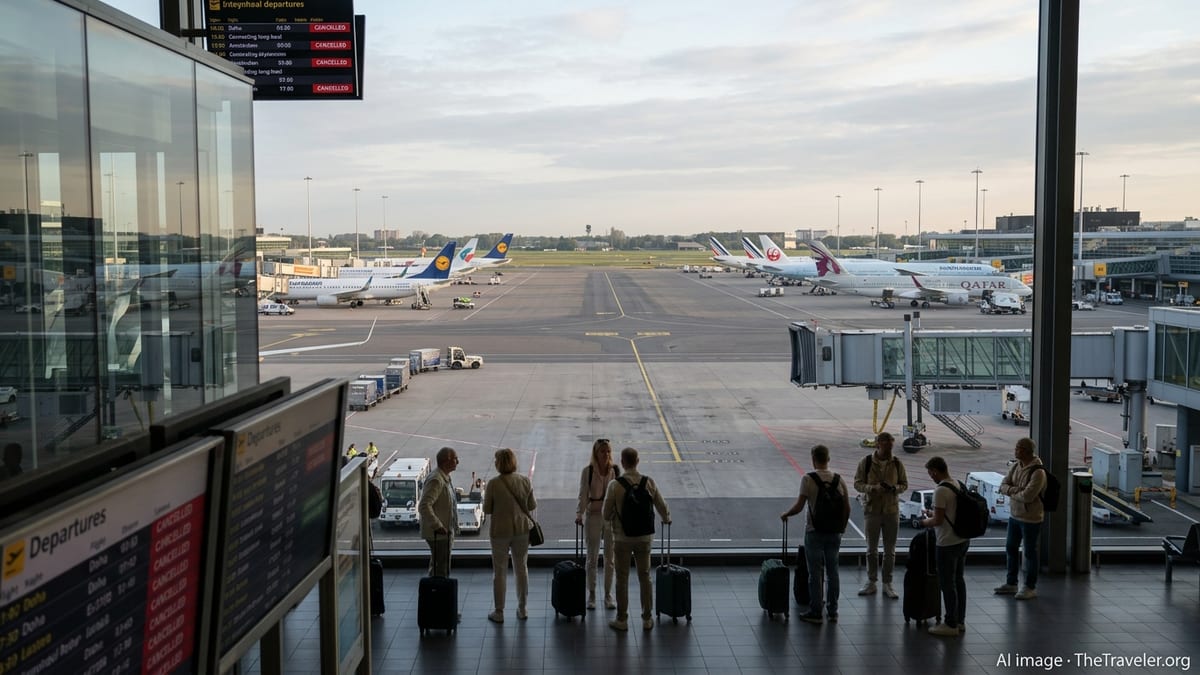
Extended Qatar Airways Cancellations Deepen Global Disruption
Qatar Airways has prolonged the suspension or cancellation of most regular passenger services until the latter part of March, in response to the continuing closure and restricted use of Qatari airspace following recent missile strikes and regional military escalation. Publicly available information from aviation authorities and airline advisories indicates that only limited relief and repatriation services have been operating, with standard commercial schedules still largely on hold.
The extension of cancellations into late March affects passengers across Europe, Asia, Africa and the Americas who rely on Doha’s Hamad International Airport as a connecting hub. Reports from airline communication channels and traveler forums show that Qatar Airways has repeatedly widened its waiver policies, initially covering departures through early March and then progressively extending eligibility for refunds and date changes further into the month as the airspace situation fails to normalize.
While some narrowly defined emergency corridors have allowed one-off repatriation flights to cities such as London, Paris, Madrid, Rome and Frankfurt, these operations remain exceptions rather than a sign of full resumption. Travel advisories emphasize that the airline intends to restore its network only when regulators confirm that routine operations through Qatari airspace can be conducted safely.
Netherlands Coordinates Response Alongside UK, Germany and Others
The Netherlands has now aligned itself with a growing group of governments including the United Kingdom, Germany, Thailand, Spain, Japan and China that are coordinating emergency responses to the ongoing disruption. According to published coverage and official travel advice, Dutch authorities have been updating guidance for citizens transiting through Doha, while also working within European and international channels to monitor the security and aviation risk environment.
Similar actions are visible across Europe and Asia. The United Kingdom and Germany have issued regular updates to their foreign travel advice, flagging continued uncertainty for itineraries involving Doha and advising passengers to check with airlines before departure. Spain has also highlighted potential knock-on effects on services to and from Latin America and North Africa that frequently connect via Qatar Airways.
In Asia, publicly available advisories from Thailand, Japan and China underline the scale of disruption for travelers heading to Europe, the Middle East and Africa. Many of these journeys would typically route through Doha, and regional media reports describe a surge in demand for alternative connections via other Gulf and Asian hubs, as well as pressure on limited seat availability over peak spring travel periods.
Refunds, Rebookings and the Scramble for Alternative Routes
As cancellations stretch toward the end of March, passenger experiences shared across consumer platforms indicate a patchwork of options. Qatar Airways has issued a series of updated passenger guidelines allowing affected travelers to request full refunds, change dates within specified windows or, in some cases, be rerouted on other carriers when seats are available. However, travelers report that rerouting capacity is constrained, especially on popular routes between Europe and Southeast Asia or Australia.
Publicly available information suggests that the airline initially limited its most flexible policies to tickets with original departure dates in the first half of March, then gradually broadened refund eligibility toward later dates in the month as it became clear that normal operations would not quickly resume. Some travelers holding tickets for the second half of March report that refund and rebooking options have improved in recent days, but many remain uncertain whether future departures will in fact operate.
The scramble for alternatives has driven passengers toward other major carriers in the Gulf and across Europe and Asia. Reports from online booking platforms and travel agencies point to rising fares and shrinking availability on routes that bypass Doha, particularly around late March when many travelers have already postponed earlier trips. For some, the cost of switching carriers at short notice has become a significant barrier, encouraging passengers to wait in the hope that their original flights will be reinstated.
Government Advisories and Airport Measures in Affected Countries
Beyond the Netherlands and its European partners, several governments in Asia and other regions have been issuing rolling updates as the situation evolves. Public guidance generally urges passengers with itineraries involving Doha to monitor airline notifications closely, consider flexible booking options and allow extra time for potential re-routing via alternative hubs. Some countries also recommend that travelers avoid non-essential transit through conflict-adjacent airspace while the security outlook remains volatile.
Major airports in affected countries, including in the Netherlands, the United Kingdom, Germany, Spain, Thailand, Japan and China, have reported periodic congestion around customer service desks as passengers seek clarity on their options. Travel industry coverage notes that handling agents and airport staff have been working with multiple airlines to process last-minute changes, though the speed and ease of rebooking vary widely by carrier, point of sale and fare conditions.
Insurance providers and consumer advocates are also drawing attention to the role of travel protection policies and international air passenger regulations. Many standard policies cover certain types of disruption, but coverage often depends on whether a flight is formally cancelled, how long delays last and whether travelers purchased additional protection for political or security-related incidents.
What Late-March Travelers Should Expect in the Coming Days
With Qatar Airways signaling cancellations and severe schedule reductions until late March, travelers holding bookings in the second half of the month face a narrowing window for decisions. Publicly available airline notices indicate that further updates are typically issued in short increments, often expanding the date range for cancellations and waivers by a few days at a time as the security picture evolves.
Travel experts quoted in media coverage recommend that passengers weigh the risk of ongoing disruption against the rising cost of alternative routes. Those with critical journeys, such as relocations, essential work trips or time-sensitive personal travel, may wish to secure backup options on other carriers, even if they are more expensive, while continuing to monitor the status of their Qatar Airways flights.
For now, the extension of cancellations into late March, combined with the coordinated emergency posture adopted by the Netherlands and a widening circle of countries, underscores the continuing fragility of air connectivity through the Gulf region. Until Qatari airspace reopens for routine operations and airlines can reliably schedule services through Doha, travelers are likely to face a combination of uncertainty, limited options and elevated fares on many long-haul routes.