

Planning a trip to the Low Countries but torn between the Netherlands and Belgium? You are not alone. These close neighbors share flat landscapes, medieval cities, and excellent rail connections, yet they offer very different travel personalities. Choosing between them really comes down to the kind of experience you want: sharp and modern or slow and nostalgic, canal houses or gilded squares, craft beer or canal-side cafés. This guide walks you through the key differences so you can decide which destination is better for your trip, or whether to combine both in one itinerary.
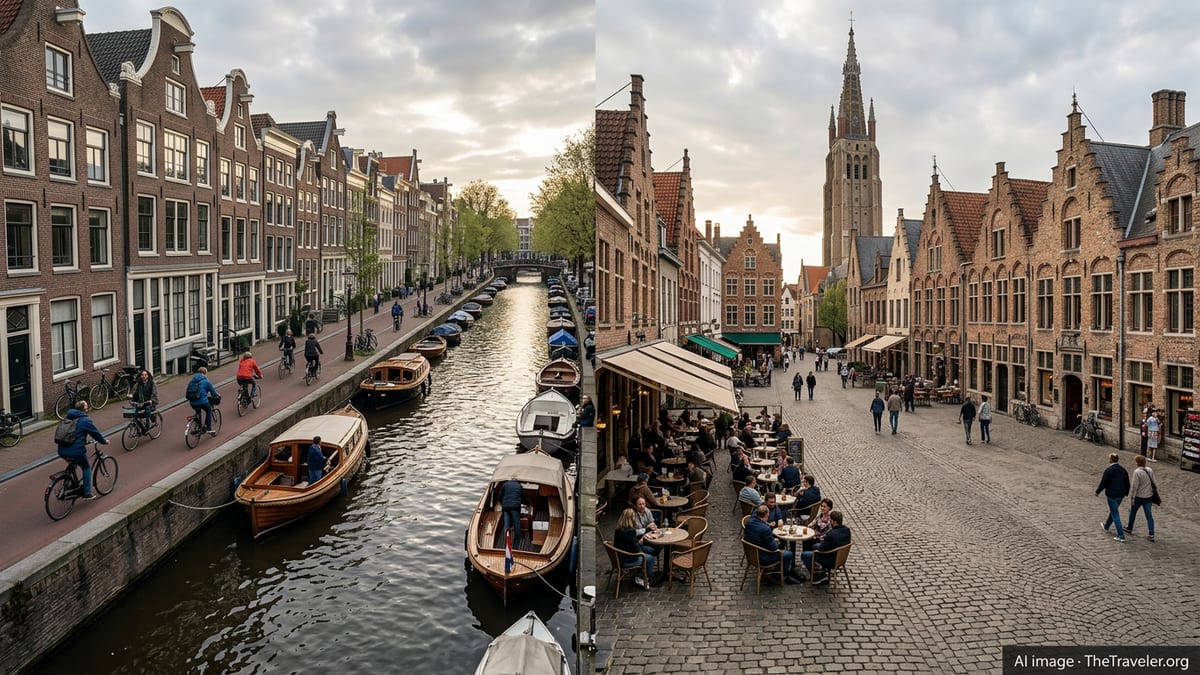
Overall Vibe: Modern Energy vs Old-World Charm
The Netherlands often feels crisp, organized, and forward-looking. Cities like Amsterdam, Rotterdam, and Utrecht mix historic canals with contemporary architecture and strong design culture. Public spaces typically appear tidy and carefully planned, from dedicated bike lanes to polished waterfronts. Many travelers describe Dutch cities as efficient and easy to navigate, with a strong emphasis on cycling, sustainability, and practical urban planning.
Belgium, by contrast, leans into its patina and texture. Brussels, Bruges, Ghent, and Antwerp showcase cobbled streets, ornate guild houses, and slightly weathered facades that give them a soft, old-Europe atmosphere. Things can feel less tightly organized than in the Netherlands, but that relaxed, slightly chaotic edge is exactly what many visitors love. Cafés spill casually onto squares, and time seems to move a little slower.
If you enjoy a feeling of order, clear systems, and a modern aesthetic wrapped around historic cores, the Netherlands may suit you better. If you are drawn to moody medieval streets, atmospheric alleys, and an emphasis on lingering in cafés and brasseries, Belgium often wins. Many travelers choose to start in the structured Netherlands, then drift south into Belgium for a more languid finale.
In practical terms, both countries feel generally safe, walkable in city centers, and comfortable for first-time visitors to Europe. English is widely spoken in both, so the choice is far more about ambiance than accessibility.
Top Cities and Sights: What You Will Actually See
In the Netherlands, Amsterdam remains the main draw, with its canal belt, Golden Age houses, and heavyweight museums such as the Rijksmuseum and the Van Gogh Museum. Beyond the capital, Utrecht offers a similar canal charm with fewer crowds, while Rotterdam attracts architecture fans with its bold skyline and rebuilt waterfront. Smaller historic towns such as Haarlem, Leiden, Delft, and Den Bosch give a gentler, compact taste of Dutch history with easy day-trip access by train.
Belgium’s city highlights are more concentrated in a smaller area. Brussels combines European Union institutions with a richly decorated old center, including the Grand-Place and Art Nouveau townhouses. Bruges seduces visitors with its picture-perfect canals and medieval core, Ghent blends student energy with Gothic towers and riverside quays, and Antwerp offers a mix of port-city grit, fashion, and Baroque art. Thanks to short rail distances, it is easy to base yourself in one city and day trip to others.
If your main goal is world-class museums and a deep dive into Dutch painting, the Netherlands has the edge. If you imagine yourself wandering cobbled squares framed by stepped gables and ornate facades, Belgium’s historic cities may better match your mental postcard. Coastal travelers will find broad sandy beaches and resort towns in both countries, but the Dutch coast is generally more oriented toward wind sports and nature reserves, while the Belgian coast is lined with more continuous beach towns and promenades.
For those with more time, both countries also provide access to less-touristed corners. In the Netherlands, the northern provinces such as Friesland and Groningen offer open skies, quiet villages, and the Wadden Sea islands. In Belgium, Wallonia brings rolling hills, castles, and forests in the Ardennes, a pleasant contrast to the flat Flemish north.
Culture, Language, and Local Personality
The Netherlands and Flanders in northern Belgium share the Dutch language, while southern Belgium is predominantly French-speaking, with German spoken in a smaller eastern area. For most visitors, English proficiency is very high across both countries, especially in cities and in younger generations, so language rarely becomes a barrier. Still, you may notice subtle differences: Dutch in the Netherlands tends to sound a bit sharper to foreign ears, while Flemish Dutch in Belgium is often perceived as softer in tone.
Culturally, the Netherlands has a reputation for directness and a certain pragmatic openness. You may find that service interactions are efficient and to the point, and topics that might be considered sensitive elsewhere are discussed quite matter-of-factly. This can feel refreshing to some travelers and blunt to others. Public life leans strongly secular, with a visible emphasis on personal freedom and individual choice.
Belgium’s social style is sometimes described as more understated and reserved at first, but warm and convivial once you settle into a café or restaurant for a while. In Flanders, you might notice a quieter version of Dutch culture with a strong attachment to tradition, while in Wallonia the rhythm and café culture feel closer to northern France. Long meals, lingering over drinks, and a certain unhurried approach to the day are common features.
If you enjoy straightforward communication and highly structured systems, you may feel immediately at home in the Netherlands. If you prefer a softer, more low-key social tone and a focus on food and lingering conversation, Belgium may resonate more. In practice, you are likely to encounter friendly, helpful people in both, especially if you greet locals politely and show an interest in the place.
Food, Drink, and Nightlife
Food can be a decisive factor when choosing between these neighbors. Belgium has an outsized reputation for its culinary scene relative to its size. It is famous for rich stews, moules frites, waffles, pralines, and a serious restaurant culture that ranges from simple brasseries to Michelin-starred dining. Belgian beer is a major attraction in its own right, from Trappist ales to farmhouse saisons and strong dark brews served in proper glassware. Many travelers plan entire evenings around visiting historic beer cafés, brewery taprooms, and tasting rooms.
The Netherlands is rarely the first country people mention for classic European cuisine, but it has quietly built a strong food reputation in recent years. Traditional Dutch fare includes hearty dishes, cheese, pancakes, and street snacks like herring and deep-fried croquettes. In cities, the real strength lies in international variety: Indonesian rijsttafel, Surinamese and Caribbean flavors, contemporary vegetarian and vegan spots, and a wide range of Asian and Middle Eastern cuisines. For travelers who value global food options and modern café culture, the Netherlands can be surprisingly impressive.
Nightlife styles differ too. Amsterdam has a well-established nightlife scene with canal-side bars, music venues, and clubs, plus a reputation for liberal attitudes toward cannabis and sex work. Other Dutch cities like Rotterdam and Utrecht offer a more local, creative feel with live music and design-forward bars. Belgian nightlife tends to be more focused on sociable drinking, smaller bars, and live music, though Brussels and Antwerp both have solid club scenes. In Bruges and smaller towns, evenings often revolve around cozy pubs rather than late-night dancing.
If your dream trip involves tasting a different beer style every night in atmospheric taverns and splurging on refined restaurant meals, Belgium is difficult to beat. If you are excited by multicultural food scenes, specialty coffee, and a mixture of bars and clubs, the Netherlands might be the better fit.
Costs, Crowds, and Practical Travel
Both the Netherlands and Belgium sit in a similar price band to other Western European destinations, though travelers often find the Netherlands slightly more expensive overall, especially in Amsterdam. Hotel rates in central Amsterdam and peak-season prices across the Dutch coast can be notably high. Belgium’s tourist centers like Bruges are not cheap either, but you may find somewhat better value in Brussels, Ghent, or Antwerp when booked ahead, especially outside major festivals and events.
Crowds are another important factor. Amsterdam and Bruges are among the most visited cities in Europe relative to their size, and both have been grappling with the impact of heavy tourism. Amsterdam has introduced measures to manage visitor behavior and spread tourism beyond the city center, while Bruges encourages overnight stays and visits beyond midday peak hours. In both places, traveling in shoulder seasons, staying slightly outside the most popular areas, and exploring secondary cities can dramatically improve your experience.
Public transport is a strong point for both countries. The Netherlands is known for efficient, frequent trains that connect major cities in under an hour in many cases, along with a famously dense network of bike paths that make cycling an everyday mode of travel. Belgium’s rail system also offers frequent intercity services, especially between Brussels and the major Flemish cities, and it is straightforward to hop between cities on day trips. Crossing the border by train between Amsterdam and Brussels is simple, with multiple direct services per day and journey times of roughly two to three hours, depending on the train you choose.
For most travelers, there is no need to rent a car in either country unless you plan to focus on rural areas or the countryside. Using trains and local public transport, combined with walking and cycling, is usually more convenient and avoids parking challenges in historic centers.
Nature, Cycling, and Small-Town Escapes
Nature lovers and cyclists often gravitate to the Netherlands, which has made cycling a national way of life. Extensive, well-marked bike routes run through cities, along canals, and across the countryside. You can cycle between towns on separated paths for much of the way, and bike rental is easy in most urban areas. Flat terrain and strong cycling infrastructure make the country accessible even for less experienced cyclists, with popular routes through polder landscapes, flower fields in spring, and along the North Sea coast.
Belgium also offers enjoyable cycling, though infrastructure can be more varied. Flanders has increasingly invested in dedicated bike routes, and many visitors enjoy leisurely rides between towns or along canals. In Wallonia, the Ardennes bring gentle hills and wooded valleys, providing scenic rides and hikes that contrast with the lowland plains to the north. Wild-feeling forests, river valleys, and small villages make good bases for walking holidays and outdoor weekends.
When it comes to small-town charm, both countries shine in different ways. Dutch towns such as Delft, Leiden, Gouda, and Hoorn feature tidy canals, gabled houses, and central market squares that feel instantly recognizable from postcards. Belgian towns like Mechelen, Leuven, and Dinant lean more into stone facades, belfries, and slightly more weathered streetscapes that feel older in mood, even when they are similar in age.
If your priority is an easy, bike-centric trip with well-developed routes and a strong emphasis on water landscapes and modern infrastructure, the Netherlands holds a clear advantage. If you want a mix of gentle outdoor activities and storybook stone towns with a slightly more rustic edge, Belgium may appeal more.
Trip Styles: Who Each Country Suits Best
For first-time visitors to Europe, the Netherlands often works especially well. Amsterdam’s international air connections, clear public transport, and wide use of English make arrivals straightforward. The country is compact enough that you can see several cities on short day trips without changing hotels frequently. Travelers who like structured sightseeing, major museums, design-forward neighborhoods, and an active, outdoorsy urban experience often feel the Netherlands matches their pace.
Belgium tends to charm travelers who value atmosphere over checklists. Many visitors use Brussels as an arrival hub, then spend most of their time in Bruges, Ghent, Antwerp, or smaller towns, moving slowly between them. This can be a particularly good fit for couples’ getaways, food-focused travel, and return visitors to Europe who have already seen the major capitals and now want to settle into one region more deeply.
Short trips of three to four days often favor picking one country and digging in, usually Amsterdam plus one secondary Dutch city or Bruges and Ghent with perhaps a quick stop in Brussels. Longer trips of one to two weeks can easily include both countries, linked by fast trains between Amsterdam and Brussels or Antwerp. In that case, it can work well to start with a few days in the Netherlands for museums and cycling, then glide into Belgium for food, beer, and medieval ambiance.
Solo travelers, families, and older visitors can feel comfortable in both destinations. Families may lean toward the Netherlands for its pedal-friendly cities, open parks, and interactive museums, while adults traveling without children might prioritize Belgium if gourmet meals and long evenings in historic bars are at the center of their plans.
The Takeaway
So which destination is better for your trip, the Netherlands or Belgium? There is no universal answer, because they excel in different ways. The Netherlands stands out for its cycling culture, efficient infrastructure, and world-class museums wrapped in a modern, organized package. Belgium captivates with its culinary scene, legendary beer, and hauntingly beautiful medieval cities that invite slow exploration.
If you picture yourself gliding along immaculate bike paths, museum-hopping by day and relaxing beside sleek canals at night, the Netherlands should probably come first on your list. If your dream is to lose track of time in cobbled squares with a strong ale in hand, savoring rich dishes and admiring centuries-old facades, Belgium is likely your best match.
The good news is that you do not really have to choose. Thanks to short distances and frequent trains, combining both countries in a single itinerary is remarkably easy. Think of them as two complementary personalities within one region: the clear-lined, forward-looking Netherlands and the romantic, indulgent Belgium. Whichever you choose, you will find an accessible, welcoming destination that rewards wandering, curiosity, and a willingness to slow down just enough to watch daily life unfold along the canals and squares.
FAQ
Q1. Is the Netherlands or Belgium better for a first trip to Europe?
For a first trip, many travelers find the Netherlands slightly easier because of its very straightforward transport, compact layout, and clear tourist infrastructure. Belgium is just as rewarding, but its charm often lies in slower exploration and lingering in a few cities rather than rushing between sights.
Q2. Which country is more budget friendly for travelers?
Costs are broadly similar, but everyday expenses in Amsterdam and popular Dutch coastal towns can feel higher than in many Belgian cities. With careful planning and travel in shoulder seasons, you can manage a mid-range budget in either country, though Belgium sometimes offers slightly better value on food and drink.
Q3. Where will I find better food, in the Netherlands or Belgium?
Belgium has a stronger traditional food reputation, with rich dishes, excellent chocolate, and a serious restaurant culture. The Netherlands shines for international cuisine, from Indonesian and Surinamese influences to innovative vegetarian options. If you are after classic European comfort food, Belgium usually wins, while the Netherlands is ideal for global variety.
Q4. Which destination is better for beer lovers?
Belgium is a world leader for beer, with an extraordinary range of styles, historic breweries, and characterful bars. Serious beer enthusiasts can easily build entire itineraries around Belgian breweries and cafés. The Netherlands has a growing craft beer scene too, but for most travelers, Belgium remains the top choice for beer-focused travel.
Q5. Is it easy to visit both the Netherlands and Belgium on one trip?
Yes, it is very easy to combine them. Frequent trains link Amsterdam with Brussels and Antwerp in a few hours, and there are many daily services. With a week or more, you can comfortably spend several days in each country without feeling rushed.
Q6. Which country is better for families with children?
The Netherlands often has the edge for families thanks to excellent cycling infrastructure, family-friendly museums, and green urban spaces. Many Dutch cities feel manageable with strollers and bikes, and children often enjoy canal cruises and hands-on science or maritime museums. Belgium can also be great for families, especially if your children enjoy castles and historic city centers.
Q7. Where should I go for the best cycling experiences?
The Netherlands is one of the best cycling destinations in the world, with extensive, well-marked bike paths and flat terrain that suits most fitness levels. Belgium offers enjoyable cycling too, especially in Flanders and the Ardennes, but the Dutch system is more consistently developed and beginner friendly.
Q8. Which destination has more impressive museums?
Both countries have excellent museums, but the Netherlands has a higher concentration of world-famous art institutions, especially in Amsterdam, Rotterdam, and The Hague. Belgium’s museums are strong in areas such as medieval and Baroque art and local history, but if iconic Dutch masters are a priority, the Netherlands is the better choice.
Q9. Is one country better than the other in winter or summer?
Summer brings outdoor café life, festivals, and pleasant cycling in both countries, but also the biggest crowds. Winter can be atmospheric, especially in Belgian medieval cities lit for the holidays. The Netherlands tends to feel more active year-round thanks to its indoor museums and strong urban infrastructure, while Belgium’s charm in colder months revolves around cozy cafés and hearty food.
Q10. If I have only three or four days, which should I choose?
With a very short trip, it usually makes sense to focus on one country. Many travelers choose Amsterdam plus a nearby Dutch town, or Bruges with Ghent or Brussels as a complement. Pick based on your priorities: museums and cycling point toward the Netherlands, while romantic old towns and food point toward Belgium.