

More news on this day
From the Middle East to Eastern Europe, a widening patchwork of conflict zones is punching holes in the world’s airspace map, squeezing airlines into ever-narrower corridors and reshaping how passengers and cargo move between continents.
Middle East Conflict Turns a Hub Into a No-Fly Zone
Escalating hostilities involving the United States, Israel and Iran have triggered some of the most extensive airspace closures the modern industry has seen over such a critical region. In recent days, Iran, Iraq, Israel and Jordan have shut their skies entirely, while Gulf states including the United Arab Emirates, Bahrain and Kuwait have imposed partial restrictions, according to regional aviation authorities and airline statements. That has effectively severed several of the most heavily used east west flight paths linking Europe with Asia and Australasia.
Major Middle Eastern carriers that built their business on acting as global connectors are now curtailing that role. Emirates, Etihad, Qatar Airways and FlyDubai have suspended most regular commercial services at least through later this week, operating only limited repatriation and cargo flights. Airports in Dubai, Abu Dhabi and Doha, normally among the busiest international hubs on earth, are processing a fraction of their usual daily traffic.
The disruption is cascading outward. Tens of thousands of passengers have been stranded or forced into lengthy detours as flights are canceled, re-timed or re-routed at short notice. Governments in Europe, North America and Asia are organizing special services and advising citizens to leave the region while commercial options still exist, even as seats on remaining flights sell out in hours and fares jump sharply.
For airlines and travelers, the uncertainty is as challenging as the closures themselves. Schedules are being revised day by day as military advisories and notices to air missions change, and carriers are warning that even confirmed itineraries may be altered in flight to respond to shifting risk assessments.
Narrow Corridors and Crowded Skies Replace Direct Routes
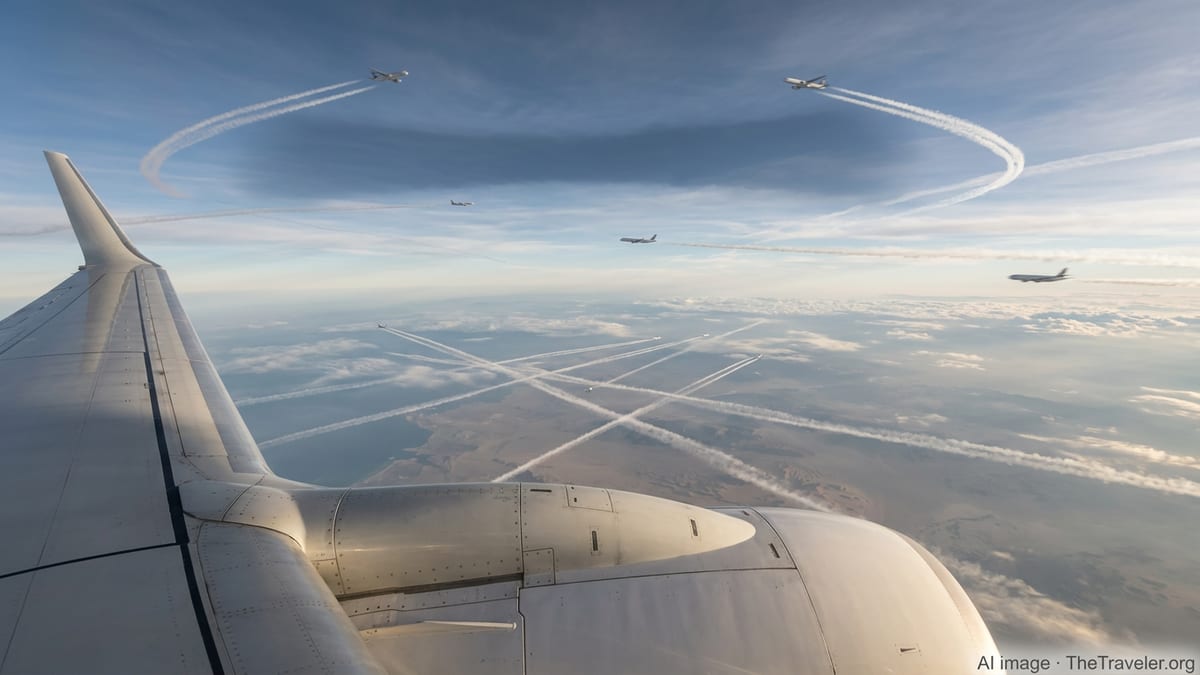
With vast sections of Middle Eastern airspace now off limits and Russian skies already largely closed to Western carriers due to the ongoing war in Ukraine, airlines are being forced into a shrinking set of safe corridors. One of the most critical now runs through the Caucasus, where traffic is funneled between Russian territory to the north and conflict-affected states to the south.
Flight-tracking data shows long-haul services that once crossed Iran or Iraq now arcing north over Turkey and on toward Georgia, Armenia and Azerbaijan, or bending far south over Egypt and Saudi Arabia before turning east. Some carriers are scheduling technical stops in Europe or Central Asia to manage the additional flight times and fuel requirements imposed by these longer routings.
The concentration of traffic in a handful of corridors brings its own complications. Increased congestion adds pressure on air traffic control systems that were not designed to handle such sustained volumes of intercontinental traffic. Airlines are padding block times and building in greater operational buffers, which in turn ripple through crew scheduling, aircraft utilization and onward connections.
For passengers, the experience is measured in extra hours in the air and on the ground. Journeys that previously took six or seven hours are stretching to nine or ten. Missed connections are more common as weather or minor technical issues have less slack to be absorbed within tightly stretched networks.
Rerouting Raises Costs and Climate Concerns
Beyond immediate disruption, the increasingly fragmented airspace environment is pushing up the structural cost of global aviation. Detours around conflict zones can add hundreds of nautical miles to a long-haul sector, driving higher fuel burn at a time when carriers are already grappling with volatile energy prices.
Longer flight times also require more crew hours and in some cases additional flight deck and cabin crew to stay within duty limits. Aircraft may need to operate with payload restrictions on the most extended routings, reducing cargo capacity or limiting seats sold to ensure safe fuel reserves. Insurers are reassessing their exposure to routes near active war zones, further increasing operating costs for airlines compelled to fly close to, but not through, restricted areas.
The climate impact is becoming harder for the industry to ignore. A year after many airlines announced more ambitious net zero road maps, they are being pushed into less efficient routings that increase emissions per passenger. While safety remains the overriding priority, sustainability experts warn that repeated, long-lived detours could materially slow progress toward decarbonization targets if the current pattern of closures persists.
Some carriers are responding by accelerating fleet renewal plans in favor of more fuel-efficient widebodies and by reviewing marginal routes whose economics have been tipped into the red by airspace constraints. For travelers, that is likely to translate into reduced choice on thinner long-haul markets and a renewed focus on mega-hubs that can sustain high loads even on elongated routings.
Layered Risk After Ukraine, Yemen and Sudan
The latest crisis in the Middle East adds to a growing list of conflict-driven gaps in the global airspace map. Russian airspace has been largely off limits to airlines from North America, Europe and some Asia Pacific states since shortly after the full-scale invasion of Ukraine, forcing lengthy transpolar and transatlantic detours for routes connecting Europe and Asia. That single closure reconfigured traditional great-circle paths between hubs such as London, Paris or Frankfurt and cities in Japan, Korea and northern China.
To the south, the long-running conflict in Yemen, intensified by missile and drone attacks on Red Sea shipping and on targets in Israel, has rendered most Yemeni airspace effectively prohibited for commercial traffic. Western regulators classify the area as extremely high risk, and only a handful of services operating far offshore over the Red Sea or Gulf of Aden still pass nearby.
In Africa, civil conflict in Sudan has disrupted overflight permissions and raised safety concerns in and around the Khartoum and Nyala flight information regions. Several African, Middle Eastern and European carriers have shifted routes to avoid the area, redirecting traffic over neighboring states and adding to congestion in already busy North South corridors linking Europe with East and Southern Africa.
Together, these overlapping danger zones are fragmenting what was once a largely continuous band of commercially viable airspace from the North Atlantic across Europe, the Middle East and into Asia. Airlines are increasingly reliant on real-time intelligence from militaries, aviation regulators and private risk consultancies, and are building sophisticated internal teams to monitor threats and reconfigure routings at short notice.
What Travelers Can Expect in the Months Ahead
For passengers planning international trips in the coming weeks, the new geography of risk at altitude is likely to mean fewer direct options, longer journeys and more last-minute change. Industry executives stress that airlines will not knowingly fly through airspace deemed unsafe, even if it means accepting significant commercial pain and operational complexity.
Travel advisors and airline representatives are encouraging customers to allow additional connection time, book flexible tickets where possible and monitor itineraries closely in the days before departure. Even once airborne, routings may shift as crews receive updated instructions from operations centers responding to the latest advisories.
Some carriers are temporarily consolidating services on key trunk routes and suspending marginal destinations to preserve network resilience. That is particularly evident in Europe to Asia traffic, where flights are being concentrated through a smaller number of hubs that retain workable access to remaining safe corridors. Low cost and leisure-focused airlines with thinner margins may be more exposed to the financial strain of prolonged detours.
Ultimately, the reshaping of global aviation routes reflects a broader reality that air travel cannot be insulated from geopolitical shocks. As conflict zones multiply and expand, the sky itself is being redrawn, creating new airspace gaps that will challenge airlines and travelers alike long after today’s headlines fade.