

Travelers using Gatwick, Luton, Manchester and Birmingham are facing a fast-changing patchwork of baggage and security rules, as new high-tech scanners roll out and long-standing liquid limits are eased, reinstated or overhauled. Understanding exactly what applies at each airport is now essential to avoiding delays, confiscated items or missed flights.
Why UK baggage rules are changing again
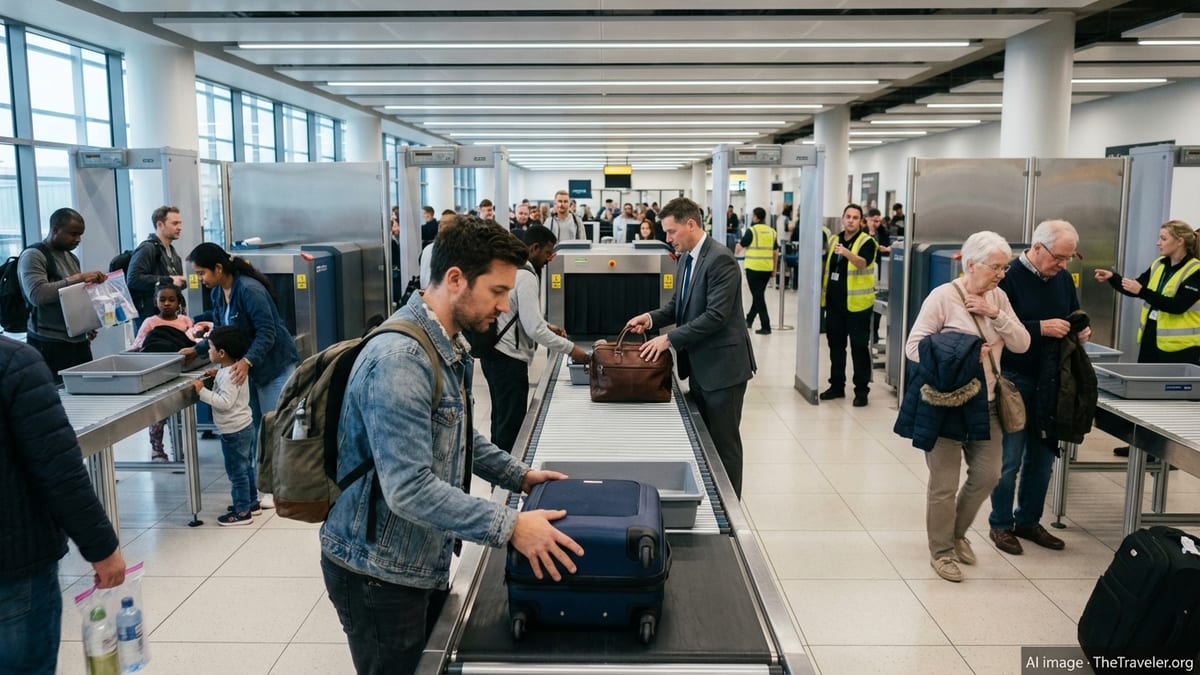
The biggest driver of change at Gatwick, Luton, Manchester and Birmingham is the installation of next-generation computed tomography security scanners in hand baggage lanes. These machines generate detailed 3D images of cabin bags, allowing staff to inspect contents from multiple angles without passengers removing liquids or electronics. The UK government tied this technology rollout to a wider reform of liquids and laptop rules, promising faster queues and fewer plastic bags.
After several missed national deadlines and reversals of policy, 2025 and early 2026 have finally seen major UK airports complete or near completion of their upgrades. Birmingham and Gatwick have joined a group of airports where new scanners are now standard across security, while Manchester and Luton have expanded their fleets and clarified guidance. However, variations in regulatory approval and international standards mean rules are not identical, even where the equipment looks the same.
For passengers, that complexity translates into a simple risk. If you assume that all airports treat liquids, laptops and cabin bag size in the same way, you may arrive at security with an oversized bottle or unprepared hand luggage. The result can be extra searches, seized toiletries or, during peak times, missing your flight departure. Authorities and airlines are now urging travelers to check both airport and airline rules before packing.
Gatwick: from old 100 ml limits to a new liquids regime
Gatwick has been one of the most closely watched airports in the UK liquids overhaul, both for its size and for the scale of its investment in new scanners. After initially warning that the national June 2024 deadline for full deployment would be missed, Gatwick continued to operate mixed security lanes through much of 2024 and 2025, with many passengers still required to remove liquids and laptops and comply with the 100 millilitre cap in plastic bags.
By early 2026, Gatwick is among the so-called "big six" UK airports where high-tech scanners are now standard across security, supporting a far more relaxed approach to cabin liquids for most passengers. At these upgraded lanes, liquids can typically remain inside the bag and containers of up to around two litres are allowed, provided they are screened by the new equipment rather than older X-ray machines. Travelers also generally no longer need to remove laptops and tablets into separate trays.
The catch is that Gatwick still advises passengers to pack as if traditional restrictions apply until they are physically at the checkpoint and can see current signage or receive guidance from staff. This reflects the fact that operational or regulatory issues can force temporary reversion to older protocols. Passengers starting a trip at Gatwick but returning via a foreign airport, particularly in the European Union where 100 millilitre limits remain widely enforced, are warned to make sure all onward journeys comply with the strictest rules they will encounter.
Gatwick has also paired its security upgrade with wider ground-side changes, including higher vehicle drop-off fees and efforts to shift more passengers onto rail and coach services. While these are not baggage rules in the strict sense, the airport’s broader strategy is to keep vehicles and large bags flowing more smoothly through the terminal approach roads and check-in halls, complementing the new security process in the departures area.
Luton: high-tech scanners, but prepare for legacy rules
London Luton was among the first major UK airports to confirm it was on track to replace older X-ray units with CT scanners, stating in 2024 that it planned to remove the 100 millilitre liquids limit in time for the main summer holiday season. That timetable slipped as national rules evolved, but Luton has continued to expand its new-generation scanner lanes through 2025 and into 2026, with the goal of matching Gatwick and other leading hubs on both speed and convenience for security.
In practice, this means many passengers at Luton will now pass through scanners where they can leave liquids and electronics inside their cabin bags, without using clear plastic bags or separate trays. However, as at other UK airports in transition, Luton’s official message remains cautious. Travelers are instructed to prepare hand luggage as if the old rules still apply, only relaxing those preparations once they are clearly directed to do so at the security conveyor.
The reason for that conservative stance is twofold. First, not every security lane may be operating with the new machines at all times, especially during maintenance, staff training or peak surges. Second, national and international regulators retain oversight of how and when limits on liquid volumes can be raised, even where scanners are technically capable of handling larger containers. Until that approval framework is fully settled, Luton's management favours consistent instructions to passengers over complex if-and-when explanations at the airport door.
Passengers connecting through Luton from airports that still enforce traditional 100 millilitre restrictions, such as many in the EU, should remember that their carry-on may have been repacked to meet those tighter rules. While Luton may be able to accommodate larger containers, travelers need to avoid assuming reciprocal flexibility at their previous or onward airports in the same journey.
Manchester: confusion gives way to clearer liquid and electronics guidance
Manchester Airport has been a focal point of confusion over hand luggage liquids, partly because it has three terminals and a complex mix of older and newer technology. In 2024 and early 2025, some lanes operated with CT scanners that permitted larger liquids to stay inside bags, while others still required passengers to follow the old 100 millilitre regime. This inconsistent experience led many travelers to arrive believing that rules had been relaxed across the board, only to be told to repack at the belt.
By late 2025 the airport had completed a multi-million pound rollout of CT scanners across all three terminals and moved to clarify its messaging. Official guidance now stresses that while the technology is in place, passengers should continue to prepare as though the longstanding 100 millilitre limit and plastic bag requirement still apply, unless they are explicitly instructed otherwise by security staff at the lane. This means decanting liquids into small containers, placing them in a single clear resealable bag and being ready to take them out, together with laptops and large electronics.
Security officers are then able, on a lane-by-lane basis, to waive some of those steps where the new systems are fully active and regulatory approval allows. In those lanes, travelers may be told to leave liquids and electronics in their bags and will see trays moving more quickly through the scanners. Manchester’s priority, however, remains to ensure compliance with whichever standard currently governs any given lane, even at the cost of some frustration among passengers expecting a universal relaxation of rules.
The airport has said that as experience with the new scanners grows and national policy stabilises, it expects to move to a simpler, clearly advertised regime. Until then, passengers with tight connections, large families or medical liquids should assume they may still be asked to present liquids separately and arrive early enough to handle potential repacking or additional searches.
Birmingham: a near-complete shift to new security procedures
Birmingham has been one of the UK’s pioneers in implementing a new security hall with CT scanners for all passengers. After a phased move into the upgraded area in 2024, the airport indicated that its new machines allowed liquids up to 100 millilitres to remain inside hand luggage, with no requirement for plastic bags. Laptops, tablets and other large electronics could also stay inside cabin bags rather than being removed for separate screening.
Initially, Birmingham expected to raise the permitted volume of cabin liquids to two litres once final regulatory approval was secured. While that sign-off took longer than airport managers had first hoped, Birmingham is now listed among the UK airports operating with a two-litre liquid allowance tied to its CT-equipped security lanes. Passengers flying from the airport in early 2026 benefit from a streamlined process that is closer to a simple bag drop than the tray juggling familiar from the past decade.
Official security advice at Birmingham still emphasises general good practice. Travelers are encouraged to pack non-essential liquids, foods and powders into checked baggage where possible, both to reduce the chance of extra searches and to speed up queue movement. They are also reminded to check airline-specific hand luggage size and weight limits, which can be stricter than the airport’s own maximum dimensions, particularly on low-cost carriers.
Importantly, Birmingham underlines that its rules apply only to the departure airport. Anyone returning via an airport that has not yet fully adopted CT scanners or lifted the 100 millilitre cap must repack to meet that airport’s standards, or risk losing items on the return leg. The airport is advising passengers to think of the strictest security regime on their itinerary as the one that should guide packing for the entire journey.
Cabin bag sizes, weight limits and airline-specific rules
While much of the public attention focuses on liquid limits and laptops, the shift in security technology does not change a more traditional constraint: the physical size and weight of cabin bags. Gatwick, Luton, Manchester and Birmingham each publish their own upper limits for hand luggage dimensions, but these are routinely overruled in practice by individual airline policies, especially among low-cost carriers using tighter allowances to manage overhead bin space.
For instance, Birmingham’s guidance allows bags up to roughly 56 centimetres by 45 centimetres by 25 centimetres, including wheels and handles, in the security area. Yet many airlines out of the airport restrict free cabin baggage to smaller "personal item" sizes, charging extra for anything larger. A bag that sails through security may still be stopped at the boarding gate or forced into the hold if it does not match the airline’s template. Similar discrepancies exist at Gatwick, Luton and Manchester.
This split responsibility can be confusing, particularly for infrequent flyers who may wrongly assume that an airport’s published dimensions are universally accepted. Security staff at scanners are not enforcing airline baggage contracts and will typically only intervene if a bag is physically too large to fit on the belt or inside the machine. Travelers, therefore, must treat airline emails and booking confirmations as the definitive source on how many bags they can carry, how big they can be and whether wheels or laptop sleeves count as separate items.
Weight limits add another layer of complexity. Some airlines specify maximum weights for cabin baggage and do weigh bags at the gate, while others focus only on size and let passengers self-police weight. None of the recent scanner upgrades affect those commercial rules. Passengers should check both dimensions and weight before leaving home to avoid last-minute repacking or fees.
What these changes mean for checked baggage
The overhaul of hand luggage screening at Gatwick, Luton, Manchester and Birmingham has raised questions about whether similar shifts are under way for checked baggage. In reality, the new CT scanners are focused almost entirely on cabin bags passing through passenger security lanes. The systems used to screen hold luggage were already based on advanced imaging technology and have not required the same headline-grabbing changes.
For most travelers, the main checked baggage considerations at these airports remain familiar. Airlines set the number of bags permitted, their maximum weight and any oversize or sports equipment charges. The items that can and cannot be packed in hold luggage are governed by international safety regulations, covering everything from lithium batteries and flammable liquids to firearms and certain tools. Airport security teams continue to conduct random physical inspections, and any prohibited items discovered in checked bags may be removed or result in delays.
One indirect impact of the smoother cabin baggage process is that some passengers may now choose to move items back into their hand luggage, seeing less advantage in paying for a checked bag if they can carry full-size toiletries and electronics through security. Airlines and airports are monitoring whether this trend increases pressure on overhead bin space and boarding times. If so, stricter enforcement of cabin bag size and number limits may follow, even as security itself becomes more streamlined.
Oversized and awkwardly shaped baggage, such as musical instruments and sports gear, remains subject to special handling rules at all four airports. While the new scanners can cope with a wider variety of cabin bags, they do not change the need to pre-arrange carriage of large instruments, bicycles or surfboards with airlines, nor do they eliminate extra charges for such items.
How to avoid delays under the new regime
For passengers trying to navigate these overlapping changes, a few simple habits can sharply reduce the risk of problems at Gatwick, Luton, Manchester and Birmingham. The first is to treat official airport websites and airline communications as the only reliable guides, especially in the weeks immediately before travel. Media headlines about liquids being "freed" or rules being "scrapped" often gloss over the fine print about specific terminals, dates or lanes where old limits still apply.
Second, travelers should pack as if they will encounter the strictest possible rules on their itinerary. That means assuming a 100 millilitre liquid limit, using clear resealable bags, and being ready to remove laptops and tablets at security, even if their departure airport now often allows a more relaxed approach. If they arrive to find that their lane operates with fully approved CT scanners and larger allowances, the worst outcome is that they have over-prepared and enjoy a faster-than-expected journey through security.
Third, passengers should factor in extra time for security, particularly during school holidays and early morning peaks. The new scanners are designed to speed up screening, but temporary closures, staff training and mixed expectations among travelers can still generate queues. Airports continue to recommend arriving at least two hours before short-haul flights and three hours before long-haul departures, with some airlines urging even earlier arrival during peak travel weeks.
Finally, keeping valuables, vital medications and important documents in hand luggage remains as important as ever. Even with more generous cabin liquid allowances and smoother security checks, checked bags can be delayed or misrouted. The new technology in departure halls is not a substitute for basic packing discipline and careful reading of both airline and airport rules.