

More news on this day
Europe’s major airlines are overhauling what passengers can carry into the cabin, with new bag sizes, fees and membership perks at Ryanair, easyJet, Jet2, TUI and British Airways reshaping how travellers pack for short-haul flights across the continent.
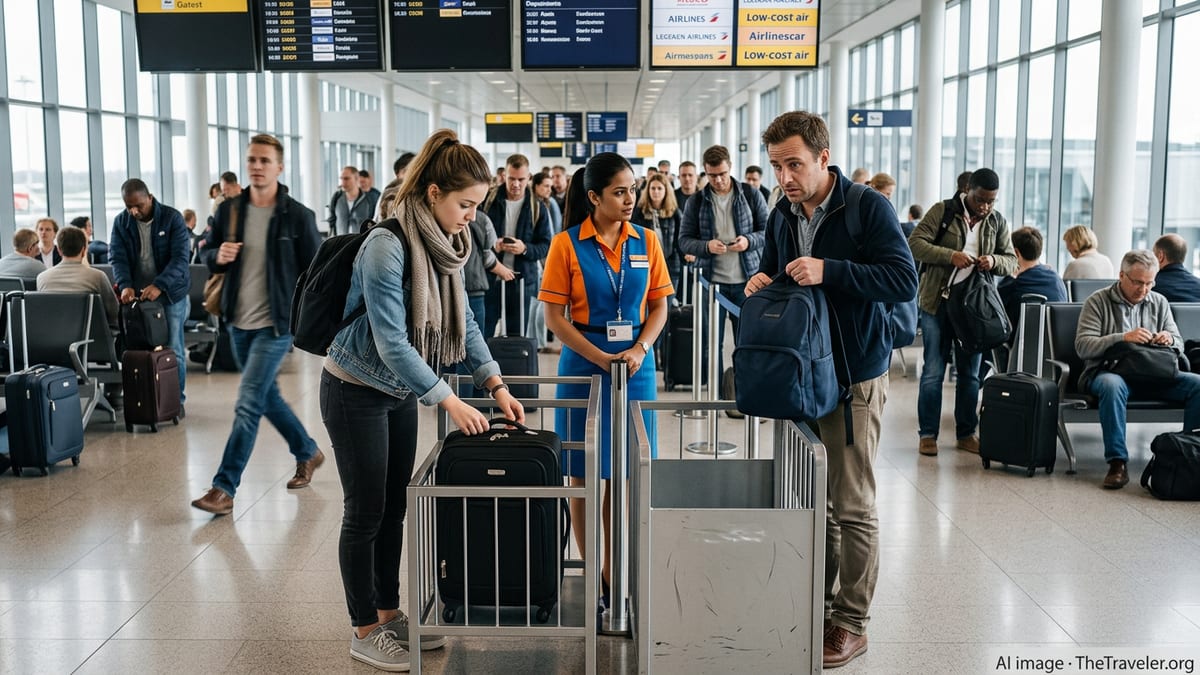
Ryanair Leads With Bigger Free Bag Amid EU Pressure
Ryanair, Europe’s largest low cost carrier, has triggered a new round of cabin baggage changes by increasing the size of its free under seat bag. From the 2025 summer season, the airline’s complimentary personal item grows by around 20 percent in volume, moving from a compact 40 x 25 x 20 centimetres to 40 x 30 x 20 centimetres, giving travellers noticeably more space without an automatic fee.
The move aligns Ryanair more closely with a standard being promoted by Airlines for Europe, a trade body representing many of the region’s biggest carriers. That standard is built around a personal item sized roughly to an A4 footprint and a separate small cabin suitcase, and is designed to reduce confusion for passengers who switch frequently between airlines on intra European routes.
For Ryanair customers, the change does not alter the basic structure of the airline’s luggage model. All passengers still receive a single small bag that must fit under the seat in front, while overhead locker space is effectively sold through priority boarding and paid cabin bags. However, the extra depth on the free bag gives many travellers the option to avoid buying additional baggage on shorter trips.
At the same time, Ryanair is maintaining strict enforcement at the gate, supported by staff incentives to spot oversized luggage. Travellers whose bags exceed the newly enlarged dimensions or the separate wheeled cabin bag limit can still face steep charges at the boarding gate and have their luggage placed in the hold.
EasyJet Bets on Consistency and Paid Perks
While Ryanair fine tunes dimensions, easyJet has chosen stability. The carrier is keeping its long standing free under seat allowance of 45 x 36 x 20 centimetres, one of the more generous complimentary cabin bags in Europe. This single piece must fit entirely under the seat in front but has no formal weight limit, giving passengers considerable flexibility as long as they can lift and stow the bag safely.
Access to additional overhead bin space on easyJet remains tied to fare bundles and add ons. Customers booking Standard Plus, FLEXI or Up Front fares, or paying separately for a large cabin bag, can bring a second piece up to 56 x 45 x 25 centimetres, which is intended for the overhead lockers. The airline has not introduced new restrictions for 2025, a decision likely to appeal to regular flyers who have already invested in cabin bags tailored to easyJet’s dimensions.
Instead of changing core allowances, easyJet is focusing on marketing its paid membership and bundled products. The easyJet Plus programme, frequently promoted with introductory discounts, packages together priority boarding, a large cabin bag, dedicated bag drop and seat selection for an annual fee. The approach positions cabin baggage not only as an ancillary revenue stream but also as a loyalty tool for frequent short haul travellers.
Enforcement of size rules on easyJet is generally firm but less punitive than at some rivals. Oversized bags are typically shifted to the hold at standard checked baggage rates rather than attracting separate penalty style gate fees, which slightly softens the impact for passengers who misjudge dimensions.
Jet2 and TUI Maintain Traditional Allowances
Holiday focused airlines Jet2 and TUI are taking a different tack, retaining comparatively traditional hand luggage models that bundle a small suitcase into the base fare. On most Jet2 flights, customers can bring one cabin bag up to 10 kilograms with dimensions around 56 x 45 x 25 centimetres, in addition to a small personal item such as a handbag or laptop case, although the latter often has to sit inside the main cabin bag at busier times.
TUI Airways similarly allows a cabin bag of about 55 x 40 x 20 centimetres weighing up to 10 kilograms on many of its European leisure routes, with variations on certain tour operator packages and long haul services. These more conventional allowances are designed for holidaymakers who prefer to travel with a single wheeled carry on case rather than navigating tiered small versus large cabin bag rules.
Both airlines, however, face the same broader regulatory and operational pressures as the low cost giants. Overhead locker space remains a bottleneck on full flights, especially where families attempt to keep all their belongings out of the hold. As a result, Jet2 and TUI continue to remind customers that bags may be gate checked free of charge once bins are full, even when dimensions and weight are within the published limits.
For package holiday travellers, the relative generosity of cabin bag rules is only part of the picture. Many Jet2 and TUI bookings still include a checked suitcase in the overall holiday price, which reduces the need to squeeze everything into the cabin and makes these airlines less aggressive about monetising carry on space than some pure low cost competitors.
British Airways Balances Legacy Model With Cabin Crunch
British Airways remains closest to the traditional full service template, offering two items of cabin baggage on most European routes. Passengers are generally allowed a larger cabin bag that fits overhead, often around 56 x 45 x 25 centimetres, plus a smaller personal item such as a handbag or laptop bag that must go under the seat. Combined weight limits apply, and staff regularly check bags at the gate when flights are busy.
Unlike low cost rivals, BA tends not to charge a specific cabin bag fee at the boarding gate. Instead, when overhead space runs out, bags are tagged and placed in the hold at no extra charge, a practice that preserves the perception of inclusivity even as operational realities force more luggage out of the cabin. That said, the airline sells basic economy style “hand baggage only” fares on many routes, and passengers who later need to check a case can face substantial charges.
The British Airways loyalty programme also plays a role in how much hand luggage frequent flyers can bring. Higher tier members may benefit from additional checked baggage allowances and priority boarding, both of which indirectly influence cabin bag competition. Earlier boarding improves access to overhead lockers, while extra hold luggage can reduce the need to carry multiple items into the cabin.
BA has so far avoided the headline grabbing cabin bag clampdowns seen at some low cost carriers, but rising load factors and the shift towards denser seating on short haul aircraft continue to put pressure on bin space. Travellers on busy European city pairs increasingly report that boarding position and bag shape can matter as much as the published allowance.
What Travellers Should Expect in 2026
Across Europe, the direction of travel on cabin baggage is toward clearer but more stratified rules. Ryanair’s decision to enlarge its free personal item slightly while maintaining paid overhead access, easyJet’s choice to hold steady on its under seat allowance while monetising a second bag, and the relatively generous but capacity constrained approaches of Jet2, TUI and British Airways all point to the same underlying trend: space in the overhead lockers is an increasingly valuable commodity.
Regulators in Brussels are still debating whether to force airlines to adopt more uniform minimum standards, a move that could eventually guarantee every passenger at least one personal item and one small cabin suitcase without extra fees. Until any such rules take effect, carriers retain considerable freedom to tweak dimensions, enrich membership schemes and adjust enforcement in pursuit of both operational efficiency and ancillary revenue.
For travellers planning European trips in 2026, the practical message is to scrutinise cabin baggage rules route by route and fare by fare. Two flights of similar length between the same cities can offer very different carry on experiences depending on the airline, ticket type and even boarding group. Investing in a soft sided bag that fits comfortably within the smallest common dimensions and packing with security screening in mind remains the safest strategy.
With summer schedules approaching and aircraft fuller than ever, how much you can bring into the cabin is now a central part of the booking decision rather than a small print afterthought. For Europe’s airlines, cabin baggage has become a frontline tool in the battle for both passengers and profit, and the rules are still evolving.