

More news on this day
Aegean Airlines’ newly announced nonstop service between Casablanca and Athens is set to redraw tourism and business maps between North Africa and southeastern Europe, giving travelers unprecedented one-hop access to two of the Mediterranean’s most dynamic cultural hubs while opening a fresh corridor for trade and investment.
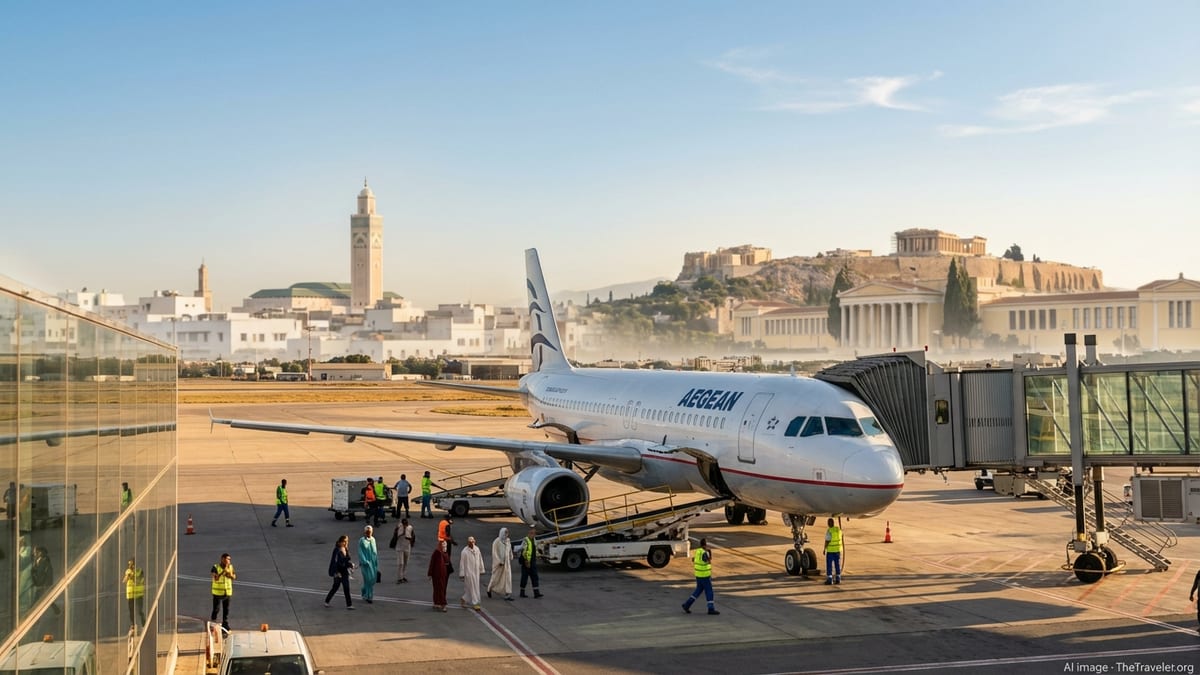
A Strategic New Bridge Across the Mediterranean
The new direct route between Casablanca and Athens, unveiled by Aegean Airlines for launch on October 25, 2026, signals a calculated push by both Morocco and Greece to capitalize on surging global demand for culturally rich, year-round destinations. The service will link Morocco’s commercial capital and primary air hub with the Greek capital in a single hop, significantly cutting travel times that until now often required connections through major European airports.
For both countries, the announcement is more than a simple schedule update. It reflects a broader vision to turn air connectivity into a lever for economic diversification, tourism growth and diplomatic engagement. Officials and industry analysts see the Casablanca–Athens corridor as a natural extension of each nation’s efforts to deepen ties with new markets while easing access for established visitor bases in Europe, the Middle East, Africa and beyond.
Casablanca’s role as a gateway to Africa and Athens’ status as a growing hub for southeastern Europe make the route particularly strategic. The nonstop flight effectively stitches together two regional crossroads, offering smoother itineraries for travelers who want to combine the medinas and mountains of Morocco with the islands and antiquities of Greece in a single trip.
The move dovetails with Aegean’s broader international expansion, which in recent seasons has included new links to destinations as varied as Marrakech and Baghdad, positioning the Greek carrier as a nimble connector between emerging tourism markets and Europe’s traditional heartlands.
Morocco’s Aggressive Push to Expand Air Connectivity
Morocco has spent the past several years systematically widening its global air network, and the new link to Athens fits squarely into that agenda. The Moroccan National Tourism Office has been signing a string of strategic agreements with major carriers, including China Eastern Airlines and Turkish Airlines, to deepen air access from Asia, Europe and North America while promoting the country as a diversified, year-round destination.
New long-haul services such as Royal Air Maroc’s upcoming Los Angeles–Casablanca route, due to start in June 2026, and the recent Atlanta–Marrakech announcement with Delta Air Lines underscore how the kingdom views aviation as a central pillar of its tourism and investment strategy. These moves are designed to make Moroccan cities easier to reach for high-spending long-haul visitors, from American and Canadian travelers to rapidly growing Asian markets.
Short- and medium-haul connectivity has been expanding just as rapidly. Moroccan authorities have backed new and restored routes linking secondary cities like Tangier, Agadir and Essaouira to a widening array of European capitals. The result is a more finely grained network that spreads visitor flows beyond the traditional centers of Casablanca and Marrakech, easing pressure on established hotspots and channeling tourism revenue into lesser-known regions.
In this context, the Casablanca–Athens nonstop is a logical next step. It builds on Morocco’s success in attracting direct services from carriers across the alliance spectrum and strengthens the country’s hand as a launchpad for multi-country itineraries that combine North Africa with Europe and the Middle East.
Greece Leans Into Its Role as a Regional Aviation Hub
Greece, too, has been steadily reshaping its aviation footprint. Athens International Airport has emerged as a fast-growing gateway for travelers connecting between Europe, the eastern Mediterranean and, increasingly, parts of Africa and Asia. Aegean Airlines has played a central role in this transformation, adding routes that extend its reach beyond traditional European leisure markets.
In recent months, Aegean has announced or launched services that underscore its regional ambitions, including a pioneering Athens–Baghdad connection that expands Greece’s presence in a market long underserved by European carriers. At the same time, other airlines are helping make Athens a more globally networked hub, with Indian carrier IndiGo using the city as its first European long-haul destination from Mumbai and Delhi, leveraging the range of its new Airbus A321XLR aircraft.
The new nonstop to Casablanca slots into this evolving picture, anchoring Athens more firmly on maps used by African, Middle Eastern and Asian travelers. For Greek tourism planners, Morocco offers not only inbound visitor potential but also an appealing outbound destination for Greek travelers seeking winter sun, desert landscapes and cultural experiences beyond Europe’s borders.
By capturing two-way flows and enabling convenient connections over Athens to the Greek islands, the Balkans and eastern Mediterranean, the Casablanca service is expected to generate traffic well beyond the point-to-point market between the two capitals.
Tourism Boon: Two Cultures, One Seamless Journey
For leisure travelers, the most immediate impact of the new route will be the ability to pair two distinct yet complementary destinations with minimal transit friction. Morocco offers a vivid mix of Atlantic and Mediterranean coastlines, Atlas Mountain villages, Saharan oases and historic imperial cities, while Greece combines ancient archaeological sites, renowned island escapes and a thriving culinary and arts scene.
Until now, travelers wishing to experience both countries in a single itinerary often had to route through hubs such as Paris, Madrid or Rome, adding hours and complexity to their journeys. The nonstop service shrinks that barrier, making it more realistic for North American, European or Middle Eastern visitors to land in Casablanca, tour Morocco, then continue straight to Athens as a second anchor destination without backtracking through Western Europe.
Tour operators are already eyeing opportunities to build multi-country packages that knit together Moroccan riads and Greek island guesthouses, desert excursions and Aegean sailing, contemporary art in Casablanca and Athens’ newly revitalized neighborhoods. The route is expected to appeal especially to repeat Mediterranean travelers looking for fresh combinations of culture, cuisine and landscapes.
The timing also aligns with major regional events on the horizon, including preparations for the 2030 FIFA World Cup, which Morocco will co-host. Improved access between North Africa and southeastern Europe is likely to feed into larger itineraries crafted around sporting, cultural and business events across the broader Mediterranean basin.
Economic and Trade Ties Set to Deepen
While tourism may capture the headlines, policymakers in both countries see the new nonstop service as a tangible tool for strengthening bilateral economic ties. Casablanca is Morocco’s financial and industrial engine, home to a growing services sector and an expanding base of manufacturing and logistics operations that look northward to Europe as a primary market.
Athens, meanwhile, anchors a Greek economy in which tourism and shipping dominate but where investment, technology and services play an increasingly visible role. Faster, more predictable air links are critical for executives, investors and technical teams who need to shuttle quickly between headquarters, branch offices and project sites.
The route is expected to facilitate business missions, trade fairs and sector-focused delegations, particularly in areas where Morocco and Greece have overlapping interests such as renewable energy, maritime services, logistics and agri-food exports. Direct connectivity typically correlates with rising trade volumes, as transport costs fall and face-to-face engagement becomes easier to sustain.
Analysts also highlight the soft-power dimension. Regular air links often precede or accompany deeper institutional cooperation, including university partnerships, cultural exchanges and joint tourism promotion in third markets. As Casablanca and Athens grow more tightly connected, both countries gain opportunities to position themselves jointly as gateways to their respective regions.
Airlines Position for an Intensifying Mediterranean Competition
The new Casablanca–Athens route arrives amid intensifying competition among Mediterranean hubs vying to capture post-pandemic travel demand. Legacy carriers and low-cost operators alike are racing to lock in strategic corridors that tie together Africa, the Middle East and Europe, while also courting long-haul feed from North America and Asia.
Morocco’s flag carrier Royal Air Maroc has outlined a long-term plan to more than triple its fleet by the late 2030s, part of a broader effort to turn Casablanca into a powerhouse connecting Africa with Europe and the Americas. Greece’s Aegean has likewise been expanding its fleet and network, betting that Athens can attract connecting traffic and serve as a nimble alternative to larger but more congested European hubs.
In this landscape, the nonstop link is a clear statement of intent. By investing in a route that connects two medium-sized but strategically located markets, Aegean is signaling confidence that travelers increasingly value direct connections between secondary hubs, not just traditional capital-to-capital trunk lines through Western Europe.
Industry observers point out that success will depend on how effectively the airline can coordinate schedules with other partners and how robustly tourism boards on both sides of the Mediterranean market the new link. Early visibility among travel agents, online platforms and corporate travel managers will be key to building a sustainable base of both leisure and business demand.
Opportunities and Challenges in Building a New Corridor
Despite strong potential, ramping up a brand new interregional route is rarely straightforward. Airlines must carefully calibrate capacity, pricing and seasonality, particularly in markets where demand patterns can fluctuate sharply between peak summer months and quieter shoulder seasons. Both Morocco and Greece are working to position themselves as year-round destinations, but sun-and-sea tourism remains heavily concentrated in warmer months.
There are also operational considerations, from securing attractive slots at busy airports to ensuring that ground handling, security and border control processes are efficient enough to make connections over Casablanca or Athens competitive with rival hubs. For passengers traveling on to third countries, the appeal of the new route will hinge on total journey times and ease of transfer compared with existing options.
On the policy side, aviation taxes, visa regimes and air service agreements can all influence how quickly a new corridor matures. Continued coordination between Moroccan and Greek authorities on issues such as streamlined visa processing, reciprocal promotion and support for joint tourism initiatives will be vital to unlocking the full benefits of the nonstop service.
Still, both countries have shown a willingness to move quickly when opportunities arise, as seen in recent agreements with airlines across Europe, North America and Asia. The Casablanca–Athens link is widely viewed as a natural extension of that momentum, rather than an isolated experiment.
What Travelers Can Expect When the Route Launches
As details of schedules and onboard products are finalized, travelers can expect a service tailored to both short-break tourists and connecting passengers heading to or from third markets. Flight times of around five hours make the route competitive not only for point-to-point journeys but also for those linking, for example, African cities beyond Casablanca with island destinations beyond Athens in a single stop.
Industry insiders anticipate that initial frequencies will be calibrated to capture peak demand periods, with scope to scale up if the route performs strongly. Connections in Casablanca could be particularly attractive for travelers originating in West and Central Africa, while Athens offers onward access across Greece, the Balkans and parts of eastern and central Europe.
For Morocco-bound visitors starting in Greece, the route opens up an array of experiences, from coastal cities like Tangier and Agadir to the medinas of Fez and Marrakech and the mountain and desert landscapes that lie beyond. Greek travelers, in turn, gain a fast track to a nearby yet distinct cultural universe, where Arabic, Amazigh and European influences converge in architecture, music and cuisine.
With the countdown to the first departure now under way, tourism stakeholders in both countries are preparing campaigns to ensure that the new nonstop service is not just a line on a route map but a catalyst for a new era of Mediterranean mobility, in which Morocco and Greece stand out as twin anchors of a more closely connected region.