

More news on this day
A new generation of long range electric SUVs, arriving alongside denser ultra rapid charging coverage on UK motorways, is transforming the classic British road trip into a lower emissions, tech driven travel experience for 2026 holidaymakers.
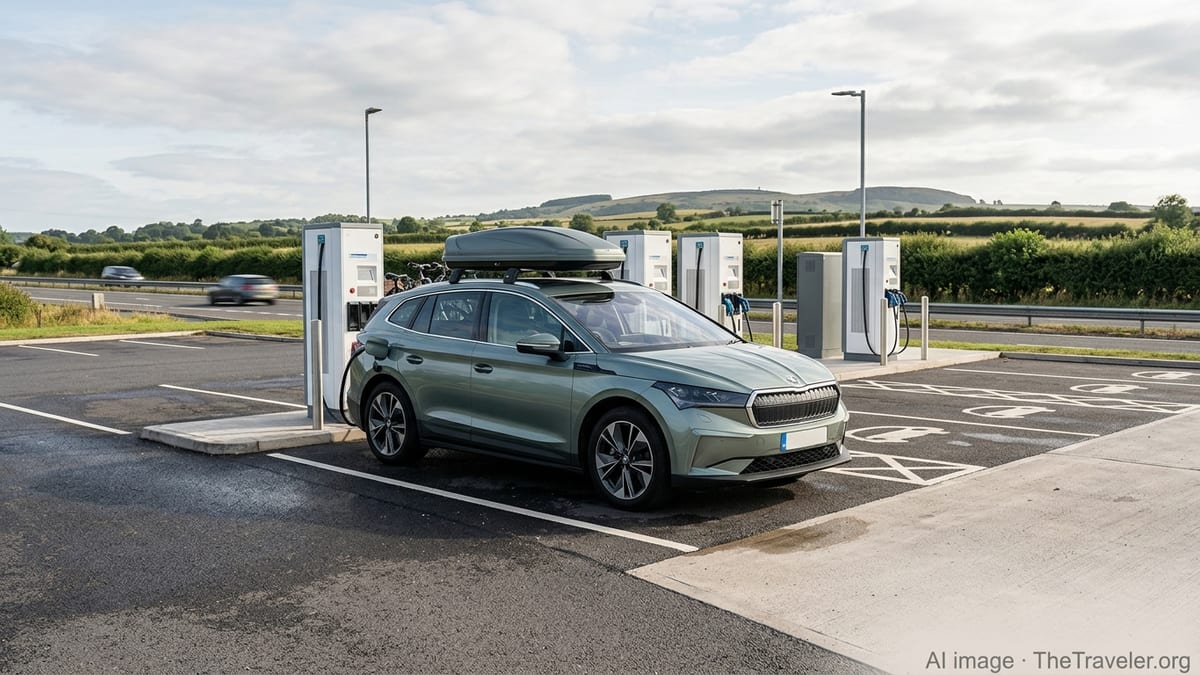
Long Range Electric SUVs Target Touring Holidaymakers
The latest wave of electric SUVs launching into the UK market is being pitched directly at drivers who want to cover long distances fully powered by batteries. Models such as the MG S5 and other mid size crossovers now routinely quote WLTP ranges in excess of 400 kilometres, with higher specification versions edging beyond that benchmark. This is aimed squarely at families and couples who want to undertake multi stop journeys across England, Scotland and Wales without constant charging anxiety.
These vehicles are typically equipped with battery packs of around 60 to 80 kilowatt hours, paired with increasingly efficient powertrains. That combination allows a single charge to cover many of the UK’s most popular touring legs, from London to the Lake District or from Birmingham to the Cornish coast. For drivers willing to integrate a short charging stop into their route, even longer itineraries such as circuits of the North Coast 500 in Scotland or cross country journeys to Snowdonia are becoming realistic in an electric SUV.
Manufacturers are also configuring interiors and luggage space with road trips in mind. Flat floor designs, adjustable rear seating and enlarged boot capacities make it easier to carry walking gear, bikes or paddleboards. In car infotainment now routinely integrates route planning and live charger data, so drivers can visualise energy use and potential stops as they would with traditional sat nav guidance.
Price positioning remains critical. Several of the newest electric SUVs are being introduced at price points that sit close to popular petrol crossovers, especially once purchase incentives, dealer discounts or salary sacrifice schemes are factored in. That narrowing gap is encouraging some motorists to treat an electric SUV not as a second experimental car, but as their primary touring vehicle.
Charging Network Expansion Rewrites Journey Planning
Publicly available information shows that the UK’s strategic road network is now lined with thousands of rapid and ultra rapid chargers within a short distance of motorways and major A roads. Recent government and industry data indicates there are more than 5,500 rapid and ultra rapid charge points within one mile of the strategic road network, including over 1,100 devices located directly at motorway service areas. This scale of coverage has moved electric touring from early adopter territory into the travel mainstream.
Most new installations at motorway services and dedicated charging hubs are specified at 150 kilowatts or higher, enabling modern electric SUVs to recover a substantial portion of their range in 20 to 30 minutes under optimal conditions. Networks such as Ionity, BP Pulse, MFG EV Power and others have been concentrating new hardware along primary leisure corridors, including routes to coastal resorts in the South West, the Scottish Highlands and national parks in the Midlands and North.
Industry analysis acknowledges that the overall pace of charger rollout slowed in 2025 compared with earlier years, as some investors reassessed demand projections. However, commentators also highlight that ultra rapid charging remains a bright spot, with strong growth in higher power devices that most benefit road trip drivers. Government backed funding streams for local and strategic infrastructure are expected to support a fresh wave of installations through 2026 and 2027.
For travellers, this infrastructure shift changes how routes are stitched together. Instead of carefully threading a path between rare high power units, many itineraries can now be built around multiple viable options at successive service areas. That redundancy is particularly important during school holidays, bank holiday weekends and summer getaway peaks, when charger queues were previously a prominent concern.
New Tech Tools Smooth the Electric Road Trip Experience
Alongside the vehicles and the hardware, software is playing a growing role in making electric SUV road trips feel predictable. Route planning apps used widely in the UK combine real time charger availability, connector types and pricing with vehicle specific energy consumption modelling. For a driver in a new electric SUV, that means the app can suggest when and where to stop, and estimate arrival battery levels, before they even leave home.
Many of the latest electric SUVs integrate these capabilities directly into their native infotainment systems. Drivers can select a destination, indicate their preferred minimum battery reserve and allow the system to schedule charging halts on compatible networks. Over the air updates enable these tools to adapt as new chargers are commissioned, tariffs change or software optimisation improves the accuracy of range predictions.
Contactless payments and simplified pricing structures at public chargers also reduce friction for travellers. A growing number of hubs allow drivers to plug in and pay via bank card without needing to download bespoke apps or pre register, an approach that mirrors expectations formed by petrol forecourts. For frequent tourers, subscription models and discounted kilowatt hour bundles offer the possibility of lowering overall trip energy costs.
These digital layers are particularly valuable in rural or coastal regions where mobile coverage can be variable. Many apps now cache key route and charger data offline, while cars store recent maps and charging locations locally. This ensures that drivers following scenic but remote stretches of road can still make informed decisions about detours and charging opportunities.
From Range Anxiety to Itinerary Optimisation
As hardware, software and vehicle capability converge, the central question for many UK travellers is shifting from whether an electric SUV can complete a road trip to how that journey can be optimised. Travel writers and motoring organisations are increasingly documenting itineraries designed specifically with electric driving in mind, selecting routes that balance scenic interest, charging convenience and accommodation with on site charge points.
Hospitality businesses are responding in kind. Hotels, guesthouses and holiday parks across popular UK destinations are adding destination chargers to their facilities, allowing visitors to arrive with a low battery and depart fully charged the next morning. This pattern reduces reliance on motorway infrastructure alone and helps spread charging demand more evenly across the network.
Surveys cited in recent research by financial and property consultancies suggest that easy access to charging is becoming a deciding factor in where some households choose to stay for domestic holidays. Locations that can advertise both nearby ultra rapid chargers and reliable overnight top ups may hold an advantage when competing for the growing cohort of electric SUV owners planning longer breaks.
At the same time, there is recognition that gaps remain, particularly in more remote parts of Scotland and Wales, and in certain tourist hotspots where grid capacity is constrained. For now, careful planning remains advisable for those venturing far from the densest parts of the charging map. Nonetheless, the overall direction of travel points toward a future where the electric SUV is regarded as the default choice for many UK road trippers.
Environmental and Economic Implications for Domestic Tourism
The rise of long range electric SUVs is also reshaping perceptions of the environmental footprint associated with UK based holidays. While the full lifecycle emissions of any vehicle depend on manufacturing, energy mix and usage patterns, switching from internal combustion to battery power can significantly cut tailpipe emissions on a per journey basis. For travellers who would previously have considered flying to short haul European destinations, using an electric SUV for domestic touring is increasingly framed as a lower impact alternative.
Domestic tourism bodies and regional destination marketers are starting to highlight electric accessibility in their promotional material, emphasising that visitors can complete scenic circuits without burning fuel. Some local authorities have explored partnerships with charging providers to increase coverage around key attractions, car parks and park and ride sites, with the twin aims of supporting tourism and encouraging cleaner transport choices.
Economically, the build out of charging hubs at service areas and in tourist towns is creating a new layer of roadside commerce. Drivers stopping for 20 to 30 minutes to charge are more likely to seek out cafes, shops and playgrounds than those refuelling in a handful of minutes. For businesses positioned near chargers, that dwell time can translate into higher spend per visitor, particularly from families travelling in larger electric SUVs.
As the 2026 holiday season approaches, the intersection of new electric SUVs, expanding rapid charging networks and evolving travel habits suggests that the UK road trip is entering a new phase. For many drivers, the shift to battery power is no longer a compromise, but an opportunity to experience familiar routes in a quieter, more efficient and increasingly convenient way.