

More news on this day
Non-EU travelers heading to Europe face the biggest border change in decades as the European Union’s biometric Entry/Exit System becomes mandatory across Schengen external borders by April 10, 2026.
Get the latest news straight to your inbox!
What the Entry/Exit System Actually Is
The EU Entry/Exit System, often referred to as EES, is a large-scale digital database designed to record the movements of non-EU nationals each time they cross an external Schengen border for a short stay. Instead of border agents relying on ink passport stamps, the system automatically logs the time and place of entry and exit, along with personal and biometric data for each traveler.
Publicly available information shows that the roll-out began in October 2025 at selected airports and land crossings, with a phased introduction over six months. By 10 April 2026, the system is expected to be in use at all Schengen external borders, covering 29 participating European countries.
The core purpose is to tighten enforcement of the long-standing “90 days in any 180-day period” rule for non-EU visitors, while also modernising border checks through automation. EES is operated by eu-LISA, the European agency that manages the region’s large justice and home affairs databases, and is intended to complement existing systems such as the Schengen Information System, which tracks alerts rather than border movements.
For travelers, the most visible change is the replacement of passport stamping with biometric registration and verification. Once fully in place, a non-EU visitor’s travel history in the Schengen area will be read from the EES record rather than inferred from physical stamps.
Who Is Affected and When It Starts to Matter
EES applies to “third-country nationals” who are not citizens of an EU or Schengen state and who enter for short stays, typically tourism, business trips or family visits of up to 90 days in any 180-day period. This includes visa-exempt travelers from countries such as the United States, Canada and the United Kingdom, as well as visitors holding a short-stay Schengen visa.
The system does not apply in the same way to non-EU nationals who are legal residents of a Schengen country and already hold a residence permit, though they may encounter EES equipment during checks. It also does not change procedures for EU and Schengen citizens, who continue to use their own lanes and systems at the border.
According to recent guidance from several European governments and transport hubs, data collection began progressively at some crossings from 12 October 2025, often in pilot form or limited time windows. The transition period continues through early April 2026, with mixed use of old passport stamps and new biometric gates, depending on how quickly individual airports, seaports and land borders upgrade their infrastructure.
The key date for travelers is 10 April 2026, when EES is scheduled to be fully operational at all Schengen external borders. Trips that begin or end close to that date may see differing procedures between outbound and inbound legs, so non-EU passengers should be prepared for both conventional stamp checks and full biometric processing.
What Data Is Collected at the Border
On a first trip after EES becomes fully active at a particular crossing point, non-EU travelers are asked to provide more information than they would for a traditional passport stamp. Public documentation from the European Commission and explanatory material distributed by airlines and airports indicate that border systems will record biographic data from the passport, the dates and locations of entry and exit, a live facial image and, in most cases, four fingerprints.
The initial registration is expected to take noticeably longer than repeat crossings, which is why border agencies and airports have warned of potential queues during the first months of operation. Once a traveler has a valid EES record, later trips should be faster, as automated gates can compare a new live scan with the data stored from the earlier registration instead of capturing everything again.
Data protection has been a central political issue around the scheme. Publicly available information shows that EES records for compliant travelers are generally stored for three years after the last exit, or longer if an overstay or related immigration incident is recorded. Access is restricted to specific national authorities involved in border control, visa issuance and law enforcement within the participating states.
For visitors used to passport stamps as a personal record of their journeys, one side effect is more cosmetic. Travel coverage in outlets such as Travel + Leisure and The Washington Post has noted that those collectible stamps will gradually disappear on routes into the Schengen area, replaced by digital records that are visible only to officials and, in some cases, via online portals.
How Airport and Land Border Checks Will Change
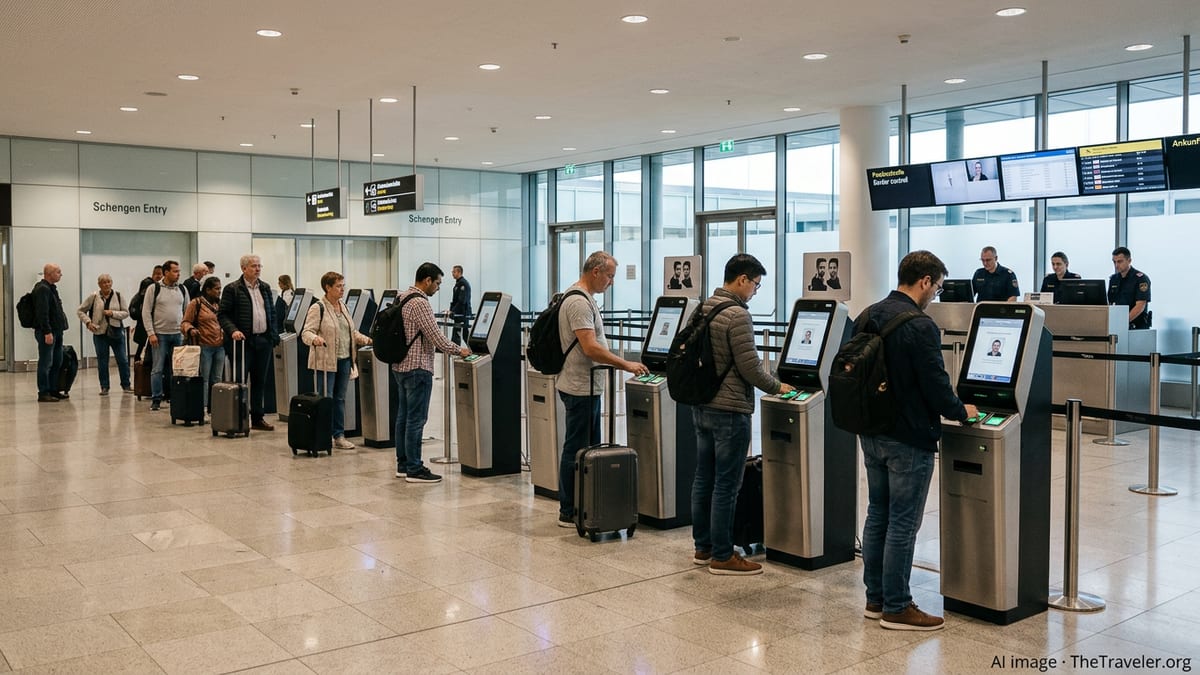
The way EES is implemented will vary by country and even by terminal, but recent operational briefings from major airports suggest a broad pattern. Many external Schengen hubs are installing self-service kiosks where non-EU travelers scan their passports, have a facial image captured and, where required, place their fingers on a reader before proceeding to a staffed booth or automated e-gate.
At some airports, travelers will complete most of the process at kiosks and then pass through e-gates that automatically verify their identity and EES record, with border officers intervening only when something flags for manual review. Other locations are expected to rely more heavily on manned booths, at least in the early months, as staff and systems adapt.
Industry groups representing airlines and airports have warned in recent months that the shift to biometric checks could initially lengthen queues, particularly where facilities are constrained or where passenger flows are peaking during holidays. Reports indicate that some border authorities are planning phased operating hours for kiosks, or keeping conventional stamp-based processing in reserve, to ease congestion during the transition.
At land crossings, especially on busy routes between non-EU neighbours and Schengen states, infrastructure upgrades are more complex. Travelers driving into the Schengen area may be directed to new lanes equipped with cameras, fingerprint scanners and document readers, while bus passengers could be processed at roadside kiosks or terminal buildings before boarding or immediately on arrival.
Practical Steps for Non-EU Travelers Before April 10
For non-EU travelers planning trips around early April 2026, a small amount of preparation can reduce stress at the border. Travel advisories from several governments and carriers recommend arriving earlier than usual for flights into Europe, particularly if the itinerary involves a first-time EES registration or tight connections at major hubs.
Passengers should ensure that passports are biometric, undamaged and valid for the required period beyond their stay, as EES relies heavily on automated chip reading and matching. Those who have previously struggled with self-service kiosks or e-gates should be prepared to seek assistance from airline or airport staff if instructed, as borderline cases and technical glitches are likely while the system beds in.
Travel experts also point to the importance of keeping careful track of days spent in the Schengen area once EES is fully live. The digital record will make overstays more visible and could affect future entries or visa applications. Non-EU visitors who frequently move in and out of the zone for work or family reasons may wish to double-check their planned itineraries against the 90-days-in-180 rule before departure.
Looking slightly further ahead, travelers should note that EES is intended to pave the way for another change, the European Travel Information and Authorisation System, or ETIAS. Public information currently indicates that ETIAS, a paid electronic travel authorisation for visa-exempt visitors, is expected to follow in late 2026. For now, though, the most immediate deadline is EES becoming standard at all Schengen external borders from 10 April 2026, reshaping the border experience for millions of non-EU travelers.