

More news on this day
Passengers across South Korea and on long haul routes to the Middle East and the Pacific are facing renewed disruption this week as Qatar Airways, Korean Air, and Air Seoul cancel more than a dozen additional flights, snarling traffic through Doha, Guam, Busan, Incheon, Seoul Gimpo, Jeju and other key gateways.
Get the latest news straight to your inbox!
Middle East Airspace Crisis Ripples Into Korean Skies
The latest wave of cancellations is being driven primarily by the continuing airspace crisis centered on Qatar, where a series of missile strikes and subsequent closures has forced Qatar Airways to repeatedly pare back its global schedule. The carrier has already suspended or rerouted hundreds of services through Doha since late February, and industry trackers show that its Seoul Incheon service remains vulnerable to short notice changes as operators wait for more stable conditions.
In recent days, flights linking Doha and Incheon have appeared as scheduled on some reservation systems only to be canceled within hours of departure, leaving Korean travelers bound for Europe, Africa and the Middle East scrambling for alternatives. At least one Qatar Airways service from Incheon to Doha on March 6 was scrubbed on the day of travel, and agents in Seoul report a rising volume of rebooking requests from passengers originally ticketed on the Doha corridor.
Qatar Airways has issued rolling travel waivers covering departures through mid March, offering fee free date changes and, in some cases, refunds for affected passengers. However, the uncertainty surrounding when normal use of key air corridors will resume means that schedules are being updated day by day, complicating forward planning for both leisure and corporate travelers originating in South Korea.
For South Korean nationals living and working in Qatar, the disruption has been particularly acute. Several hundred citizens who had been stranded in Doha following the first round of cancellations only began returning home this week on specially arranged services, underscoring how fragile connectivity between the Gulf and the Korean Peninsula remains.
Korean Air Trims Capacity on Guam and Domestic Holiday Routes
While the Qatar driven airspace restrictions are external, Korean Air has also begun tightening its own network as it recalibrates capacity on some of the region’s most popular leisure flows. Aviation schedule data reviewed on March 10 shows that the airline has quietly reduced frequencies on select services between Seoul Incheon and Guam, and adjusted aircraft types on busy weekend departures, effectively cutting available seats during what is normally a strong outbound travel period.
Travel agents in Seoul say they were notified this week of a series of Korean Air cancellations and consolidations affecting itineraries that connect regional cities such as Busan and Jeju through Incheon onward to Guam. In several cases, passengers booked on nonstop Busan Guam services have been reprotected onto itineraries requiring a transfer in Seoul, lengthening travel times and, in some instances, forcing overnight stays near Incheon.
Domestic holiday routes have not been spared. Korean Air has canceled a small number of rotations on the heavily trafficked Seoul Gimpo Jeju corridor, typically by folding lightly loaded midday flights into adjacent departures and upgauging aircraft where possible. The airline insists that the majority of affected travelers are being accommodated on same day alternatives, but warns that seat selection and preferred timings can no longer be guaranteed for some March departures.
The reshuffle comes as Korean Air continues the complex integration of Asiana’s operations and works to keep yields steady on routes that saw sharp discounting during the post pandemic recovery. Industry analysts note that trimming marginal frequencies while maintaining core departure times allows the carrier to protect profitability even as geopolitical volatility adds pressure to fuel and insurance costs.
Air Seoul Pulls Back on Guam Services Amid Capacity Shuffle
Low cost carrier Air Seoul, which only recently rebuilt its presence in the Guam market, is also cutting back. Airport and tourism officials on the island confirm that the airline has notified stakeholders of cancellations affecting a string of March and early April flights linking Guam with secondary Korean cities, including Busan, as carriers re evaluate the economics of overlapping services to the U.S. territory.
Passengers booked on Air Seoul’s Busan Guam and Incheon Guam routes have reported receiving short notice messages advising them that their flights have been canceled and offering either refunds or rebookings on different travel dates. In some instances, the only rebooking option has been a shift of several days, prompting travelers with fixed hotel reservations to seek alternative carriers such as Korean Air or Jeju Air, where seats are now at a premium.
Local tourism leaders in Guam say the cancellations, although limited in number, come at an awkward time, as the destination works to rebuild visitor numbers from its single largest source market. South Korean arrivals had been gradually recovering on the back of competitive fares and new services from Busan and other regional cities, and any perception of instability in air access could discourage short lead family trips during the spring school break period.
For Air Seoul, the pullback reflects the delicate balance that low cost operators must strike between maintaining a visible presence in key leisure markets and avoiding underperforming flights during periods of elevated operating costs. With fuel prices volatile and demand patterns skewed by wider geopolitical events, secondary routes from Korea to Guam are particularly exposed to schedule adjustments.
Travelers Face Confusion Across Incheon, Gimpo and Jeju
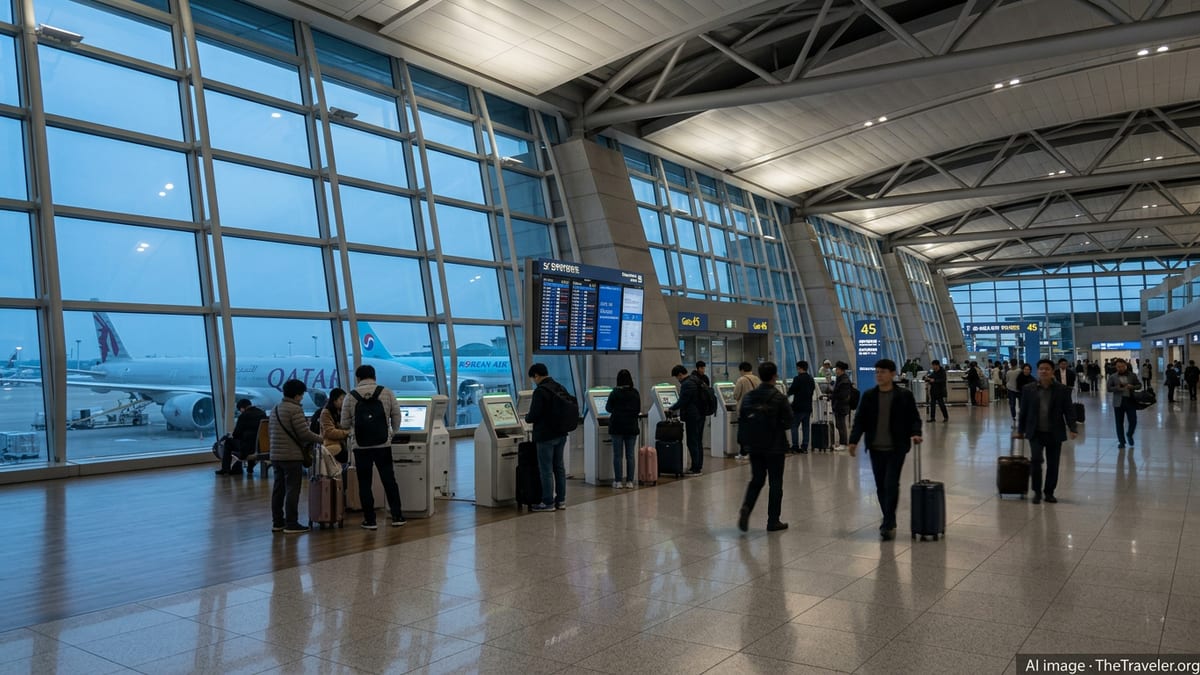
The cumulative effect of these moves is playing out most visibly at South Korea’s main gateways. At Incheon International Airport outside Seoul, departure boards in recent days have featured a scatter of canceled services to Doha, Guam and domestic points, often marked only a few hours before scheduled takeoff. Ground staff report that passengers sometimes arrive to find that their flights, still shown as “on time” in some apps, have already been withdrawn from the day’s operating plan.
At Seoul Gimpo, which handles a large share of domestic traffic, the impact is subtler but still disruptive. Travelers on the shuttle route to Jeju Island, one of Asia’s busiest air corridors, have encountered occasional last minute gate changes and consolidations as Korean Air and other carriers juggle aircraft rotations and crew hours. While most reach their destination the same day, unexpected schedule shifts have led to missed hotel check in windows and disrupted tour itineraries, particularly for tightly packed weekend getaways.
Jeju’s own airport has seen pockets of congestion when multiple delayed or consolidated flights arrive within a short window, straining baggage handling and ground transport. Local tourism businesses report a spike in late evening check ins and short staffed midnight airport transfers as visitors arriving from Seoul and Busan are funnelled into fewer, less predictable time slots.
For many travelers, the most frustrating aspect is the lack of clear visibility beyond a rolling several day window. With Qatar Airways updating its operations in tandem with airspace notices, and Korean carriers tweaking Guam and domestic schedules in response, itineraries further into March can appear confirmed on booking systems even as industry insiders warn that more adjustments are likely.
What Passengers Should Do Now
Industry experts and consumer advocates in South Korea are urging passengers with upcoming travel involving Doha, Guam or connections through Incheon, Gimpo and Jeju to take a proactive approach. Rather than relying solely on booking confirmations issued weeks or months ago, travelers are being advised to check their flight status directly on airline websites or apps at least 24 hours and again 4 to 6 hours before departure.
Those traveling on itineraries that include a Doha segment are encouraged to familiarize themselves with Qatar Airways’ latest waiver policies and, where possible, consider rerouting via alternative hubs in East Asia or the Gulf that are less affected by the current airspace restrictions. Travel agencies report that seats via Tokyo, Singapore and, to a lesser extent, Bangkok are in high demand among Korean passengers who previously favored one stop connections through Doha.
For leisure travelers heading to Guam or Jeju, flexibility on dates and departure times is emerging as a critical asset. Agents recommend that families and groups build in additional buffer days around key events, such as weddings or tours, and avoid same day connections between domestic and international legs when a single cancellation could cascade into missed long haul flights.
While airlines stress that safety and regulatory compliance remain their top priorities, the convergence of Middle East airspace disruptions, competitive capacity management and seasonal demand shifts means that South Korea’s air travel market is likely to remain unsettled in the short term. For now, passengers on Qatar Airways, Korean Air and Air Seoul are being reminded that even confirmed tickets may be subject to change, and that close monitoring and contingency planning are essential parts of flying this month.