

More news on this day
New Jersey rail commuters are bracing for weeks of disruption as Amtrak begins shifting trains from the century-old Portal Bridge to the new Portal North Bridge, triggering steep schedule cuts and forced detours for thousands who rely on daily service into New York Penn Station.
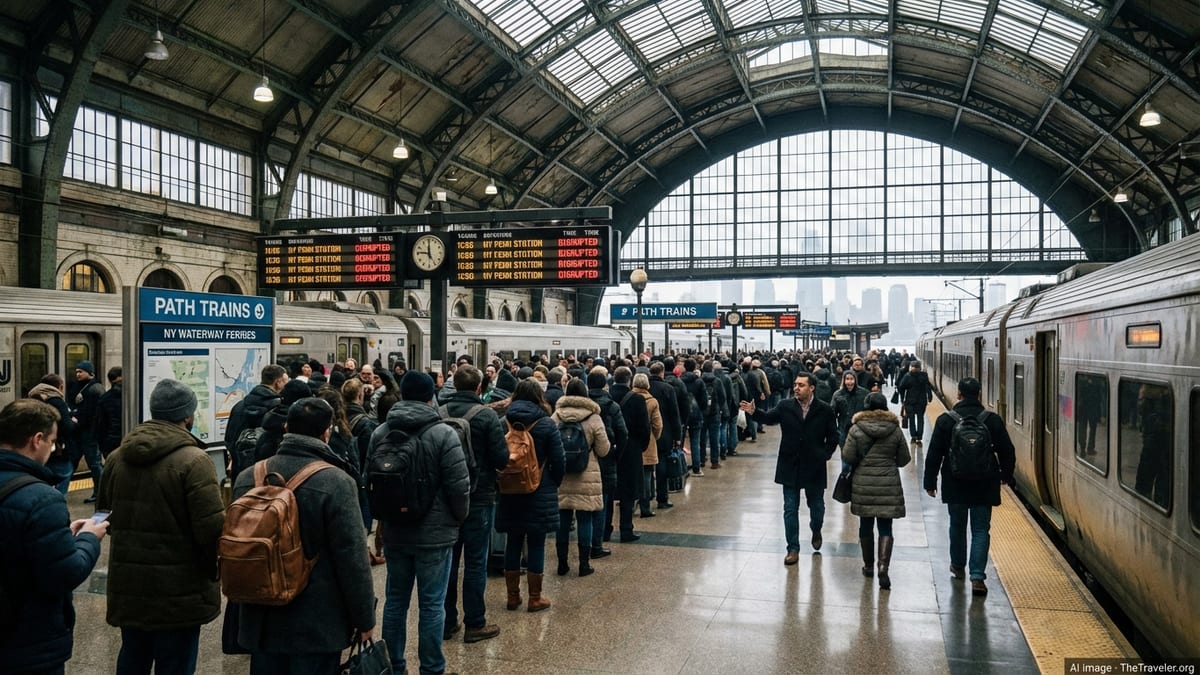
A Critical Bridge Reaches a Turning Point
The Portal Bridge over the Hackensack River, a 115-year-old swing-span structure long synonymous with delays, is finally being sidelined as crews commence a complex “cutover” to the taller, fixed Portal North Bridge. The work, which began over Presidents Day weekend, represents one of the most significant rail infrastructure milestones in the Northeast Corridor in decades, but it will come at a steep short-term cost for riders.
From February 15 to roughly March 14 or 15, trains between Newark and Secaucus will operate on a single track while Amtrak engineers splice 2.5 miles of new railroad into the existing main line, reconfigure interlockings, and bring new signal, power, and communication systems online. The reduced capacity on this chokepoint into Manhattan means far fewer trains will be able to reach New York during peak hours, forcing agencies to rewrite timetables, consolidate service, and divert entire lines.
Officials at NJ Transit and Amtrak have framed the coming month as a necessary sacrifice to eliminate one of the most fragile pieces of rail infrastructure on the East Coast. The Portal Bridge’s movable design has been notorious for malfunctioning when opened for marine traffic, sometimes freezing in place and cascading delays up and down the corridor from Washington to Boston. Replacing it with a high fixed span that will not need to open is expected to dramatically cut those disruptions in the years ahead.
In the meantime, however, the immediate reality for commuters is a daily scramble. Agencies are warning that crowding, longer journeys, and missed connections will become routine, especially for passengers who until now have enjoyed direct “Midtown Direct” service into Penn Station New York.
Deep Schedule Cuts Hit Core NJ Transit Lines
The most visible impact of the cutover is a sweeping reduction in NJ Transit’s weekday rail schedule. According to updated timetables, the agency is cutting its weekday service over the Portal crossing by nearly half, dropping from more than 330 trains to fewer than 180 during the four-week construction window. That translates to a roughly 50 percent drop in capacity at key times when commuters are trying to reach Manhattan.
The Morristown Line, Gladstone Branch, and Montclair-Boonton Line will bear the brunt of the changes. All weekday Midtown Direct trains that normally run straight into New York Penn Station are being diverted to Hoboken Terminal through mid-March. Riders who once stepped off a single train in Midtown will now need to transfer to PATH trains, buses, or ferries to cross the Hudson River, adding pressure to a Hoboken hub that is already busy in the morning rush.
Even lines that retain direct service to New York will see thinner schedules. The Northeast Corridor and North Jersey Coast Line, which carry some of the highest volumes of riders in the system, will operate fewer trains into Manhattan on weekdays. Schedules show earlier departure times, longer gaps between trains, and extended trip durations as the single-track bottleneck between Newark and Secaucus forces dispatchers to thread fewer trains through the corridor each hour.
NJ Transit has been urging riders to study the special timetables and adjust their routines well in advance, warning that missing a train could mean a much longer wait for the next available departure into New York. Local officials across suburban New Jersey communities have circulated alerts reminding residents that nearly all rail lines except the Atlantic City Rail Line will be on modified schedules until at least mid-March.
Amtrak Trims Flagship Services Along the Northeast Corridor
Amtrak, which owns the infrastructure and leads the Portal North Bridge project, is also instituting significant service reductions across its New York area routes. To free up capacity for construction windows and testing, the railroad is sidelining or adjusting roughly 280 trains during the cutover period, affecting its Acela, Northeast Regional, and Keystone services.
Passengers traveling between Boston, New York, Philadelphia, and Washington will find fewer daily departures and some retimed trips, while riders on the Keystone line linking New York and Harrisburg will also encounter reduced frequencies and altered stopping patterns. Amtrak has told customers that trip times should remain broadly consistent but that options will be more limited, particularly at peak hours when NJ Transit trains still dominate the route into Penn Station.
Rail advocates note that the Portal work underscores how closely intertwined Amtrak and NJ Transit operations are on the Northeast Corridor. With both carriers sharing tracks north of Trenton and funneling into the same crossing into New York, any reduction in capacity at the Portal choke point reverberates through the entire timetable. The result during this month-long project is a tighter, more fragile schedule in which delays and ripple effects may be harder to absorb.
Amtrak leaders have emphasized that, despite the cuts, trains will continue operating throughout the day and that crews are working to balance construction needs with the imperative to keep passengers moving. For many intercity travelers, however, flexibility will be essential as previously convenient departure times disappear from the schedule until the cutover is complete.
Hoboken Becomes the Relief Valve for Midtown Direct Riders
For tens of thousands of New Jersey commuters, the most dramatic day-to-day change is the loss of one-seat rides into Midtown Manhattan. Beginning this week, all weekday Midtown Direct trains from the Morristown, Gladstone, and Montclair-Boonton lines are terminating at Hoboken instead of New York Penn Station. That shift effectively turns Hoboken into the primary relief valve for the region’s disrupted rail network.
At Hoboken Terminal, riders are being directed to connect to PATH trains bound for 33rd Street, as well as to NY Waterway ferries and NJ Transit buses into Manhattan. To ease the transition, NJ Transit is cross-honoring rail tickets on PATH between Hoboken and Midtown, on select bus routes, and on expanded peak-hour ferry services to and from Midtown. Even so, officials are blunt that platforms, passageways, and transfer points in Hoboken are likely to be congested, especially in the morning and evening rush.
Transit planners and local officials have urged commuters who have the option to consider traveling earlier than 7 a.m. or after 9 a.m. into the city, and to avoid the 4 p.m. to 7 p.m. evening crush when outbound trains and ferries are expected to be most crowded. Employers in Manhattan have been encouraged to allow flexible hours or remote work to help thin the peaks, but many riders say their jobs still require them to be at a specific place at a specific time.
The concentration of diverted riders at Hoboken will also test the resilience of other systems. PATH must absorb an influx of former Midtown Direct passengers, while ferry operators are adding trips to accommodate new demand from rail riders seeking a potentially faster or less crowded river crossing. Bus terminals and Port Authority facilities are likewise preparing for a short-lived but intense surge in transfers from the rail network.
Officials Urge Remote Work and Off-Peak Travel
Recognizing the severity of the disruption, NJ Transit and Amtrak have taken the unusual step of openly advising riders to stay off the trains if they can. Both agencies have recommended that customers work from home whenever possible during the four-week cutover, or at least shift their commutes outside the typical rush hour peaks to avoid the worst crowding.
Transit alerts emphasize that, during certain periods, the number of trains able to enter Penn Station New York will plunge from about 48 an hour at full capacity to as few as 18 an hour under single-track operation. That sharp reduction leaves little room for error: a minor delay or equipment problem on one train could cascade quickly through a timetable already stripped back to its minimum.
To cushion the blow, NJ Transit is expanding cross-honoring arrangements with its bus network and with private ferry operators, and is promoting flexible ticket options such as discounted multi-trip passes for riders who do not travel every day. The railroad has also made a suite of online tools available so customers can plug in their home stations and see exactly how their options change during the cutover window.
Despite those efforts, riders’ groups and local officials say the message is clear. Commuters should expect longer travel times, more transfers, and more uncertainty until the work is done. Travel planners are urging passengers to build in extra time, monitor real-time alerts, and have backup routes ready in case a preferred train is canceled or overcrowded.
Behind the Scenes: A Complex Engineering Cutover
While the disruption is playing out in stations and train cars, much of the work that requires it is happening out of public view along the Hackensack River. The Portal North Bridge cutover is more than a simple track shift. It is a tightly choreographed engineering operation involving new alignments, interlockings, signals, communications, and power systems that all must be integrated with an active, heavily used main line.
Construction crews are connecting 2.5 miles of new railroad to the existing Northeast Corridor, installing more than 4,500 feet of track and building two new interlockings that will control how trains move on and off the new bridge. At the same time, technicians are deactivating the complex mechanical and electrical systems associated with the old swing bridge and bringing new digital signal and safety systems online.
According to project briefings, the cutover will require roughly 40,000 labor hours in a span of just a few weeks, with between 70 and 90 workers on site each day. Much of the most sensitive work must be scheduled in tight windows between trains, leaving little margin for error. Safety testing and commissioning of the new systems must be completed before trains can fully transition to the new structure.
Engineers and project leaders describe this phase as one of the most technically demanding in the multi-year Portal North Bridge project. Unlike earlier construction work, which took place largely away from the active main tracks, the cutover directly interfaces with live rail operations. That is why, despite the frustration it causes, such a significant and temporary reduction in train service is considered unavoidable by those overseeing the project.
Short-Term Pain, Promised Long-Term Gain
The Portal North Bridge project is part of the broader Gateway Program, a multibillion-dollar effort to modernize the busiest stretch of the Northeast Corridor between New Jersey and New York. When fully complete, the new bridge will eliminate the need to open for marine traffic, allow higher train speeds, and provide more reliable operations for both NJ Transit and Amtrak.
Officials have called this month’s cutover a “100-year investment,” arguing that a few weeks of intense inconvenience will translate into decades of smoother, more predictable commuting. Once both tracks on the new bridge are fully in service and the old Portal Bridge is retired, the hope is that many of the chronic delays that have plagued riders for years will fade into memory.
The current phase is expected to bring just the first track of the new bridge into operation. A second cutover, likely in the fall of 2026, will be needed to connect and commission the remaining track, meaning another period of service reductions looms on the horizon. Beyond that, broader Gateway Program elements, including new Hudson River tunnels and rehabilitation of the existing North River tunnels, promise further disruption but also major gains in capacity and resilience.
For now, commuters are focused on getting through the next four weeks. Many acknowledge the long-term benefits but say that the immediate challenge of juggling altered schedules, packed transfer points, and uncertain arrival times cannot be wished away. How smoothly this first Portal cutover proceeds, and how effectively agencies keep riders informed in real time, is likely to shape public confidence in the broader Gateway effort.
How Riders Can Navigate the Chaos
Transportation planners and rider advocates are offering practical advice for those who have no choice but to travel during the Portal Bridge cutover. The first step, they say, is to confirm whether a usual train even exists in the temporary schedules and to identify all realistic alternatives, whether via Hoboken, a different rail line, or a bus or ferry connection.
Regular riders are being urged to download updated schedules, sign up for real-time service alerts, and check conditions each morning before leaving home. With trains operating less frequently and platforms expected to be more crowded, having an earlier or later option in mind can help soften the impact if a desired departure is too full or unexpectedly canceled.
Commuters who normally depend on a one-seat ride to Midtown are being encouraged to familiarize themselves with PATH station layouts, ferry terminals, and key bus stops around Hoboken and lower Manhattan. For some, this month will mean building a new commute from scratch, complete with new walking routes, transfer points, and backup options in case the first plan unravels.
Ultimately, the message from agencies and advocates is one of cautious patience. The Portal North Bridge cutover is expected to test the limits of New Jersey’s rail system and its riders. Yet if the work stays on schedule and the new track enters service as planned in mid-March, the short-term chaos could give way to a more dependable daily journey for the region’s long-suffering commuters.