

More news on this day
New Jersey’s long-awaited replacement of the aging Portal Bridge has reached a turning point in early 2026, marking a transformational moment for hundreds of thousands of commuters traveling between New Jersey and New York City on the busy Northeast Corridor.
Get the latest news straight to your inbox!
From Aging Chokepoint to Modern Rail Lifeline
The existing Portal Bridge, a 116-year-old swing bridge over the Hackensack River in Kearny, has long been one of the most notorious weak links on the Northeast Corridor between Newark and New York Penn Station. Publicly available information shows that the bridge’s need to pivot open for marine traffic, combined with aging mechanical systems, has repeatedly caused it to stick or fail to lock back into place, triggering cascading delays for Amtrak and NJ Transit riders.
The new Portal North Bridge, now entering its final construction phase, is designed as a higher fixed-span structure that will not need to open for river traffic. According to federal project profiles and recent agency presentations, the new two-track bridge is built to support higher speeds, improved reliability, and significantly greater capacity for future service growth across one of the nation’s busiest rail arteries.
The replacement project forms a core early component of the broader Gateway Program, a multibillion-dollar effort to modernize the rail connection between New Jersey and New York. For daily riders from cities such as Newark, Jersey City, Hoboken, Trenton, and Philadelphia, the Portal North Bridge is widely viewed as the single most consequential near-term upgrade for getting into and out of Manhattan more dependably.
Rail planners describe the old Portal Bridge as both a structural and operational bottleneck, with only two tracks and frequent mechanical issues. By contrast, the new bridge has been engineered for more consistent operations, with simplified movements and upgraded power and signal systems that are expected to reduce unplanned outages once both tracks are in full service.
Cutover Work Brings Short-Term Pain, Long-Term Gain
The transformation reached a visible milestone in February and March 2026, when Amtrak and NJ Transit began the complex “cutover” process to shift train operations from the old span to the new Portal North Bridge. Amtrak’s January 15, 2026 construction update described the work as essential to connecting the new structure, wires, and signaling to the main line and preparing the first track for regular service.
To complete this task, rail operators temporarily reduced the number of trains operating between Newark and New York, consolidating or canceling some departures and adjusting stopping patterns across most NJ Transit lines except the Atlantic City Rail Line. Publicly posted schedules and advisories show that the main service changes began around mid-February and were expected to continue through at least mid-March, with single-track operations through the Portal corridor limiting how many trains could run at peak times.
Recent coverage in regional outlets such as NorthJersey.com and local broadcast reports has highlighted the scale of the disruptions, including crowding on alternative trains and shifts in commuting patterns as riders tried to avoid the most congested travel windows. Online rider forums and community discussions have tracked day-to-day conditions, with some commuters reporting longer travel times and more standing-room-only trains during the height of the cutover.
Despite the inconvenience, agency communications emphasize that the cutover marks the bridge’s final approach to service in 2026. Project documentation circulating ahead of the work indicates that once the first new track is fully commissioned, a second major outage is anticipated in 2027 to bring the second track online and retire the old Portal Bridge entirely.
First Trains Cross New Portal Bridge Ahead of Schedule
In mid-March 2026, the shift from construction site to active rail link became tangible as trains began crossing the new Portal North Bridge for the first time. According to Amtrak’s March 2026 project updates, the early moves over the new span were prompted in part by issues with several overhead catenary poles on the old bridge, which temporarily affected train movements and accelerated the use of the new structure for live traffic.
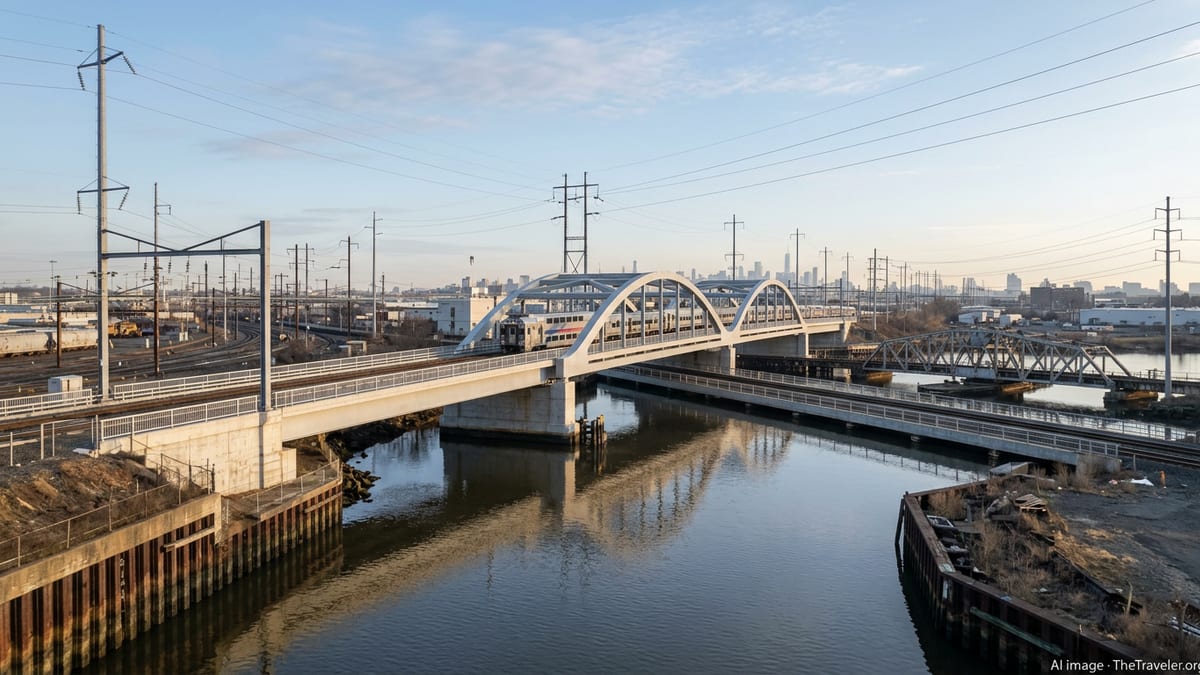
Posts on commuter-focused forums and social media over the weekend of March 13 described the experience of unexpectedly riding over the new bridge days before many riders anticipated seeing it in action. Images shared publicly show trains gliding over the higher, arched concrete-and-steel structure, a visible contrast with the low-slung, rust-streaked profile of the century-old swing bridge just to the south.
Amtrak statements summarized in local reporting suggest that, for now, operations are being carefully managed while work continues on associated systems and on the remaining track and infrastructure around the bridge. The official transition to the new schedules tied to the Portal North Bridge cutover is still keyed to mid-March, but the early activation has given transit observers a glimpse of the post-Portal future.
Rail advocates note that even partial use of the new span represents a significant operational shift. With one track on the new bridge taking some traffic, dispatchers gain new flexibility to route trains around potential problems on the old structure, reducing the risk that a single mechanical failure or misaligned span will freeze a critical east-west link for hours at a time.
What Changes for NYC–New Jersey Commuters in 2026
For the typical commuter into New York City, the Portal North Bridge’s 2026 milestones may initially feel like a mix of frustration and cautious optimism. During the cutover period, public service advisories indicate that riders face fewer trains, busier platforms, and the need to build in extra time for potential crowding or delays between Newark, Secaucus, and Penn Station.
Transit planners, however, are positioning 2026 as the pivot year when those short-term challenges begin to translate into tangible improvements. Official project profiles published by the Federal Transit Administration describe the new bridge as a “core capacity” investment, capable of supporting more trains per hour through the corridor once both tracks and connecting infrastructure are fully in service.
In practical terms, that could mean more resilient rush-hour operations, improved on-time performance, and additional capacity for future service expansions. Commuters who have endured years of disruption from occasional Portal Bridge openings, stuck spans, and emergency repairs are watching closely for signs that the pattern of chronic delays is beginning to break.
Longer term, the Portal North Bridge is expected to dovetail with other Gateway Program elements, including new Hudson River tunnels and upgrades in and around Penn Station. Together, these investments are intended to make cross-Hudson rail travel less fragile and more adaptable to surging demand, offering New Jersey residents a more reliable path to jobs, schools, and cultural destinations in New York City.
A Symbol of Gateway’s Next Era
Beyond its immediate operational impact, the Portal North Bridge is emerging as a powerful symbol of what the Gateway Program aims to achieve along the Northeast Corridor. Project renderings and recent construction photographs show a modern, multi-arch concrete bridge rising above the Hackensack River, replacing a low, aging swing span that once epitomized the region’s infrastructure backlog.
Transportation analysts point out that the new bridge is not simply a like-for-like replacement, but a strategic capacity upgrade in a corridor where rail ridership has grown dramatically over the past two decades. By allowing higher speeds, smoother movements, and more consistent service, the structure is intended to anchor a more frequent and reliable rail network linking Washington, Philadelphia, Newark, and New York.
For communities on both sides of the Hudson, the 2026 cutover is one of the first visible signs that long-discussed megaprojects are finally reaching the point of delivering everyday benefits. Even as riders navigate schedule changes and temporary slowdowns this year, the sight of trains beginning to cross a gleaming new span hints at a future in which the infamous Portal Bridge delays recede into memory.
As work continues through 2026 and into 2027, travelers, agencies, and local businesses will be watching closely to see how quickly the promised reliability gains materialize. For now, the new Portal North Bridge stands as a visible, functioning reminder that the region’s rail system is entering a new era, with New Jersey and New York City commuters at the center of the transformation.