

More news on this day
A new alignment of Ethiopian Airlines, Air France and KLM at New York’s John F. Kennedy International Airport is emerging just as international travel from Canada, Germany and the United Kingdom shows signs of renewed momentum, a combination that analysts say could channel more long‑haul visitors into New York City hotels in the coming seasons.
Get the latest news straight to your inbox!
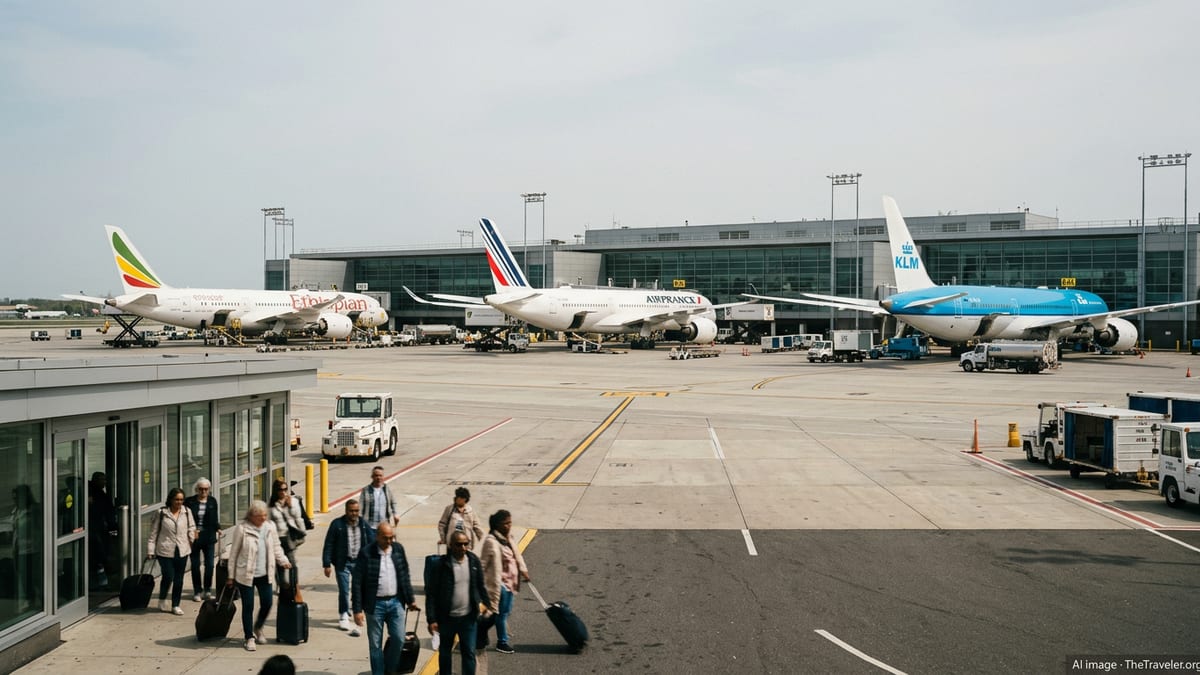
Airline Grouping at JFK Strengthens Transatlantic and African Links
Publicly available information indicates that Air France and KLM are among the anchor carriers for JFK’s New Terminal One project, part of a multibillion-dollar redevelopment designed to consolidate major long-haul airlines in a modern facility. Recent airline and airport statements show that Ethiopian Airlines is aligning its New York operations with the same terminal community, creating a denser cluster of connectivity between Europe, Africa and the U.S. East Coast.
By co-locating at JFK, the three carriers are expected to simplify connections for travelers flying from major European hubs such as Paris Charles de Gaulle and Amsterdam Schiphol, onward to New York and beyond. For Ethiopian Airlines, which has grown its global network via Addis Ababa into both Africa and Europe, closer operational proximity to Air France and KLM strengthens one of the busiest transatlantic gateways at a time when travelers are increasingly mixing business trips, family visits and leisure stays in New York.
Aviation analysts note that grouping complementary long-haul carriers at a single terminal typically reduces minimum connection times and improves the appeal of through-tickets combining multiple airlines. That can be particularly important for passengers from secondary cities in Canada, Germany and the UK, who often rely on a European or African hub before continuing to the United States. A more seamless JFK experience, they say, tends to translate into higher propensity to stop over in New York for at least one night.
Canada, Germany and UK Travel Set to Rebound After 2025 Dip
While overall international arrivals to the United States softened in 2025 amid economic and currency headwinds, forward-looking tourism intelligence suggests that travel from Canada, Germany and the UK is poised to recover gradually through 2026 and beyond. Market forecasts compiled by Tourism Economics and national tourism boards point to improving consumer confidence, easing inflation and stabilizing air capacity as key factors expected to support a rebound in outbound trips from these countries.
In the case of Canada, government and industry data show that cross-border travel to the United States contracted sharply in 2025, particularly via land crossings, before signs of stabilization began to appear in late-year booking trends. Analysts now expect Canadian outbound volumes to grow again over the next several years, although from a lower base, as travelers recalibrate budgets and look for short- to medium-haul destinations where existing air links, including to New York, already are well established.
Germany and the UK, traditionally among the top long-haul source markets for New York City, also registered double-digit percentage declines in U.S.-bound visitor numbers in 2025 compared with the previous year, according to federal statistics. However, updated projections from international market research show both countries returning to modest growth trajectories for U.S. travel as airlines restore capacity and the euro and pound recover some ground against the dollar. With strong brand awareness of New York and deep corporate ties, the city remains high on the priority list once households resume discretionary long-haul spending.
New York City Hotels Already Posting Revenue Gains
New York City’s lodging sector has entered this next phase of international recovery from a position of relative strength. Recent reports from municipal fiscal authorities and hospitality consultancies show that hotel occupancy in 2025 averaged in the low- to mid‑80 percent range, with revenue per available room primarily driven by higher average daily rates rather than volume alone. Hotel occupancy tax collections, a proxy for overall room revenue, rose strongly through fiscal 2025, underscoring the resilience of demand in the nation’s largest urban hotel market.
Industry research indicates that Manhattan properties, in particular, have been able to sustain elevated room pricing even as domestic leisure growth plateaus, supported by a combination of returning business travel, large-scale events and a constrained pipeline of new hotel openings. While the city has regained much of its pre‑pandemic visitor volume, hotel performance has outpaced raw arrival counts due to longer average stays in some segments and a shift toward higher-rated corporate and international business.
With more European and African capacity funneled through JFK by Ethiopian Airlines, Air France and KLM, hoteliers are watching closely for an uptick in high-yield international guests who typically book central locations and higher room categories. Revenue managers say that even modest percentage gains in arrivals from Canada, Germany and the UK can translate into outsized impacts on room revenue, given these markets’ relatively strong spending power and propensity to travel in shoulder seasons.
Airport Connectivity and Visitor Behavior Could Shift
The evolving airline landscape at JFK is expected to influence how visitors move between the airport and city hotels. As additional long-haul services consolidate into the upgraded Terminal One facilities, transportation providers anticipate incremental demand for premium transfer options into Manhattan, Brooklyn and Queens. This includes black-car services, shared shuttles and higher-end public transit options that appeal to international travelers arriving from overnight flights.
Travel behavior research suggests that smoother airport experiences and more reliable arrival timings encourage visitors to plan same-day check-in at urban hotels rather than adding an airport-adjacent night, especially when customs processing and onward ground transport are predictable. For New York, where travel times from JFK to central districts can vary widely, improvements in terminal design, baggage systems and passenger flows may have a direct bearing on where and when guests choose to spend on accommodation, dining and entertainment.
Tourism strategists also point to the potential for the JFK developments to reinforce New York’s role as a multi-stop gateway. Travelers from Canada, Germany and the UK who connect via European or African hubs on Air France, KLM or Ethiopian Airlines increasingly combine New York stays with onward trips to other U.S. cities or Caribbean destinations. A well-integrated terminal environment could encourage more of these itineraries to include at least one or two nights in New York at either end of the journey, incrementally lifting hotel demand without a corresponding surge in overall visitor counts.
Outlook: Strategic Airline Moves Support Long-Term Hotel Growth
Despite recent headwinds in international arrival numbers, the combination of a strengthened airline cluster at JFK and a gradually improving outlook in key origin markets is seen by industry observers as a constructive signal for New York’s hotel sector. Current forecasts from tourism and economic agencies anticipate that, over the medium term, inbound travel from Canada, Germany and the UK will return to growth, even if the pace remains uneven and sensitive to currency swings and geopolitical developments.
For New York hotels, particularly in Manhattan, the priority is to capture a greater share of that returning demand through targeted marketing, refreshed product offerings and continued investment in service quality. Luxury and upper-upscale properties stand to benefit first from any uplift in long-haul business and high-spend leisure segments flying on Ethiopian Airlines, Air France and KLM into JFK, but midscale and lifestyle hotels across the boroughs are also likely to see gains as visitor volumes normalize.
While external risks remain, the alignment of major international carriers at JFK, combined with improving sentiment in core overseas markets, positions New York City’s hospitality industry for further revenue growth. The city’s role as a global gateway, supported by coordinated air service and infrastructure improvements, continues to underpin its appeal as both a first and repeat choice for international travelers.