

More news on this day
Austria’s long-awaited Koralm Railway has entered a new phase with the launch of high-speed services that, for the first time, knit Vienna, Graz, Klagenfurt and Villach into a fast, continuous rail corridor, dramatically cutting journey times and intensifying competition on the nation’s key southern route.
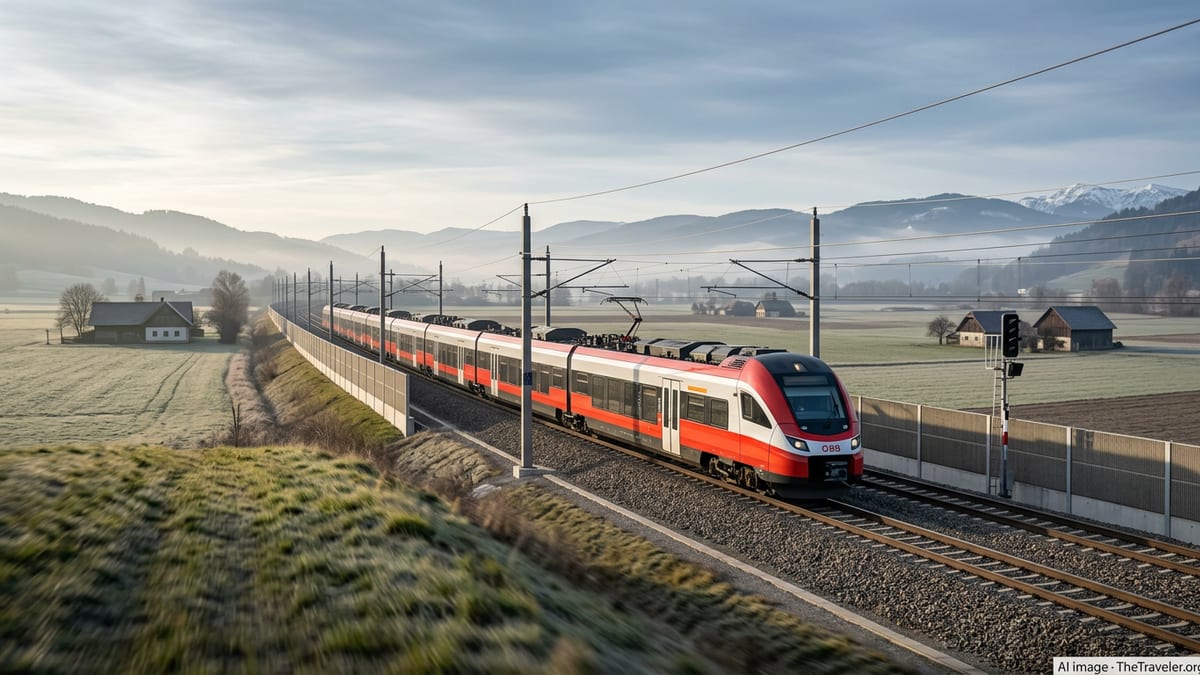
A Once-in-a-Century Rail Project Comes of Age
The opening of regular passenger services on the Koralm Railway in December 2025 marked the debut of a completely new 130-kilometre line between Graz and Klagenfurt, anchored by the 32.9-kilometre Koralm Tunnel, Austria’s longest rail tunnel. After more than two decades of construction, test runs and freight operations, the line has now become the backbone of a reimagined southward axis from Vienna to Carinthia and onward to Villach.
Travel times between Graz and Klagenfurt have been slashed to around 41 minutes, compared with close to three hours on the older mountainous route. Officials describe the project as a generational investment that not only transforms domestic mobility but also strengthens the Baltic–Adriatic corridor linking ports in Poland and northern Italy through Austria’s Alpine heartland.
For passengers, the most visible impact is the new pattern of long-distance trains. Railjet and Railjet Express services now run through from Vienna to Graz, Klagenfurt and Villach, turning what was once a multi-hour odyssey with changes into a swift, largely straight-line journey through southern Austria. The corridor is being marketed as a fast alternative to road and short-haul air travel, with national rail operator ÖBB projecting a double-digit increase in long-distance ridership.
The line’s technical specifications, allowing speeds of up to 230 to 250 km/h on key sections, mean that southern Austria now hosts one of the country’s most advanced pieces of rail infrastructure. Almost half of the route runs in tunnels, supported by more than 100 new bridges, reflecting both the engineering complexity and the strategic importance of the project for European rail freight and passenger flows.
Vienna–Graz–Klagenfurt–Villach: A New High-Speed Spine
With the Koralm Railway fully integrated into national timetables, Austria’s Southern Railway has effectively been redrawn. Vienna is now directly linked via high-speed services to Graz, then through the Koralm Tunnel to Klagenfurt, and onward to Villach, creating for the first time a continuous fast corridor connecting all four cities.
Timetables introduced in December 2025 significantly boosted the number of long-distance trains between Vienna and both Graz and Carinthia. Dozens of daily connections now run from the capital to Graz and on to Klagenfurt, many continuing further along the Drau valley to Villach and towards the Italian and Slovenian borders. Hourly and near-hourly patterns on much of the route signal a step change in southern Austria’s accessibility.
This new spine also reshapes links beyond the country’s borders. Railjet and associated services now provide faster onward journeys via Villach towards northern Italy and Slovenia, while new and extended Intercity and ICE services tie Graz and Klagenfurt more closely to Germany and the wider Central European network. For leisure travellers, that translates into quicker, more straightforward rail options to the Alps, lakes and spa resorts of Carinthia and Styria.
Crucially, Villach, long a junction on international routes but relatively distant from Vienna in travel time, stands to gain from its role as the southwestern anchor of the new corridor. Journey times from Graz to Villach are being reduced to under 66 minutes, and the city is positioning itself as an accessible Alpe-Adria hub for both tourism and cross-border commuting.
Private Operator WESTbahn Joins the Race
The competitive landscape on the southern route has shifted again in recent days with the entry of private operator WESTbahn onto the high-speed corridor. From 1 March 2026, WESTbahn has begun running services on the Vienna–Graz–Klagenfurt–Villach route, operating for the first time on the historic Südbahn and directly challenging ÖBB on one of its most strategically important lines.
To serve the Koralm Railway, WESTbahn has procured new SMILE electric multiple units from Stadler, capable of speeds up to 250 km/h. These high-specification trains are designed to take full advantage of the line’s performance parameters, promising competitive journey times and a comfort-focused onboard product, including open, bright interiors and strong digital connectivity.
Initially, the private operator is offering three pairs of trains per day on the Vienna–Villach axis, with plans to ramp up to five daily pairs by late March. While the frequency is modest compared with ÖBB’s dense timetable, the move is symbolically significant. It signals that the Koralm corridor is sufficiently mature and commercially promising to attract private investment and foster head-to-head competition on pricing and service quality.
For travellers, WESTbahn’s arrival is expected to mean sharper fares, more choice in onboard amenities and loyalty schemes, and the possibility of differentiated products on what is rapidly becoming one of Austria’s premier rail corridors. For policymakers, it is an early test of how open-access competition can coexist with a heavily subsidised national operator on brand-new, strategically funded infrastructure.
Air–Rail Integration and New International Links
The new high-speed connections are also transforming how southern Austria links to the skies. From December 2025, Austrian Airlines and ÖBB are extending their integrated AIRail product to Klagenfurt, using the time savings delivered by the Koralm line to offer through-ticketed rail services between the Carinthian capital and Vienna International Airport.
Under the expanded scheme, passengers can travel between Klagenfurt Central Station and Vienna Airport with a single combined train-and-flight ticket, timed to feed into Austrian’s wider European and intercontinental network. The rail leg takes just under four hours, running non-stop and without transfers, and is designed to compete directly with short domestic flights while cutting the environmental footprint of airport access.
International rail links are also being reconfigured around the new corridor. From December 2025, ComfortJet sets formed by Czech Railways and ÖBB began operating three pairs of Vindobona trains, connecting Prague and Brno with Vienna, Graz, Klagenfurt and Villach. These long-distance services, routed through the Koralm Tunnel, create a seamless north–south axis from the Czech capital to the Alpe-Adria region, with upgraded rolling stock aimed at both business and leisure travellers.
Further timetable changes foresee more frequent connections from Graz, Klagenfurt and Villach via the Tauern route to Salzburg and onward to Munich, while extended ICE services from Germany now reach deeper into southern Austria. Together, these adjustments signal a broader realignment of Central European rail geography around the new high-speed link.
Economic, Tourism and Climate Impacts Across the Region
Local and regional authorities in Styria and Carinthia are betting that the Koralm Railway will do more than save minutes on a timetable. Municipal campaigns, particularly in Villach and along the line’s intermediate hubs, frame the project as a catalyst for investment, tourism and demographic growth, promoting under-one-hour travel times between key cities as a selling point for businesses and new residents.
Tourism boards are highlighting the ease of weekend and short-break travel, with city dwellers in Vienna and Graz now within faster reach of Carinthia’s lakes, ski areas and spa towns, and vice versa. The improved accessibility also strengthens year-round cultural and conference tourism, making it more feasible to stage major events in provincial capitals without relying heavily on car or air travel.
From a climate perspective, Austria’s government and ÖBB portray the Koralm Railway as a flagship project in efforts to shift passengers and freight from road to rail. The line’s high capacity and speed, combined with new intermodal offerings such as AIRail, are intended to make rail the default choice on medium-distance domestic journeys. Early projections suggest a significant uplift in long-distance passenger numbers, though the full environmental impact will only become clear as complementary projects, notably the Semmering Base Tunnel between Vienna and Graz, come on stream later in the decade.
For now, what is clear is that the Koralm project has already altered the mental map of Austria. By drawing Vienna, Graz, Klagenfurt and Villach into a single, fast rail corridor, it has compressed distances, broadened horizons and set a new benchmark for how the country travels across its southern flank.