

More news on this day
A new low-cost train service linking London with major Scottish cities from prices starting at around £35 is poised to reshape budget travel in the United Kingdom, widening access to rail and promising fresh momentum for domestic tourism between England and Scotland.
Get the latest news straight to your inbox!
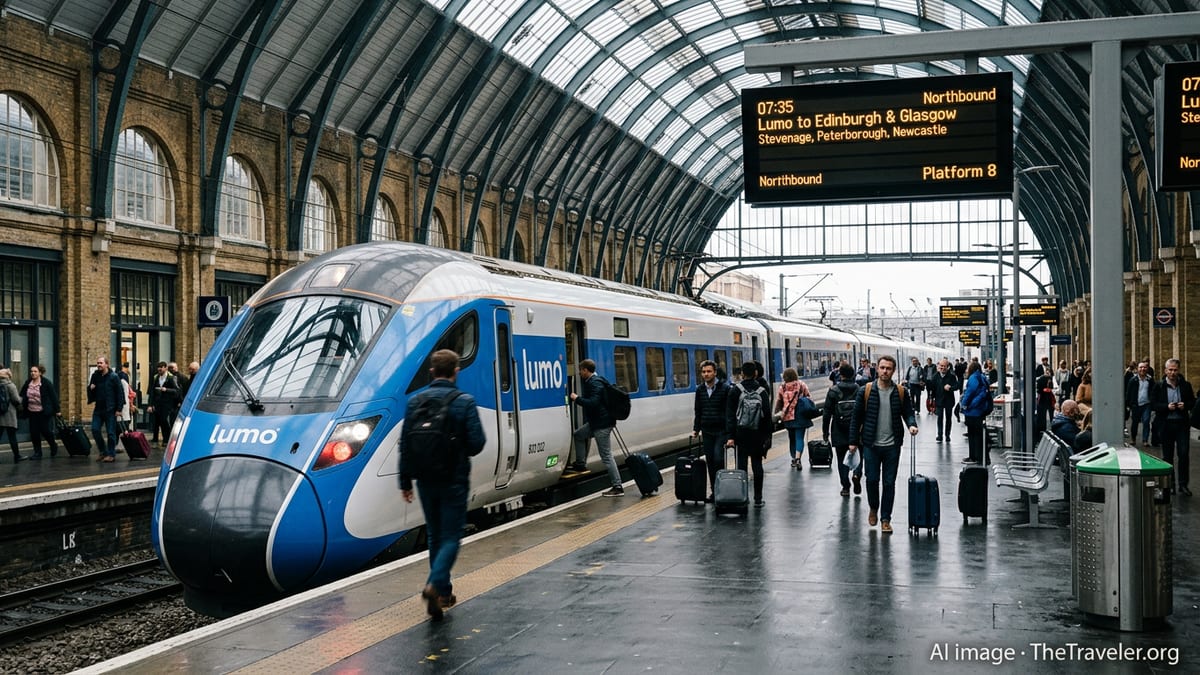
Budget Operator Expands North to Glasgow and Beyond
The most recent addition to Britain’s rail map comes from Lumo, the open-access budget operator that initially entered the market on the East Coast Main Line between London and Edinburgh. Publicly available information shows that the company has now rolled out a direct service connecting London with Glasgow, with intermediate links through Falkirk, Edinburgh and the north-east of England, positioning itself as a challenger to traditional intercity operators.
Reports indicate that advance tickets on the new route are being sold for under £35, putting rail in direct competition with low-cost airlines and long-distance coach operators on one of the UK’s busiest domestic corridors. The service is marketed around a simplified, all-standard-class offer and an emphasis on digital booking, helping to strip out some of the overheads associated with legacy rail operations.
The new trains operate on the existing electrified main line infrastructure, allowing journey times that are competitive with other daytime services while maintaining a strong cost focus. Capacity is boosted by high-density seating layouts and modern rolling stock designed to maximise the number of passengers per train without resorting to premium classes.
By extending its reach beyond the London–Edinburgh axis, the operator is attempting to establish a coherent low-cost network that serves multiple Scottish destinations, including Glasgow and key interchange points. This is expected to generate new flows of passengers who may previously have avoided rail because of high walk-up fares or limited direct options.
Sub-£35 Fares Aim to Lure Drivers and Flight Passengers
The headline fares, advertised at levels just under or slightly above £35, are central to the strategy. According to published coverage, the most competitive tickets on the new London–Scotland route sit in a price band that has traditionally been dominated by budget airlines and coach companies. By matching or undercutting those options, the low-cost rail model is designed to appeal to price-sensitive travellers who might otherwise choose to drive or fly.
Industry analysis suggests that the combination of low entry-level fares and a straightforward pricing structure can help demystify long-distance rail for occasional travellers. With advance purchase and off-peak travel, passengers can secure prices close to the widely publicised sub-£35 level, particularly on midweek and shoulder-period services where spare capacity tends to be highest.
The service also arrives at a time when domestic rail fares policy is under scrutiny. Government decisions in England to freeze regulated fares for 2026, alongside separate devolved decisions in Scotland, are intended to prevent further sharp increases in ticket prices and to maintain the relative attractiveness of rail. Within that context, a private operator pitching aggressively low lead-in fares adds a competitive dynamic that could pressure incumbents to sharpen their own deals.
Travel commentators note that while the lowest fares are limited in number and require advance booking, their presence in booking systems can shape public perceptions of rail affordability. Even passengers who ultimately pay more may be drawn into considering train travel once they see widely promoted tickets in the £30 to £40 range on a high-profile intercity route.
Tourism and Regional Economies Stand to Gain
The new connection is expected to bolster tourism flows between London and Scotland, linking cultural and commercial hubs such as Glasgow, Edinburgh and key destinations in northern England. Travel and tourism publications highlight that easier, cheaper rail options are likely to encourage more short-break trips, particularly among younger travellers, families and overseas visitors using London as a gateway.
Visit-focused industry coverage points out that Scottish cities already benefit from strong branding around festivals, heritage and outdoor activities. Lower rail fares from London and intermediate English cities can help convert that interest into actual visits, especially during shoulder seasons when hotels and attractions have spare capacity. Towns along the route, including those that function as interchange points, may also see increased stopover traffic as itineraries become more flexible.
Economic commentators have linked the expansion of open-access and low-cost rail services with broader regional development objectives. More frequent and affordable trains support labour mobility, enabling people to commute longer distances or take up opportunities in different cities without depending solely on private cars. For tourism businesses, improved rail links can widen catchment areas for customers and staff, strengthening the resilience of local economies.
There is also an environmental dimension. The operator’s use of electric trains aligns with wider policy ambitions to reduce carbon emissions from domestic travel. As more price-conscious travellers shift from short-haul flights or long car journeys to rail, the aggregate impact on emissions could be significant, provided that new services succeed in attracting passengers who would not otherwise have travelled by train.
Capacity, Competition and the Future of UK Rail Travel
The launch of Britain’s over-£35 low-cost London–Scotland connection comes amid a broader reshaping of the rail timetable. Recent timetable changes on the East Coast Main Line have increased seat capacity between London and Edinburgh, and new routes from England to Stirling and other Scottish locations are scheduled to enter service through 2025 and 2026. Together, these developments point to a more competitive and diversified long-distance market.
According to industry reports, open-access operators such as Lumo are carving out a niche alongside franchised or nationalised incumbents, particularly on corridors where infrastructure capacity exists to host additional trains. Their focus on point-to-point services, simplified onboard offerings and online-only ticketing contrasts with the multi-tiered products of traditional operators, providing passengers with distinct choices in both price and service style.
Regulators and infrastructure managers have indicated in publicly accessible planning documents that they expect rising passenger numbers across Great Britain’s railways over the next control period. Investment in renewal and capacity is aimed at keeping pace with that demand, maintaining performance standards and ensuring that the network can support both established operators and newer entrants.
For passengers, the practical result is a wider menu of options. On the London–Scotland corridor, travellers can now weigh premium intercity services, sleeper trains, and a growing array of budget daytime options, all competing not only with one another but also with domestic airlines and the motorway network. Analysts suggest that if the new low-cost services prove reliable and maintain their sub-£35 price headlines, they could accelerate a shift in how people think about long-distance travel within the UK.
Challenges Ahead: Reliability, Pricing and Awareness
Despite the optimism, the success of the new low-cost service is not guaranteed. Rail reliability across parts of the UK network has been under pressure from ageing infrastructure, extreme weather events and industrial disputes in recent years. Travel media note that budget-focused operators are particularly exposed to disruptions, as delays or cancellations can quickly erode the trust of price-sensitive customers who often have limited flexibility in their plans.
Another challenge concerns the sustainability of very low lead-in fares. While sub-£35 tickets attract attention, operators must balance promotional pricing with the need to cover track access charges, energy costs and staffing. Analysts examining open-access models in Europe and the UK argue that long-term viability depends on filling a high proportion of seats at a range of price points, rather than relying solely on the cheapest tickets.
Awareness and understanding of the new services will also be critical. Many occasional travellers are only familiar with a small number of well-known brands and booking channels, and may not realise that independent open-access operators offer alternative options on key routes. Industry observers suggest that clear branding, integration into major booking platforms and straightforward timetables will be essential to converting curiosity into regular patronage.
Nevertheless, the arrival of a low-cost, over-£35-focused train link between London and Scotland marks a significant moment in the evolution of UK rail. By directly targeting the budget segment with modern electric trains and simple fares, the new service signals that competition on the rails is moving beyond frequency and journey time to a sharper focus on affordability, potentially reshaping travel habits and strengthening tourism links across the country.