

More news on this day
The new terminal at MET – Montreal Metropolitan Airport on Montreal’s South Shore is moving toward a June 2026 launch, with planners positioning it as a key new hub to increase Greater Montreal’s overall air travel capacity and relieve congestion at Montréal–Trudeau International Airport.
Get the latest news straight to your inbox!
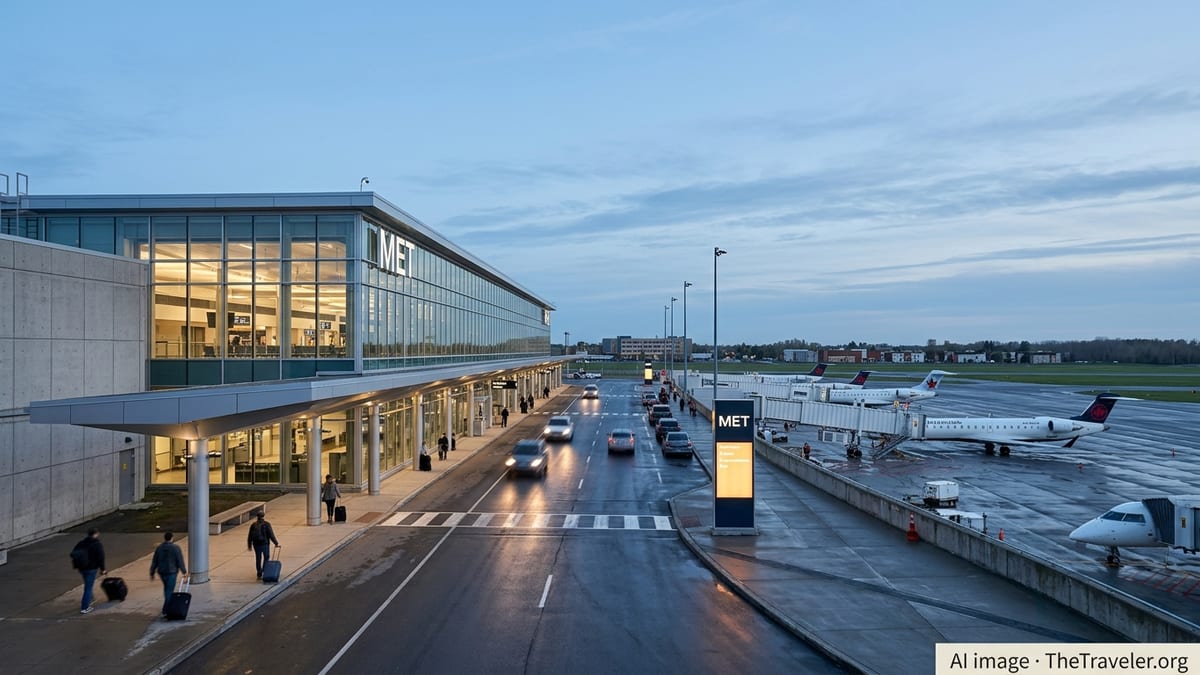
Secondary Airport Poised to Reshape Montreal’s Air Network
MET – Montreal Metropolitan Airport, located at the former Saint-Hubert Airport site in Longueuil, has been undergoing a multi‑year transformation from a primarily general aviation facility into a full-fledged commercial airport for the Greater Montreal region. Publicly available project material describes MET as a future secondary airport for the metropolitan area, intended to complement, rather than replace, Montréal–Trudeau.
The new domestic terminal, supported by a Canada Infrastructure Bank investment announced in 2024, is designed to handle scheduled commercial services with modern passenger amenities and security screening comparable to larger Canadian airports. Earlier documents pointed to a 2025 operational date; more recent timelines reported in late 2025 and early 2026 now indicate an opening aligned with the June 2026 launch window.
MET’s management and project partners have promoted the airport as a way to diversify air access to Montreal, distribute traffic more evenly across the region, and attract new short‑haul domestic routes. The strategy reflects wider Canadian and international trends in using secondary airports to absorb growth in regional and low‑cost services that can no longer be efficiently handled at constrained primary hubs.
According to published coverage and investor information, the airport’s repositioning is also intended to generate new economic activity on the South Shore, encouraging aviation‑related businesses and services around the expanded terminal zone.
Terminal Design, Capacity and Passenger Experience
Plans made public for the new MET terminal describe a compact but modern facility, with an investment figure in the range of 200 million Canadian dollars cited across several project communications. Architectural renderings show a glass‑fronted building with a contemporary façade, intended to offer faster curb‑to‑gate times than larger hubs while still providing key amenities such as check‑in counters, hold rooms, retail kiosks and food services.
One widely referenced mobility and planning document notes a terminal configuration with nine boarding gates, a scale that positions MET firmly in the regional‑airport category while still allowing a meaningful increase in the number of daily departures compared with the airport’s historic activity. The new baggage handling system is being developed by a specialist supplier under a contract announced in 2024, which highlighted technology designed to support efficient sorting, improve energy performance and facilitate future growth.
Project communications emphasize an emphasis on passenger comfort and efficiency over the vast retail footprints common at larger hubs. The terminal’s layout is being optimized for short walking distances and clear wayfinding, conditions that can be attractive to business travelers and regional passengers seeking predictable, low‑stress airport experiences.
While MET is expected to begin primarily with domestic routes, planning documents and public statements point to potential longer‑term expansion once the facility is established and traffic patterns are better understood.
Relieving Pressure on Montréal–Trudeau and Expanding Route Options
Montréal–Trudeau International Airport has experienced sustained growth in passenger volumes over the past decade, with pre‑pandemic forecasts calling for continued expansion as Montreal consolidates its position as a major North American hub. Even with subsequent fluctuations in demand, longer‑term projections still anticipate rising traffic, raising concerns about runway and terminal capacity during peak periods.
By opening the new MET terminal in June 2026, planners aim to channel a portion of regional and domestic demand to the South Shore, freeing up slots and terminal space at Montréal–Trudeau for long‑haul and higher‑yield international services. This type of traffic redistribution is already common in metropolitan regions such as Toronto, Vancouver and European multi‑airport cities, where secondary airports handle a growing share of point‑to‑point domestic and nearby international flights.
Carrier announcements over the past year have highlighted growing interest in MET as a base for short‑haul operations, capitalizing on the airport’s proximity to population centres on the South Shore and its potential for faster turnarounds. Reports of early route planning suggest that connections to Quebec City and other Eastern Canadian destinations are likely candidates for initial service, reflecting demand for frequent, high‑utilization flights.
In addition to easing capacity constraints, diversifying Montreal’s airport network is expected to introduce more competition on certain regional routes. Industry analysis indicates that such competition can translate into more varied schedules, potentially lower average fares and improved resilience when disruptions affect one of the region’s airports.
Ground Access and Regional Connectivity Plans
As the terminal project advances toward its mid‑2026 launch, attention has increasingly focused on how passengers will reach MET efficiently from across Greater Montreal. The airport is directly connected to the South Shore road network and lies within a broader corridor of commuter and freight rail infrastructure, which observers frequently cite as a foundation for future multimodal access options.
Local and regional planning discussions, reflected in publicly available mobility plans and coverage in Quebec media, describe coordination efforts with the Longueuil public transit operator to improve bus connections between MET and the Longueuil–Université‑de‑Sherbrooke metro station. References to an enhanced shuttle service concept, informally dubbed a MET‑branded bus in some discussions, indicate plans for frequent, limited‑stop service linking the terminal with the Montreal metro system in approximately twenty minutes, subject to final scheduling and funding decisions.
Beyond bus links, regional planners have signaled interest in leveraging existing rail lines in the vicinity of the airport as part of a longer‑term strategy to support sustainable access. While no firm timeline has been set for direct passenger rail service to the terminal, transport analyses note that better integration with commuter rail, light rail and intercity buses would strengthen MET’s role in the wider mobility ecosystem of Greater Montreal.
The project’s access strategy is also expected to prioritize active transportation where feasible, with plans indicating space for bike‑sharing docks and cycling connections near the terminal approaches, aligning with broader metropolitan efforts to reduce car dependence for short urban trips.
Economic, Environmental and Regional Impacts
Economic impact assessments prepared for investors and government partners suggest that the MET terminal could generate significant construction‑phase employment and support hundreds of direct and indirect jobs once operational. These include positions within airlines, ground handling, security, retail, maintenance and various airport support services, as well as induced employment in the wider South Shore economy.
Project materials consistently frame MET’s development within a sustainability narrative, emphasizing features such as energy‑efficient building systems, modern baggage equipment and a focus on public transport connectivity. The goal, according to strategy documents, is to limit the growth of single‑occupancy vehicle trips even as total passenger throughput rises, thereby moderating the airport’s overall emissions profile relative to its increased activity.
For communities in Longueuil and surrounding municipalities, the airport’s evolution into a commercial hub could reinforce existing clusters of aerospace and aviation‑related businesses. Analysis by Quebec economic development organizations has pointed to MET’s potential to complement aerospace activities concentrated around Montréal–Trudeau and in other parts of the metropolitan region, strengthening Montreal’s overall position in the sector.
As the June 2026 opening date approaches, aviation observers will be watching closely to see how quickly airlines and travelers embrace the new option. The pace of route announcements, the reliability of new ground transport links and the airport’s ability to deliver a smooth passenger experience will be key indicators of whether the MET terminal fulfills its promise to boost Greater Montreal’s travel capacity and reshape the region’s air network.