

More news on this day
European rail cooperative European Sleeper has confirmed that a new cross-border night train linking Brussels, Cologne, Zürich and Milan will launch on September 9, 2026, promising a fresh north–south corridor for travelers seeking a lower-carbon alternative to short-haul flights.
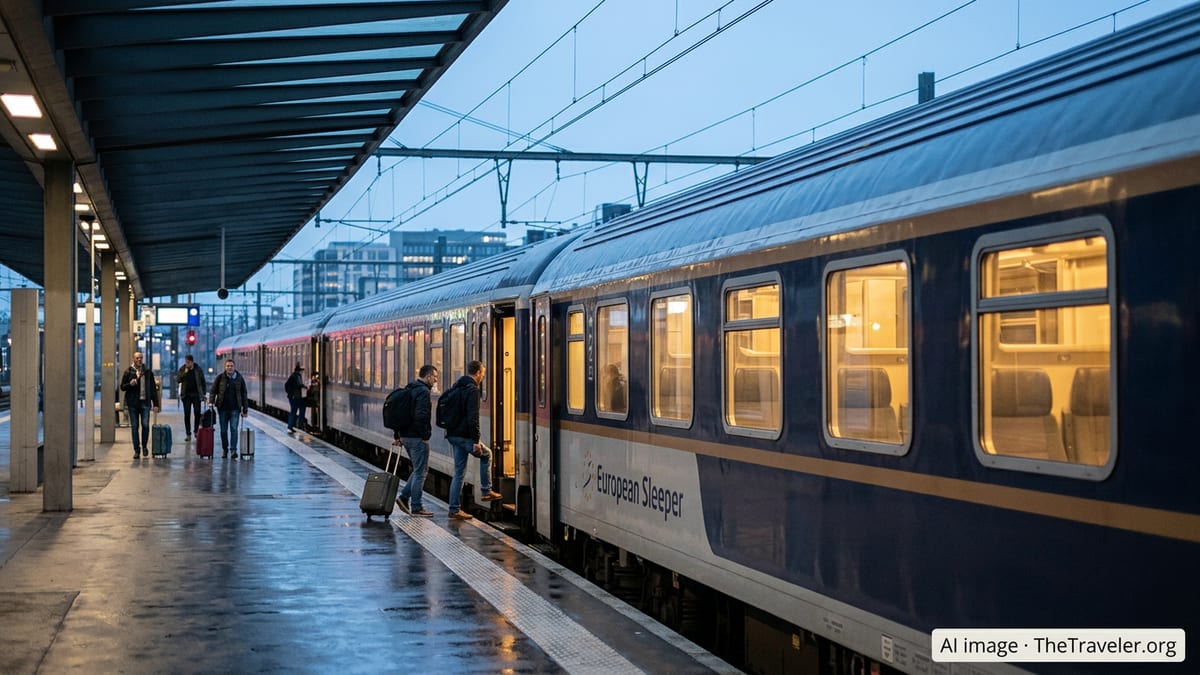
Delayed but Confirmed Launch for a Strategic Night Route
The overnight service, which will run between the Belgian capital and Italy’s financial hub via western Germany and northern Switzerland, had originally been slated to start in June 2026. Infrastructure works in Germany and related pathing constraints forced a postponement into early autumn, with the operator now locking in the first departure for September 9, 2026.
European Sleeper has positioned the new line as a core element of its expanding network of night trains across the continent. The route will establish a direct overnight rail connection between Belgium, Germany, Switzerland and Italy, filling a gap left by previous long-distance night services that were withdrawn or rerouted in recent years.
Operations will be handled by Train Charter Services, a Dutch open-access operator whose safety certification already covers the countries on the route. This existing regulatory footprint has helped smooth the path for the cross-border service, which still depends heavily on final timetable slots being maintained through several national infrastructure managers.
The train is expected to operate three times per week initially, with the potential for higher frequencies if demand and capacity conditions allow. Exact schedules and intermediate calling patterns are expected to be released closer to the opening of ticket sales.
Route via Cologne, the Rhine and Gotthard to Northern Italy
The planned route will see the train depart Brussels-Midi in the evening, stopping at key hubs such as Liège-Guillemins and Aachen before reaching Cologne, one of Germany’s principal long-distance interchange stations. From there, the consist will continue south across western Germany toward Switzerland, taking advantage of existing long-distance paths that thread along the Rhine corridor.
In updated plans issued in early March 2026, European Sleeper confirmed that the service will serve Zürich rather than Bern as its Swiss anchor point. From Zürich, the train will continue through the Gotthard corridor, using modern base-tunnel infrastructure to cross the Alps before heading into Ticino and on toward the Italian border.
On the Italian side, the train is expected to call at key intermediate stations such as Lugano and Como San Giovanni, before terminating at Milan Porta Garibaldi, a central station well connected to regional and high-speed services. This alignment is designed to appeal both to leisure passengers bound for the lakes and the Alps and to business travelers heading for Milan’s metropolitan area.
By linking four major urban regions in a single overnight journey, the route is intended to offer a rail-based alternative that competes directly with evening and early-morning flights between Belgium, western Germany, Switzerland and northern Italy.
Cabin Options, Pricing and Booking Timeline
European Sleeper has not yet published a full breakdown of fares for the Brussels–Cologne–Zürich–Milan route, but the company has indicated that pricing will follow the model used on its existing services. That typically includes a range of options from reclining seats to shared couchette compartments and more private sleeping cabins, allowing passengers to trade off comfort levels against cost.
The rolling stock will draw on refurbished couchette and sleeper cars configured for overnight comfort, with basic amenities such as power outlets and bedding, and a simple onboard service offer tailored to night operations. While details of new or upgraded interiors have not been disclosed, the operator has repeatedly stressed that it wants to make night trains an attractive alternative to budget air travel, particularly for journeys of 800 to 1,500 kilometers.
Ticket sales for the inaugural journeys are expected to open in March 2026, several months ahead of the first departure. This advance window is intended to capture early interest from international travelers planning late-summer and autumn trips, as well as from rail enthusiasts keen to sample the new service in its opening weeks.
As on its other routes, European Sleeper is expected to distribute tickets through its own online platform and via selected third-party channels, with a mix of standard fares and promotional offers designed to stimulate early demand and build brand visibility on the new corridor.
Boost for Rail-Based Climate-Friendly Travel
The announcement of the Brussels–Cologne–Zürich–Milan night train comes amid renewed political and consumer focus on climate-friendly travel options within Europe. Night trains have experienced a modest revival as governments and operators look for ways to shift demand away from short-haul aviation and toward lower-emission transport modes.
By allowing passengers to cover long distances while they sleep, overnight services can replace one or more point-to-point flights on popular business and leisure corridors. The new link is particularly significant given the density of air connections between Brussels, Germany’s Rhine-Ruhr region, Zürich and Milan, where corporate and financial sectors traditionally rely on air shuttles.
For travelers, the appeal lies not only in reduced emissions but also in the ability to depart city centers in the evening and arrive downtown the following morning, eliminating airport transfers and hotel nights at either end of the journey. Advocates of night trains argue that when door-to-door times and costs are considered, overnight rail can be competitive with air travel on many cross-border routes.
Industry observers also view the service as a test of whether a cooperative operator like European Sleeper can make a commercial case for unsubsidized international night trains at a time when infrastructure costs and energy prices remain volatile across the continent.
Integration With a Growing European Night Train Network
The Brussels–Cologne–Zürich–Milan service will not exist in isolation. It is part of a broader expansion strategy by European Sleeper, which is already operating a Brussels–Berlin–Prague night train and has advanced plans for additional cross-border routes, including a Paris–Brussels–Berlin service scheduled to start in 2026.
By anchoring several overnight corridors on Brussels, the operator aims to transform the Belgian capital into a key hub for night train travel, allowing passengers to connect between north–south and east–west axes. The new link toward Zürich and Milan will complement these existing services, offering through-booking options and same-station transfers that open up multi-leg rail itineraries across the continent.
The timing of the launch, in the run-up to the Milan–Cortina Winter Olympics in 2027, also gives the route strategic importance. Enhanced rail connections into Milan are seen by regional authorities and transport planners as a way to absorb visitor flows more sustainably during the Olympic period and beyond.
While long-distance night trains in Europe still face operational and financial challenges, the confirmation of a firm start date for the Brussels–Cologne–Zürich–Milan route signals growing confidence that coordinated cross-border services can find a durable place in the continent’s transport mix.