

More news on this day
A new wave of direct flights between Singapore and Hangzhou is reshaping travel links between Southeast Asia and eastern China, with expanded services set to funnel more visitors to the storied lake city and its fast-growing tech and manufacturing hub.
Get the latest news straight to your inbox!
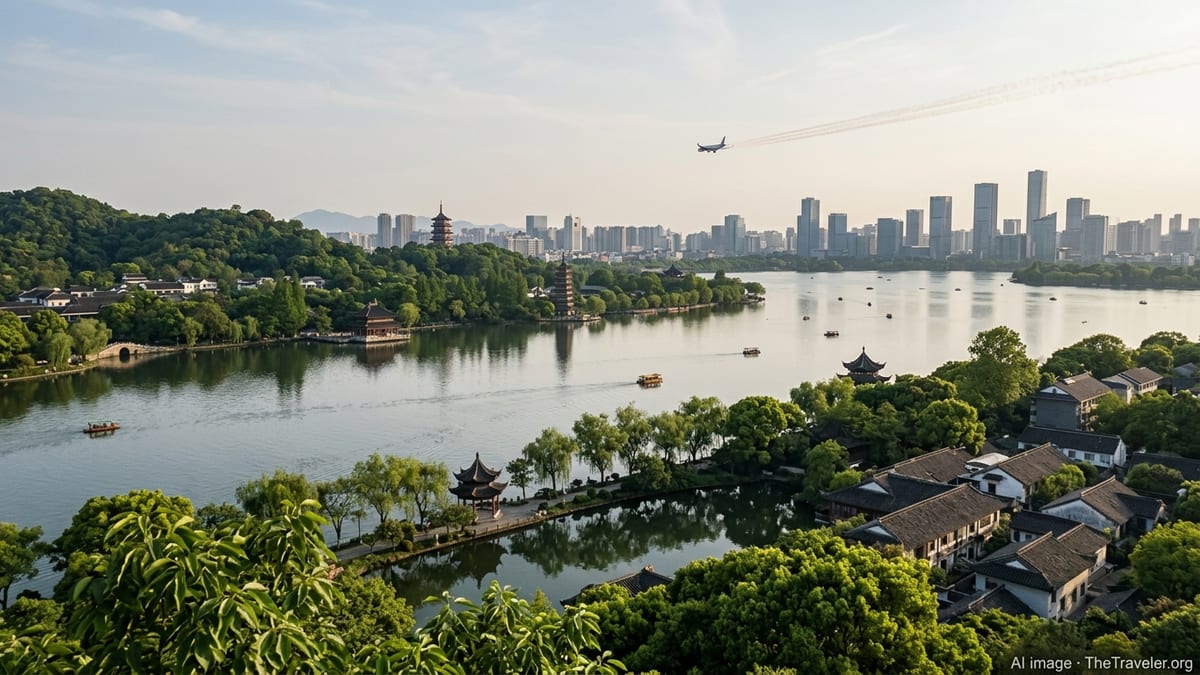
Fresh Capacity on the Singapore–Hangzhou Corridor
Flight data and recent schedule updates show a marked ramp-up in services between Singapore Changi Airport and Hangzhou Xiaoshan International Airport, turning what was once a niche connection into a steadily busy corridor. Multiple carriers are now operating non-stop flights, including Singapore-based low-cost carrier Scoot alongside Chinese airlines such as China Eastern, XiamenAir and Loong Air. Industry trackers indicate that the route has evolved from a handful of weekly rotations to regular, year-round operations, with some airlines shifting to near-daily patterns during peak periods.
Published schedules for late 2025 and into 2026 point to Scoot’s TR188 and TR189 flights forming the backbone of the connection, typically operating in the late afternoon from Singapore and returning overnight from Hangzhou. China Eastern and other Chinese carriers supplement this with additional frequencies, widening the choice of departure times for both business and leisure passengers. Aviation schedule platforms highlight that the sector, with a flight time of around five and a half hours, now ranks among the more competitive China routes out of Changi.
This expanding capacity effectively amounts to a new phase for the Singapore–Hangzhou market. While individual airlines have served the route in previous years, the current build-up of overlapping services and growing weekly seat counts gives Singapore-based travelers and transit passengers far easier access to Zhejiang’s capital and its nearby attractions, including the famed West Lake scenic area.
West Lake and Hangzhou’s Appeal as a “Lake City” Destination
Hangzhou has long been one of China’s most celebrated tourism destinations, anchored by West Lake, a UNESCO-listed landscape of willow-fringed shorelines, classical gardens and centuries-old temples. Publicly available tourism information emphasizes that the lake and its surrounding causeways are at the heart of Hangzhou’s branding as a “lake city,” drawing domestic visitors year-round and an increasingly international audience during peak spring and autumn seasons.
In addition to its historic core, modern Hangzhou has emerged as a technology and e-commerce center, with major Chinese tech firms and start-ups clustered in the city. This dual identity, combining a lakeside cultural landscape with a dynamic urban economy, is helping to broaden its appeal among Singapore travelers who may be looking to pair scenery with meetings, events or university visits. Airline marketing materials and destination guides increasingly highlight West Lake cruises, tea village excursions in nearby Longjing and visits to the city’s growing museum and gallery scene.
The improved air link from Singapore is expected to make short breaks more feasible, particularly for travelers who previously needed to connect via Shanghai, Guangzhou or Hong Kong. With direct flights, a long weekend built around West Lake walks, tea tastings and riverfront dining shifts from being a complex itinerary to a straightforward city-break option.
Visa-Free Policies and Surging China–Singapore Travel
Policy developments are reinforcing the impact of the new and expanded flights. Since early 2024, Singapore and China have implemented reciprocal 30-day visa-free arrangements for ordinary passport holders, a move that has significantly reduced friction for short-term visits. Publicly available government notices and media coverage report that the relaxation has encouraged more spontaneous leisure trips and facilitated quick business visits between the two countries.
Changi Airport traffic data quoted in local media show that China has re-emerged as one of the hub’s largest passenger markets, with volumes surpassing pre-pandemic levels across many city pairs. The return of capacity to major coastal cities, combined with the launch or resumption of secondary Chinese destinations, has created a broader network into which Hangzhou now fits as a key node serving Zhejiang province and the wider Yangtze River Delta.
For Hangzhou, easier access from Singapore means tapping into a diverse catchment of travelers transiting through Changi from Australia, Southeast Asia and parts of Europe. Airline network overviews for the Singapore Airlines Group and partner carriers highlight extensive one-stop connectivity, positioning the Singapore–Hangzhou leg as the final segment on longer itineraries that can now be completed without the need for an additional domestic flight inside China.
Tourism, Business and Education Sectors Eye Opportunities
Tourism boards, hotel operators and travel agencies across the region are moving to capitalise on the strengthened air bridge. Package offerings reported in regional travel media increasingly pair direct flights from Singapore with three- to five-night stays in Hangzhou, often combining lakeside hotels with side trips to nearby water towns such as Wuzhen or to tea plantations in the hills west of the city. The ability to arrive from Singapore on an afternoon flight and begin sightseeing the next morning is being marketed as a key convenience factor.
Business travel demand is also expected to benefit. Zhejiang is a major manufacturing and export hub, and Hangzhou plays host to technology, logistics and financial services companies with regional links to Southeast Asia. Corporate travel planners now have more options to route executives and technical teams via Singapore, consolidating regional meetings while keeping total journey times competitive with routes that transit through mainland Chinese hubs.
Education and family travel are set to be another growth area. Hangzhou’s universities, language institutes and international schools are drawing students from across Asia, and the combination of direct flights and visa-free stays simplifies visits for parents, prospective students and academic partners. Travel agencies in Singapore and Malaysia are beginning to feature Hangzhou in education-tour itineraries, framing the city’s lakeside campuses and cultural sites as a softer introduction to studying in China.
Competitive Fares and the Wider China Network Out of Changi
The competitive landscape on the Singapore–Hangzhou route is already influencing pricing and product offerings. Fare comparison platforms show a range of economy and premium-economy style options across airlines, with Scoot positioned as a low-cost choice on widebody aircraft and Chinese carriers often bundling checked baggage and meals into standard fares. Promotional campaigns tied to school holidays and major China festivals are emerging as airlines seek to lock in both outbound Singapore traffic and inbound Chinese travelers headed for Southeast Asia.
At the same time, Hangzhou is part of a broader expansion of Chinese destinations served directly from Changi. Media reports on Changi’s route development efforts highlight a roster of cities across coastal and inland China that have gained or regained non-stop links to Singapore as travel demand has recovered. This context matters for Hangzhou’s tourism prospects, as travelers from Singapore and beyond can now build multi-city itineraries that might start in Shanghai or Guangzhou and finish with a quieter lakeside stay in Hangzhou, all routed through Singapore.
With the Singapore–Hangzhou route moving into a higher-capacity phase, industry observers expect tourism flows to continue rising in both directions. For Singapore residents, the promise of West Lake vistas, tea fields and a modern Chinese city within a single direct flight is likely to be a powerful draw. For Hangzhou, the strengthened link to one of Asia’s premier aviation hubs offers a timely boost as it seeks to cement its status as China’s signature lake city on the international travel map.