

More news on this day
Travellers heading to Italy in the coming weeks face a perfect storm of disruption, as fresh strike dates collide with changing airline compensation rules and the rollout of tougher passport and biometric border checks across Europe.
Rolling Strikes Snarl Italy’s Winter and Spring Travel
Italy is entering another turbulent period for transport, with a dense calendar of industrial action set to hit key travel corridors just as visitor numbers swell for the Milano Cortina Winter Olympics and early spring tourism. National and local unions have called walkouts affecting air, rail and city transport, creating a patchwork of disruption that will vary day by day and city by city.
Among the most significant actions is a 24-hour national strike involving staff at ITA Airways on February 26, which is expected to cause widespread cancellations and schedule changes across the flag carrier’s domestic and international network. On the same day, separate actions targeting other carriers, including easyJet in Italy, are likely to compound pressure on major hubs such as Rome Fiumicino and Milan Malpensa, forcing airlines to consolidate flights or rebook passengers at short notice.
Local public transport will also be heavily affected. A 24-hour national strike across local bus, metro and tram systems is scheduled for February 25, with Rome and Milan expected to see sharp service reductions outside legally mandated “guarantee” time windows when minimum levels of service must be maintained. Travellers relying on buses and urban rail to reach airports and train stations could find themselves facing longer waits, packed carriages and sudden route changes.
The unrest does not end there. A national assembly of train drivers and on-board staff at Italy’s state rail group is planned from the evening of February 27 through February 28, threatening long-distance and regional services. In early March, further rail and air traffic control strikes are slated, including coordinated stoppages at Rome’s area control centre that manages a large share of Italian airspace. The result is that disruption in February is likely to bleed into March, with knock-on delays even on non-strike days as networks recover.
Rescheduled Walkouts Add Uncertainty After Olympic Intervention
What makes the current wave of strikes particularly confusing for travellers is the shifting timetable. Several of the most disruptive actions were originally planned for mid-February, overlapping even more directly with Olympic events, before being pushed back under government pressure. A 24-hour national walkout by ITA Airways staff, for example, was initially called for February 16 but was deferred to February 26 after authorities intervened to protect essential Olympic traffic.
These reschedulings have created a two-step impact: immediate disruption fears around the original dates, followed by renewed uncertainty around the new ones. Many passengers moved or rebooked flights to avoid the initial strike window, only to discover that the most serious actions will now arrive later in the month. For visitors with fixed hotel reservations, event tickets or cruise departures, the shifting landscape has made contingency planning more complex and, in some cases, more expensive.
The broader context is a season already strained by earlier incidents on the rail network and mounting industrial tensions over pay, staffing and working conditions. Labour representatives argue that the timing reflects a last-resort attempt to gain leverage while global attention is focused on Italy, whereas business groups and tourism operators warn that repeated disruptions risk denting the country’s hard-won post-pandemic recovery.
For travellers, the practical takeaway is that strike dates are no longer static. It is increasingly common for Italian authorities to issue last-minute injunctions or for unions to postpone or scale back actions after negotiations. Visitors who locked in their plans weeks ago may find that what looked like a “safe” date when they booked is now within a new strike window, underscoring the need for real-time monitoring of developments right up to departure.
Changing Airline Rules: What Compensation You Can Still Expect
As industrial unrest grows more frequent, passengers are simultaneously facing a shifting landscape of airline rights and obligations. Within the European Union, transport ministers have backed a package of reforms to air passenger rules that would lengthen the delay thresholds before compensation is due while also clarifying when carriers must reroute stranded customers or provide care such as meals and hotel rooms.
Under the Council’s position, which will still need final approval from the European Parliament before taking effect, most short- and medium-haul passengers would only become eligible for standard cash compensation once their arrival is delayed by at least four hours, up from the long-standing three-hour benchmark that has set expectations for years. For long-haul flights, the trigger point would typically rise to six hours. At the same time, the reforms would introduce or reinforce rights that could prove useful during Italy’s strike season, including clearer rules on rerouting via other airlines or transport modes and tighter deadlines for carriers to respond to claims.
Notably, the proposed framework also seeks to curb contentious “no-show” practices, under which passengers who skip an outbound leg can lose their return seats. That shift could benefit travellers whose plans are upended by Italian strikes and who choose to re-route themselves on the way in but still intend to use their original ticket home. However, consumer groups argue that, on balance, the package may dilute incentives for airlines to run punctual operations, particularly if compensation is harder to claim for delays in the four-hour range that many travellers consider highly disruptive.
Outside the EU’s rulemaking, travellers must also navigate a patchwork of airline-specific policies on rebooking, vouchers and voluntary changes, especially when industrial action is announced weeks in advance. Some carriers are offering limited fee-free rebooking windows for flights falling on known Italian strike days, but others are treating the strikes as extraordinary circumstances, limiting cash refunds and pushing passengers toward vouchers instead. Understanding the fine print of each airline’s conditions of carriage has therefore become as important as monitoring the strike timetable itself.
New Biometric Checks and Passport Rules Slow the Border
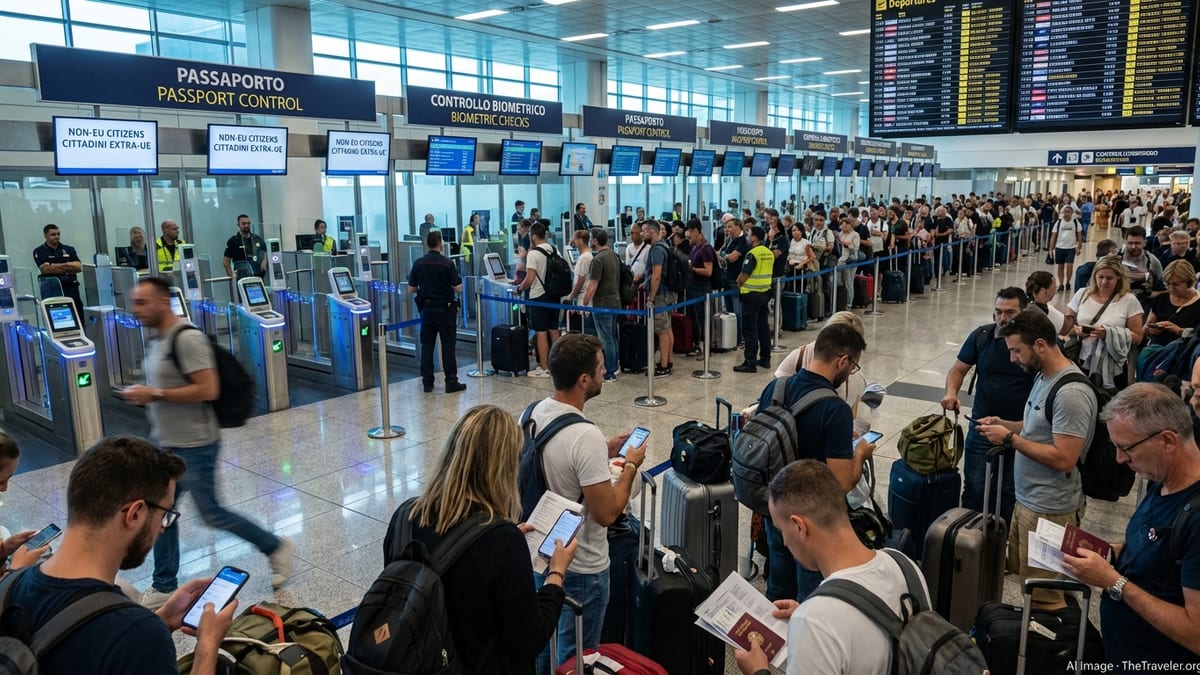
Even for travellers whose flights operate on time, reaching or leaving Italy in 2026 now involves a more complex border experience. The European Union’s new Entry/Exit System, a bloc-wide biometric scheme replacing traditional passport stamping for non-EU visitors, began rolling out at major airports in late 2025 and is due to be fully operational by April 2026. At key Italian gateways such as Rome Fiumicino and Milan Malpensa, this has meant the installation of self-service kiosks that capture fingerprints and facial images alongside passport data.
Officials say the system is designed to speed up border checks in the long term and to automate the calculation of permitted stay periods within the 90 days in any 180-day rule that governs most short visits. In the short term, however, industry groups and airport operators across Europe have warned of significant growing pains. Trade bodies report that, even with a minority of eligible passengers being processed through the new system so far, some airports in Spain, France, Portugal and Italy have already recorded queues of two hours or more at peak times.
These early strains are likely to intensify as the system is expanded and as the summer peak approaches. The combination of biometric enrolment, constrained border guard staffing and infrastructure that was originally designed around faster manual stamping could easily turn routine holiday arrivals into prolonged waits in serpentine lines. For elderly travellers, families with young children or those with tight onward connections to domestic flights and trains, the new procedures add a further layer of risk on top of the strike-related uncertainties.
At the same time, Italy and its Schengen partners are tightening adherence to passport validity rules that were previously applied more flexibly. Non-EU visitors typically must hold a passport issued within the last decade and valid for at least three months beyond the date they intend to leave the Schengen area. Automated systems are expected to enforce these cut-offs more strictly, reducing the discretion of an individual officer to waive a marginal case. Travellers who once pushed the limits on renewal dates may find themselves denied boarding by airlines or refused entry on arrival.
ETIAS and the Crackdown on Overstays
The new entry-exit regime is only one pillar of a broader shift toward tighter digital control of who can enter and stay in Italy. By late 2026, most visa-exempt nationals, including citizens of the United States, Canada, the United Kingdom and several other long-haul markets, will also be required to obtain a pre-travel authorisation under the European Travel Information and Authorisation System, or ETIAS. Although the system is not yet active, officials and travel advisers are already warning about the need to factor it into future plans.
ETIAS is designed to operate somewhat like similar electronic travel authorisations used by the United States and other countries: applicants complete an online form, pay a modest fee and receive a digital approval linked to their passport, typically valid for multiple trips over several years. Behind the scenes, the application data is checked against security and migration databases, allowing authorities to refuse entry clearance in advance in higher-risk cases. While the majority of applications are expected to be approved quickly, travellers who apply late or encounter data mismatches could find themselves unable to board flights to Italy at short notice.
Meanwhile, the Entry/Exit System is set to automate the monitoring of the 90/180 rule for short stays in the Schengen zone. Overstays that once went unnoticed due to manual passport stamping will now be logged electronically, with authorities warning of fines running into thousands of euros and potential multi-year entry bans for those who exceed their permitted time. For long-stay visitors who combine workations, extended road trips and multiple Schengen hops, this will require far more careful planning than in the past.
The rollout has already fuelled confusion and a spike in opportunistic scams, with fake ETIAS application sites mimicking official portals and collecting personal data and payments from unwary travellers. Even though no official authorisation is yet required, search results are increasingly cluttered with unofficial “assistance” intermediaries that charge inflated fees for services that will eventually be straightforward to complete independently. Prospective visitors to Italy are being advised to stay informed through trusted official sources and to treat any current demand for ETIAS payments or urgent applications with suspicion.
How Travellers Can Minimise Disruption in the Months Ahead
With airline strikes, evolving compensation rules and tightening border controls converging, smooth travel to Italy in 2026 will depend less on luck than on preparation. Travel professionals are urging visitors to build more slack into their itineraries, especially around known strike days and at major hubs like Rome and Milan. Allowing several extra hours between an international arrival and any onward domestic flight or long-distance train is now considered prudent, particularly while biometric checks are still bedding in.
Flexibility at the booking stage can also be a powerful shield. Tickets that include free date changes or that can be cancelled for a partial refund are generally more expensive upfront, but they may prove cheaper than last-minute one-way replacements if a strike renders the original itinerary unworkable. Where possible, travellers may want to route through alternative European gateways that are not affected by the same strike actions, connecting onward to Italy by rail or intra-European flights that fall outside the main disruption windows.
At a practical level, staying informed is just as important as structural planning. Official strike calendars published by Italian authorities, airport and railway operator updates, and airline notifications through apps or text messages can all provide early warning of disruption. Travellers are being encouraged to keep contact details up to date in airline profiles, to download carrier and airport apps before departure and to monitor news reports in the 72 hours leading up to travel, when last-minute injunctions or renewed strike calls are most likely.
Finally, travellers should review their rights and obligations before problems arise. Understanding what level of care and rerouting an airline owes during a disruption, what documentation is needed to support a later compensation claim and how passport validity and Schengen stay limits are calculated can all reduce stress at the moment of crisis. While Italy’s current travel environment may look daunting, those who approach their trip with realistic expectations, flexible arrangements and a close eye on the evolving rulebook will be better placed to navigate the months of turmoil ahead.