

More news on this day
Escalating conflict involving Iran, Israel, and regional armed groups is triggering new travel warnings and severe transport disruption across the Middle East, with governments and airlines updating guidance for travelers almost daily.
Get the latest news straight to your inbox!
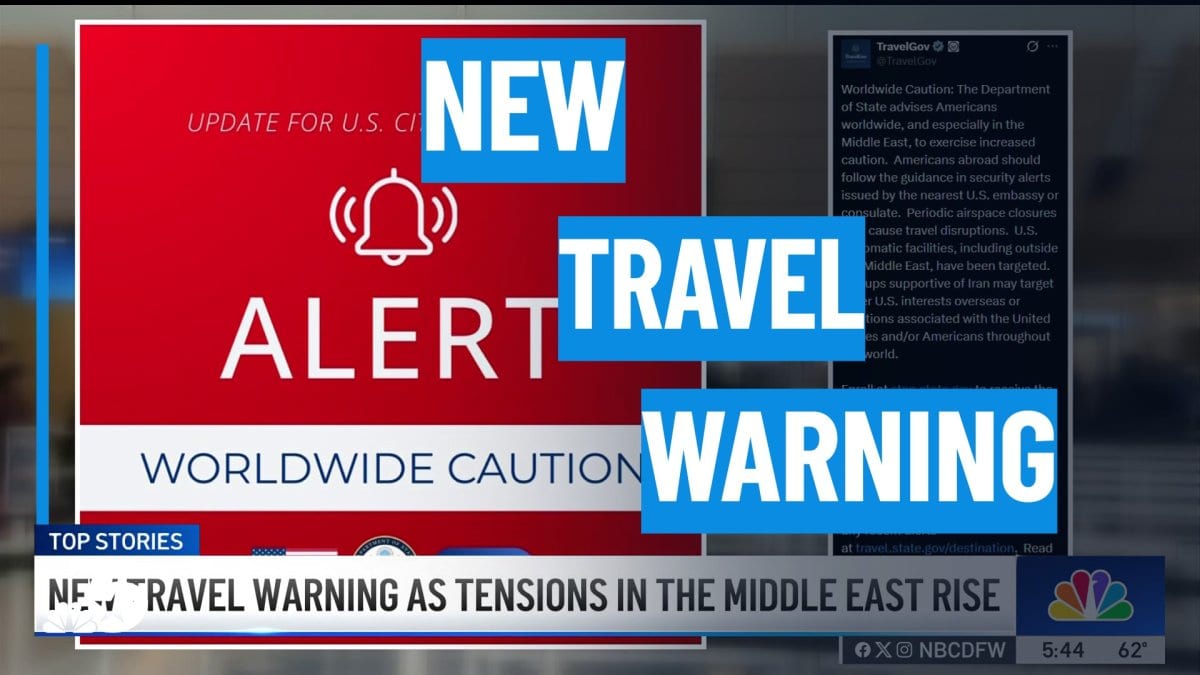
Image by NBC 5 Dallas-Fort Worth
Expanded conflict raises regional risk levels
Recent hostilities involving Iran and Israel, alongside actions by allied groups in Yemen, Iraq, Lebanon, and elsewhere, have pushed several parts of the Middle East onto higher alert for international travelers. Publicly available coverage describes missile launches, airstrikes, and proxy attacks affecting areas around the Red Sea and the Gulf, as well as parts of the Levant. These developments have compounded long-standing security concerns for destinations already subject to partial or blanket travel warnings.
Reports indicate that the reactivation of Yemen’s Houthi movement in the wider confrontation has renewed fears for maritime and aviation routes in the Bab el Mandeb Strait and the southern Red Sea, a chokepoint for global trade and passenger traffic. News outlets describe recent Houthi missile activity directed toward Israel, prompting speculation that commercial vessels and overflying aircraft could once again face an elevated risk environment.
The broader conflict has also affected strategic passages such as the Strait of Hormuz, where Iran’s posture has already limited normal traffic flows. Analysts note that any further deterioration in security conditions around these corridors would have immediate implications for flight routing, cruise itineraries, and ferry services that link the Gulf with East Africa, the Indian Ocean, and Europe.
Risk consultancies and media analyses highlight that the overall security picture is fluid, with localized conditions varying widely between city centers, border regions, and conflict zones. Travelers are being encouraged by official advisories to monitor updates for specific countries and territories rather than assuming a uniform level of danger across the entire region.
Airspace closures and major flight disruptions
Airspace restrictions have emerged as one of the most visible consequences for travelers. Coverage from aviation and regional news outlets describes widespread closures or limitations in the skies above Iran, Iraq, Israel, Syria, and adjacent areas, producing a cascading effect across international flight networks.
According to recent reporting, airlines serving hubs in the Gulf and Eastern Mediterranean have been forced to reroute or cancel thousands of flights since late February. One analysis focusing on North Africa notes that Egypt has become a critical corridor linking Europe and Asia as carriers divert around conflict-affected airspace and rely more heavily on routes across the eastern Mediterranean and Egyptian territory to reach destinations in the Gulf and beyond.
Industry-focused coverage indicates that the disruption has spread far beyond the immediate region. Airlines in Europe, Asia, and North America have lengthened flight times, suspended services to certain Middle Eastern destinations, or temporarily grounded aircraft as they adjust schedules and crew planning. This has led to irregular operations for passengers transiting key hubs, including longer layovers, unexpected diversions, and last-minute cancellations.
Travelers connecting through regional airports such as Dubai, Abu Dhabi, Doha, Jeddah, and major Turkish and Egyptian gateways are being advised through airline notices and public advisories to confirm flight status before departure and to prepare for potential schedule changes even on routes that do not directly enter conflict zones.
New government advisories and changing insurance terms
In response to the heightened tensions, a number of governments have issued updated advisories covering parts of Israel, the Palestinian territories, Lebanon, Iraq, Yemen, and border regions closer to active military fronts. Public travel advice generally emphasizes the risk of missile and drone activity, civil unrest, and the possibility of sudden airspace closures that could inhibit commercial evacuation or repatriation flights.
Security briefings published in early March highlight particular concerns around major airports and strategic infrastructure, noting that some facilities in Saudi Arabia and the United Arab Emirates have experienced intermittent disruption linked to intercepted projectiles and regional alert levels. These reports stress that while many airports remain operational, conditions can shift rapidly, sometimes with little advance notice to passengers.
The evolving risk profile is also affecting travel insurance. Industry commentary suggests that some policies may exclude coverage for trips to areas under “do not travel” or equivalent advisories, or may treat war and conflict-related disruption as excluded events. Travelers are being urged in open-source guidance to verify policy wording, including provisions for trip cancellation, medical evacuation, and emergency repatriation, before departure.
Package-tour operators and cruise lines with Middle East itineraries are likewise reassessing ports of call and overland excursion routes. Changes can include substituting alternative ports, shortening calls, or replacing land-based excursions in sensitive border areas with activities in more stable destinations.
Rerouted corridors reshape long-haul travel
The impact of the Middle East tensions is radiating across long-haul networks linking Europe, Asia, and Africa. Aviation analyses describe how the closure or restriction of several key airspace segments has pushed more traffic over the eastern Mediterranean, Egypt, and parts of North and East Africa, reinforcing the role of these regions as alternative transit corridors.
Reports from Egypt highlight that carriers are increasingly using Cairo and Egyptian airspace as a bridge between European cities and destinations in the Gulf, South Asia, and the Asia-Pacific. This shift has contributed to a spike in overflight volumes and connecting passenger traffic, but has also placed pressure on air traffic control capacity and airport infrastructure, requiring tighter coordination to maintain safety margins.
At the same time, financial and aviation industry outlets point to rising jet fuel prices linked to the Iran conflict and uncertainty around energy supplies. Major airlines in Europe and North America have acknowledged that higher fuel costs and longer routings are leading to selective capacity cuts and fare increases on affected routes. Some carriers are trimming marginal services or reducing frequencies while focusing resources on the most resilient and profitable markets.
Travelers planning multi-leg itineraries through the wider region are being encouraged by consumer travel publications to allow more connection time, consider flexible tickets where possible, and remain prepared for rebookings if their chosen route relies on airspace that could be subject to rapid closure.
Practical guidance for travelers considering the region
Across mainstream and specialist coverage, a consistent theme is emerging: conditions are highly dynamic, and informed decision-making is essential for anyone considering travel to or through the Middle East in the coming weeks. Publicly available advisories typically recommend that travelers check the latest government guidance for both transit points and final destinations, recognizing that risk levels can differ sharply between neighboring countries and even within the same country.
Airlines are publishing schedule changes and waiver policies that may allow passengers to postpone, reroute, or cancel trips without standard penalties on certain affected routes. Recent examples include temporary flexibility measures for tickets touching conflict-adjacent destinations, though the exact terms vary by carrier and are subject to frequent revision as the situation evolves.
Travel experts quoted across media coverage suggest that travelers maintain up-to-date contact details with airlines and tour operators, register with consular services where recommended, and have contingency plans for extended delays or unplanned stays if flights are disrupted. They also note that travelers who must cross the region for essential reasons may wish to favor routes that avoid the most sensitive airspace segments and rely on hubs that have demonstrated greater operational resilience in recent weeks.
While many popular destinations in the wider Middle East and North Africa remain open and continue to welcome visitors, the current conflict has introduced new layers of complexity and risk. Observers widely agree that close attention to official advisories, airline notices, and reputable news coverage is now a critical part of planning any journey that touches this strategically vital but increasingly volatile region.