

More news on this day
Travelers from the Netherlands and dozens of other European countries are facing a sharply more complex path to visiting the United States, as Washington extends a tough new web of visa restrictions designed to curb overstays and tighten screening. From higher rejection rates to costly cash bonds and narrower waivers, the changes are already reshaping transatlantic travel plans for 2026 and beyond.
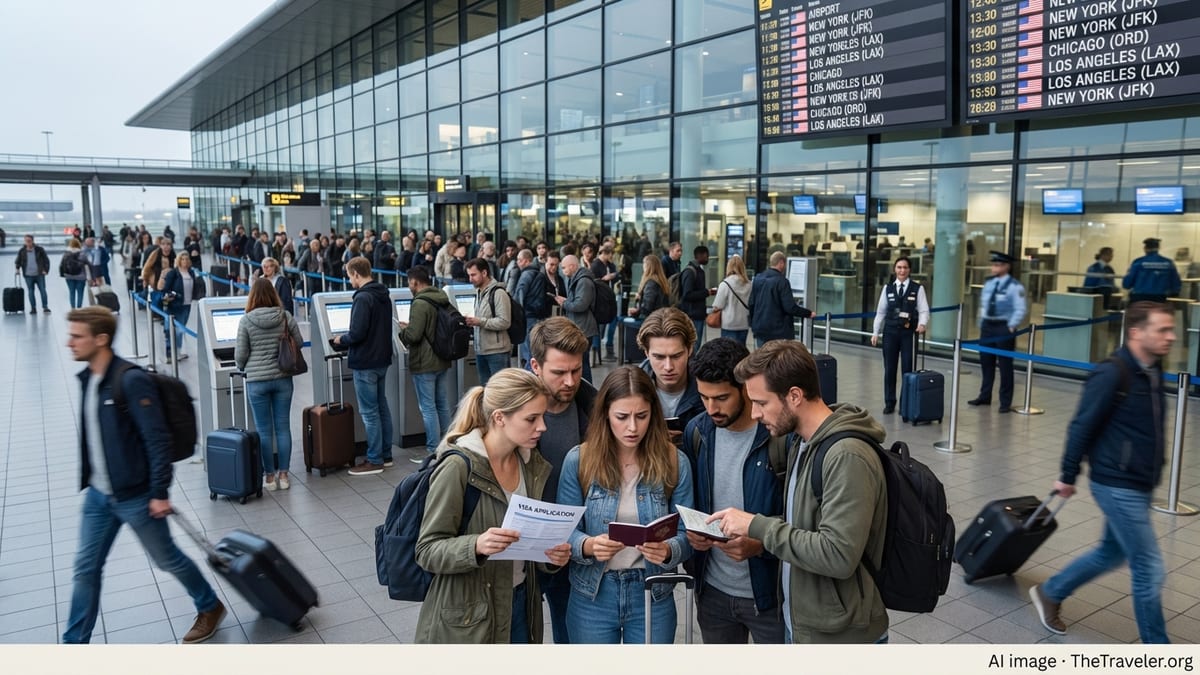
How Europe Became a Key Target of Washington’s Visa Crackdown
For years, US immigration officials have warned that visa overstays, rather than illegal border crossings, are driving a growing share of the country’s undocumented population. In response, the current administration has steadily moved to harden the rules for short-term visitors, making business and leisure travel more difficult for nationals of countries with elevated overstay rates or weak identity controls.
Until recently, that focus fell largely on Africa, Asia, and parts of the Caribbean and Latin America, where new entry bans and visa bonds have been rolled out in stages. But in late 2025 and early 2026, European countries were drawn squarely into the tightening regime. Officials in Washington say the shift reflects data showing that some European nationals are also overstaying in significant numbers, particularly on business, tourism, and student visas.
The Netherlands, Turkey, Germany, Poland, France, Romania, and Denmark now belong to a widening list of over thirty-five European states that US authorities view as higher risk under the new metrics. While these countries are not facing full entry bans, they are exposed to more intense vetting, tougher eligibility tests, and in some cases the possibility of being swept into the United States’ experimental visa bond system.
Travel industry groups and European officials warn that the measures could dampen demand, complicate corporate travel, and undermine the traditional ease of transatlantic movement. But US policymakers insist that stricter controls are necessary to restore compliance with visa rules and to close what they see as a long-neglected gap in border enforcement.
What Exactly Has Changed for European Travelers
The most visible aspect of the new approach is a sharp tightening of consular scrutiny. Applicants from the Netherlands and other affected European countries are reporting longer interview backlogs, more detailed questioning about finances and employment, and a noticeable rise in refusals for B-1 business and B-2 tourist visas. Consular officers have been given broader discretion to deny applications where they perceive a higher risk of overstay or misrepresentation.
In parallel, the US Department of Homeland Security is leaning more heavily on overstay statistics to drive country-by-country policy. Officials now regularly track how many visitors from each nation fail to depart on time or violate the terms of their stay, then feed that data into algorithms that flag countries for heightened requirements. Once a state crosses certain thresholds, its nationals can be subject to more frequent interviews, tighter documentation standards, and reduced eligibility for multi-year visa validity.
For many European travelers, the impact is subtle but real. Repeat visitors who once received ten-year multiple-entry visas are in some cases being limited to shorter validity. Business travelers are being asked to provide more comprehensive proof that their employment, income, and family ties are strong enough to ensure they will return home. Even frequent-flyer corporate executives from countries like Germany or France are no longer assumed to be low-risk by default.
A further shift is taking place at the border itself. US border officers have been instructed to more aggressively check the travel history and compliance record of arrivals from countries identified as concern points. While most Europeans will still be admitted if they hold valid visas, those with previous overstays or ambiguous travel patterns may face secondary inspections, shortened periods of authorized stay, or even immediate refusal of entry.
The Controversial Visa Bond Pilot and Who Could Be Swept In
Among all the new tools in Washington’s arsenal, none is more contentious than the visa bond pilot, a one-year program scheduled to run from August 2025 to August 2026. Under this scheme, certain applicants for US visitor visas can be required to deposit a refundable cash bond of between 5,000 and 15,000 dollars as a condition of being granted entry for business or tourism.
Initially, the bond requirement has been directed primarily at countries in Africa, Asia, and the Caribbean with consistently high rates of overstays or weak document security. However, the rule was drafted broadly, allowing US authorities to add or remove countries as new data become available. That flexibility means European states with rising overstay rates could potentially be brought under the bond regime, especially if enforcement agencies conclude that existing measures are not achieving sufficient compliance.
For now, reports from consulates across Europe suggest that the bond has not yet been widely imposed on nationals of the Netherlands, Turkey, Germany, Poland, France, Romania, or Denmark. Even so, officials and immigration lawyers caution that the mere possibility is already influencing decision-making. Applicants that consular officers perceive as higher risk, such as younger solo travelers with limited financial ties, may be the first to encounter bond demands if the program expands.
Should European countries be formally added to the bond list, the effect on tourism and small business travel could be significant. A family of four could face tens of thousands of dollars locked up with the US Treasury for months, a burden many households and smaller firms would simply be unable or unwilling to shoulder. That prospect alone has prompted diplomatic pressure from European capitals seeking clarity and exemptions.
Netherlands and Key European Partners: Why They Are on Washington’s Radar
The inclusion of the Netherlands among the countries hit hardest by the new restrictions has surprised some travelers who associate Dutch nationals with relatively high compliance and strong administrative systems. US officials, however, say their decisions rest not on perceptions but on evolving overstay data that reflect real-world behavior rather than reputation.
Travel analysts point out that the Netherlands sits at a crossroads of European air travel, with major hub airports connecting passengers to the United States from across the continent and beyond. This role as a transit and logistics hub means Dutch-issued visas and Dutch departure points frequently show up in US entry records, making the country a focal point for closer tracking and enforcement. Any upward trend in overstays, even from a modest base, draws attention more quickly in such a high-volume environment.
Turkey, Poland, Romania, and other Eastern and Southeastern European nations have attracted separate concern due to higher relative overstay rates among some traveler categories, particularly seasonal workers, students, and visitors with family already in the United States. Germany, France, and Denmark, meanwhile, are seen as large-volume sources of tourism and business travel where even small percentage increases in overstays translate into sizable absolute numbers.
By grouping so many European states into its high-attention category, Washington is sending a signal that geography alone is no longer a shield. Whether a traveler comes from a Schengen state, a traditional ally, or a newer partner country, the same data-driven enforcement logic is now being applied. European diplomats have pushed back, arguing that the measures risk stigmatizing ordinary travelers and could invite reciprocal restrictions on Americans, but so far Washington has shown little sign of retreat.
Impact on Tourists, Students, and Business Travelers
For individual travelers, the practical consequences of the new visa environment can vary widely, but a few trends are becoming clear. Leisure travelers from affected European states are being advised by tour operators and travel agents to apply earlier, prepare more documentation, and avoid making nonrefundable bookings until their visas are securely in hand. Long, predictable processing times are being replaced by longer queues and greater uncertainty.
Students and exchange visitors face an even more sensitive landscape. US authorities have signaled particular concern about overstays and status violations in the student and training categories, citing global data showing higher-than-average non-compliance in some education-related programs. Applicants from the Netherlands, Turkey, Poland, Romania, and other monitored countries are increasingly being asked to show detailed proof of financial support, genuine study plans, and credible prospects of returning home after graduation.
Corporate travelers are also feeling the strain. In sectors such as aviation, logistics, technology, and energy, cross-border teams that once flew back and forth with relative ease now must treat each US trip as a project requiring careful planning. Some firms report delaying or canceling short-notice meetings in the United States due to uncertainty over whether key staff will obtain visas or be admitted without hiccups at the border.
Travel insurers, for their part, are beginning to adapt products that account for visa-related disruptions, offering limited coverage for lost deposits or rebooking fees when applications are refused or significantly delayed. These emerging offerings reflect a new reality in which visa risk is no longer regarded as a remote or exceptional factor in European travel to the United States.
What Travelers from the Netherlands and Other Affected Countries Should Do Now
For Dutch nationals and citizens of the other European countries most affected, planning ahead is now essential. Prospective visitors are being urged by travel advisers and immigration specialists to start the visa process several months before their intended departure date, particularly during peak holiday or academic seasons. Leaving applications to the last minute, once a routine gamble, has become far riskier.
Applicants are also being told to prepare more thoroughly for consular interviews. That means gathering clear evidence of employment, business ownership, property, family responsibilities, and financial stability in their home country. For students, signed acceptance letters, detailed funding plans, and ties to institutions or sponsors back home are increasingly critical to persuading officers that they will respect the terms of their visas and return on time.
At the same time, travelers are advised to check their previous US travel history carefully, ensuring there were no unintentional overstays or status violations. Many people misunderstand the difference between the expiration date printed on a visa and the separate period of authorized stay recorded on US arrival documents. Any discrepancy or prior overstay, even of a single day, can trigger heightened scrutiny or outright refusal under the stricter 2026 rules.
Finally, seasoned immigration lawyers recommend that high-frequency travelers, such as executives and specialists who visit the United States regularly, keep meticulous records of entry and exit dates, itineraries, and business purposes. Being able to demonstrate a clean, well-documented history of compliance can make a decisive difference when seeking renewals or facing questioning at the border.
How European Governments and the Travel Industry Are Responding
The policy shift has not gone unnoticed in European capitals. Governments including those of the Netherlands, Germany, France, and Poland have raised concerns with Washington about the potential impact on trade, tourism, and academic exchange. Some officials have warned that persistent, one-sided tightening could force them to reconsider their own entry rules for US citizens, although such reciprocal steps remain largely hypothetical for now.
Diplomats are pressing for more transparency about how countries are assessed and how they can work their way off high-risk lists. They argue that clear benchmarks on overstay reduction, document security, and data-sharing would allow European partners to plan reforms and reassure their citizens. Without such clarity, they say, policymakers and travelers alike are left guessing about how long the current squeeze might last and whether even tougher rules, such as broader imposition of visa bonds, are on the horizon.
The travel and aviation industries, meanwhile, are attempting to adapt rather than confront. Airlines serving transatlantic routes are investing in clearer pre-travel communication, warning passengers about the need for visas and suggesting early application timelines. Major online travel agencies are embedding more prominent visa reminders into booking flows, emphasizing that possessing a ticket does not guarantee entry.
Tourism boards and convention bureaus in the Netherlands and other affected nations are retooling their marketing strategies to highlight longer-stay itineraries and combined trips, aiming to make each successful visa more valuable. If visiting the United States becomes harder, the logic goes, travelers may choose to stay longer and spend more once they make it in, partially offsetting the decline in spontaneous or short-stay travel.
What to Watch Next as 2026 Visa Policies Evolve
Looking ahead through 2026, several developments could determine how severe and long-lasting the new visa restrictions prove to be for the Netherlands and its European peers. One key milestone will be the review of the visa bond pilot, which is scheduled to conclude in mid-2026. US officials will assess whether the program meaningfully reduced overstays and whether it is administratively sustainable. If they deem it a success, the bond concept could become a permanent fixture and be expanded geographically, potentially drawing in more European countries.
Another factor is the ongoing refinement of US overstay tracking technology. As data systems grow more precise, US agencies will have more granular insight into which traveler categories and routes are most associated with non-compliance. That could lead to more tailored, and possibly more targeted, restrictions rather than broad-brush country designations, but it could also expose new pockets of risk in countries that have so far escaped attention.
On the European side, domestic political debates will shape how governments respond. Some leaders may prioritize preserving the ease of transatlantic travel by quietly encouraging better compliance and information-sharing with US authorities. Others may face pressure to push back more forcefully, particularly if voters perceive that their citizens are being unfairly singled out or subjected to financial barriers such as hefty bonds.
For now, travelers from the Netherlands, Turkey, Germany, Poland, France, Romania, Denmark, and the rest of the affected European group can expect a future in which visits to the United States demand more preparation, paperwork, and patience than in years past. As the policy experiments in Washington play out, the delicate balance between border security and the free flow of people will remain at the center of a changing transatlantic travel landscape.