

More news on this day
Dozens of additional flight cancellations by Qatar Airways, Gulf Air and Malaysia Airlines are rippling through Hamad International Airport in Doha this week, disrupting links to key hubs including Bahrain, Paris, Munich, Kuala Lumpur, Lagos and Amsterdam and leaving already stranded passengers facing renewed uncertainty over when they will be able to travel.
Get the latest news straight to your inbox!
Regional Conflict Keeps Pressure on Doha’s Main Hub
The latest wave of cancellations comes against the backdrop of the Iran conflict that has reshaped air traffic patterns across the Gulf since late February 2026. Published coverage describes how Qatari airspace was initially shut after Iranian strikes in the region, forcing a near standstill at Hamad International Airport and stranding thousands of transit passengers who were using Doha as a global connection point.
Subsequent limited reopenings have enabled only a fraction of normal traffic to operate, mainly priority and repatriation flights. Aviation analyses note that major Gulf hubs such as Doha, Dubai and Abu Dhabi are still operating well below pre-crisis capacity, with restrictions on routes and corridors that would usually carry dense flows between Europe, Asia and Africa.
This constrained environment has intensified the impact of each new cancellation. Even when airspace technically reopens, airlines are having to work around military risk zones, higher fuel costs and narrower routing options, leaving schedules vulnerable to rapid change. The result for Hamad International is an ongoing pattern of rolling updates rather than a clean return to normal operations.
Qatar Airways Trims Network as Reboot Proves Uneven
Qatar Airways, the dominant carrier at Hamad International, has restored parts of its network in stages, but publicly available information indicates that the recovery remains patchy. Reports from airline industry outlets describe how the carrier resumed a limited schedule in mid-March, then adjusted again as regional conditions evolved and as aircraft were repositioned to long-term storage outside the Gulf.
Within this volatile framework, more than 50 additional Qatar Airways cancellations have been recorded in recent days across European, African and Asian routes touching Doha. Services involving Paris and Munich, as well as long-haul connections that feed into Amsterdam and Lagos, have seen repeated changes, with some flights removed from timetables only a short time before departure.
For passengers in transit through Doha, these late adjustments have been particularly disruptive. Travel forums and social media posts describe travelers who successfully reached Qatar from Asia or Europe only to find their onward flights scrubbed at short notice, forcing unexpected overnight stays in the terminal or in overflow accommodation around the airport.
The carrier’s focus on a reduced core network also means many travelers are being rebooked on later dates rather than rerouted through alternative hubs the same day. This approach preserves limited capacity but extends waiting times for those stuck in Doha or in origin cities still relying on Qatar Airways connections.
Gulf Air and Malaysia Airlines Disruptions Spread Beyond the Gulf
The cancellations are not confined to Qatar’s flag carrier. Publicly available schedules and traveler reports show Gulf Air trimming frequencies on routes that interact with Doha’s traffic flows, including services to Bahrain and onward connections into Europe. With Bahrain positioned as a key regional node, any cuts there reverberate across itineraries that would otherwise link smoothly with Qatar Airways’ long-haul network.
Malaysia Airlines has also been affected, particularly on its Kuala Lumpur services that depend on safe, efficient corridors across the Gulf and Middle East. Recent cancellations on itineraries linking Kuala Lumpur with Doha and onward to European cities such as Amsterdam have disrupted travel for passengers heading to or from Southeast Asia.
These knock-on effects mean that even travelers who do not pass through Doha may experience indirect disruption. When Gulf Air or Malaysia Airlines pull flights or adjust timings, onward Qatar Airways legs can become misaligned, leading to missed connections or multi-day gaps between available services. In some cases, travelers have reported being advised to accept refunds and build entirely new itineraries with other carriers rather than wait for the original multi-airline routing to be restored.
Passengers at Hamad International Face Long Waits and Limited Options
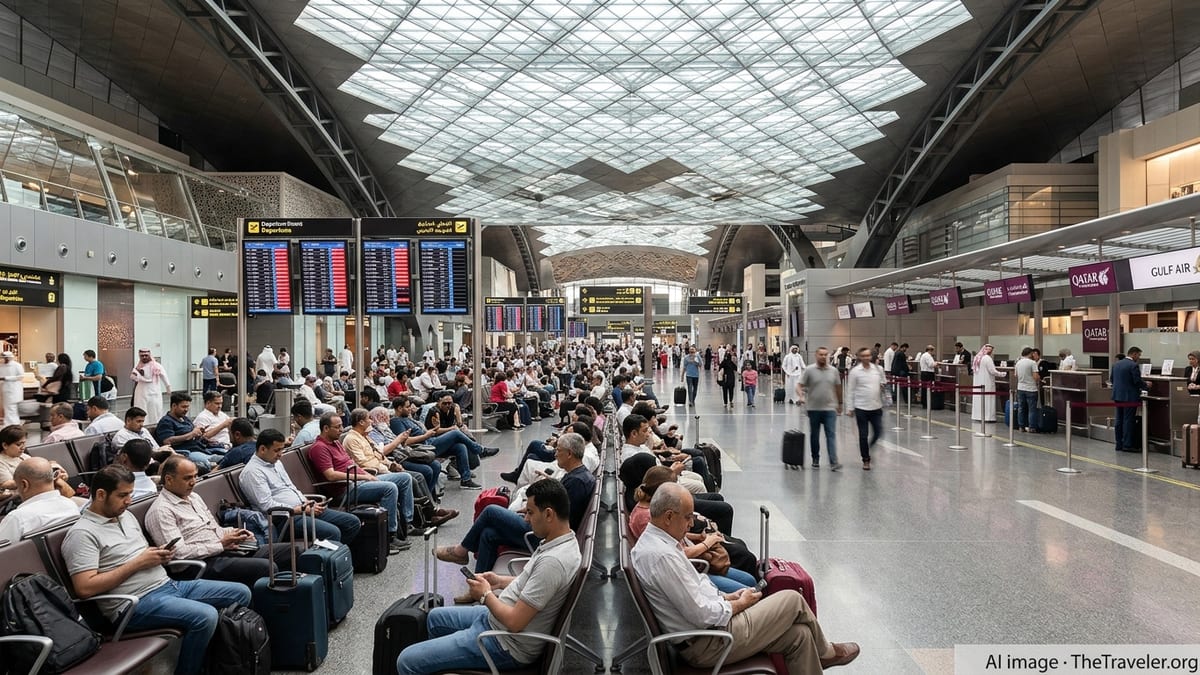
For those already at Hamad International Airport, the lived reality of the disruption is visible in crowded seating areas, long queues at airline desks and busy transfer zones. Firsthand accounts shared on public forums describe passengers sleeping in terminal chairs, repeatedly rejoining customer service lines and monitoring departure boards that display waves of cancellations alongside a small number of confirmed departures.
Some travelers report that flights to key destinations such as Bahrain, Paris, Munich, Kuala Lumpur, Lagos and Amsterdam appear on schedules for several days in a row before being pulled, creating a cycle of hope and renewed frustration. Others note that priority is often given to repatriation passengers and those with earlier cancelled tickets, leaving newer bookings more vulnerable to being bumped when capacity tightens.
Because multiple Gulf gateways have been affected by the same regional security issues, alternatives are not always straightforward. Passengers attempting to rebook via other hubs in the United Arab Emirates or Saudi Arabia have encountered limited seat availability and higher fares, as airlines across the region deal with rerouted flights, extended flight times and increased operating costs.
Consumer advocacy groups and legal commentators have highlighted that passenger rights vary significantly depending on the origin of the journey. Travellers starting in the European Union may have stronger compensation and rerouting protections under EU aviation rules, while those originating elsewhere often rely on individual airline policies, which can change during a large-scale crisis.
What Travelers Should Watch in the Coming Days
While there are signs that parts of the Gulf aviation network are slowly stabilizing, forecasts suggest that disruptions involving Qatar Airways, Gulf Air and Malaysia Airlines could persist as long as regional tensions and airspace restrictions remain in place. Airline planners are expected to continue prioritizing essential and high-demand routes, which may mean further cancellations or timetable reshuffles on secondary city pairs.
Travel specialists advise that passengers booked on near-term flights touching Doha, Bahrain or other Gulf hubs should treat schedules as provisional and monitor them repeatedly rather than assuming early confirmation will hold. Public advisories emphasize the importance of checking both legs of multi-stop journeys, since a cancellation on one segment can cascade across an entire itinerary.
Analysts also point to broader impacts beyond individual inconveniences. With Gulf hubs acting as major connectors between Europe, Asia and Africa, ongoing instability in Doha’s operations may influence how travelers and corporate travel managers plan long-haul journeys for the remainder of 2026, including a possible shift toward routings that bypass conflict-adjacent corridors where alternatives exist.
For now, the situation at Hamad International Airport remains fluid. Passengers headed to or from destinations such as Bahrain, Paris, Munich, Kuala Lumpur, Lagos and Amsterdam through Doha in the coming days should be prepared for last-minute changes, stay informed using multiple information channels, and build extra flexibility into their plans as the region’s aviation network works through one of its most challenging periods in recent years.