

More news on this day
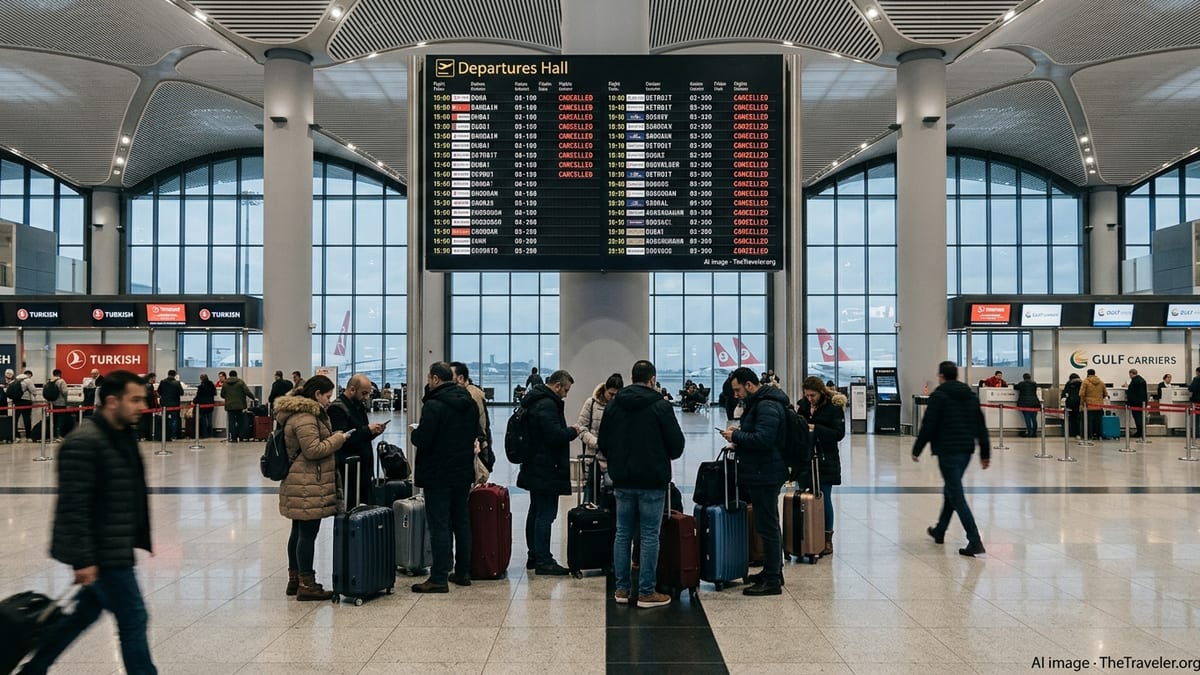
Fresh rounds of flight cancellations involving Gulf Air, Qatar Airways and several other carriers are rippling through Türkiye and parts of North America, disrupting journeys via Istanbul, Antalya and the US city of Marquette on routes connecting travelers to Bahrain, Algeria, Doha, Detroit, Dubai and other major hubs.
Get the latest news straight to your inbox!
Regional Tensions and Weather Turbulence Converge on Key Routes
Publicly available information shows that the latest disruptions are unfolding against a backdrop of geopolitical tension in the Gulf and volatile late-winter weather across North America. In recent weeks, a series of Iranian missile strikes targeting Qatar has led to the closure and subsequent partial reopening of Qatari airspace, severely curbing activity at Doha’s Hamad International Airport. Commercial schedules that once relied on seamless Doha connections have been cut back, with only limited emergency and evacuation flights permitted.
At the same time, airline operations feeding into and out of Türkiye have been tested by a string of powerful winter systems in the United States. Blizzard conditions and ice storms affecting the Upper Midwest have triggered large numbers of cancellations at smaller regional airports such as Marquette in Michigan, where traffic often connects onward via Detroit to long-haul services. These conditions have created a knock-on effect for transatlantic itineraries that intersect with Turkish gateways before continuing to the Middle East and North Africa.
The combined effect is being felt most sharply along routes linking Istanbul and Antalya with Bahrain, Algeria, Dubai and Doha, where carriers have trimmed frequencies, cancelled rotations outright or swapped in smaller aircraft to cope with erratic demand and routing constraints. Travelers who once counted on a predictable network of evening and overnight departures are encountering thinner schedules and a higher risk of last-minute disruption.
According to published coverage from regional outlets, these patterns are not confined to a single airline. Instead they reflect a wider reshaping of traffic flows across the eastern Mediterranean and Gulf region as airlines thread their way around closed airspace and adverse weather corridors, often at short notice.
Gulf Air and Qatar Airways Adjust Türkiye Operations
The latest round of cancellations includes several services linking Türkiye directly with Gulf hubs. Bahrain-based Gulf Air, which has traditionally relied on Istanbul as a key source market and transit point, has reduced some frequencies and scrubbed selected flights as demand softens and routings into the wider Gulf become more complex. Industry schedules indicate that flights between Istanbul and Bahrain have seen temporary cancellations on days when connecting options onward to affected Gulf destinations are limited.
Qatar Airways, already heavily constrained by the closure of Qatari airspace and the suspension of most regular commercial flights to and from Doha, has also seen its Türkiye services drawn into the wider disruption. Reports from travelers indicate a pattern of short-notice cancellations on Istanbul and Antalya routes that would normally funnel passengers into the Doha hub for onward journeys to Asia, Africa and Oceania. With Hamad International Airport operating on a restricted basis, many of these itineraries are no longer viable under their original timings.
Passengers ticketed on Qatar Airways services connecting Istanbul with Doha and then onward to destinations such as Kuala Lumpur, Manila or various Indian cities have described receiving cancellation notices in the days leading up to departure. Some have been offered rerouting via alternative hubs, particularly Istanbul itself, while others have opted to cancel and seek new tickets with different carriers. The instability of the Doha hub has turned Turkish airports into both staging points and pressure valves as passengers look for substitute connections.
While formal timetable updates can lag behind operational decisions, pattern tracking of departures boards and airline apps over recent days points to at least seven newly affected rotations involving Gulf Air, Qatar Airways and other carriers serving Bahrain, Algeria, Doha, Detroit and Dubai, with Istanbul and Antalya forming the central nodes in Türkiye.
North African and US Links Also Feel the Strain
Beyond the high-profile Gulf connections, routes between Türkiye and North Africa have also been touched by the latest cancellations. Flights linking Istanbul with Algeria, already sensitive to seasonal demand swings, have seen a handful of rotations dropped as carriers recalibrate capacity and crew availability. Disruption in the broader Middle East has prompted some airlines to reposition aircraft or consolidate flights, leaving fewer options on certain days between Turkish airports and North African gateways.
On the transatlantic side, North American weather has added another layer of uncertainty for itineraries connecting Detroit and other Midwest hubs with Türkiye. Major winter storms and severe weather outbreaks in recent weeks have forced airlines operating out of Detroit to thin schedules and cancel dozens of departures. Travelers using Detroit as a stepping-stone from smaller airports such as Marquette toward Istanbul have encountered missed connections and overnight delays as domestic legs are grounded by snow, ice or high winds.
In practice, this has meant that a single weather system in the Upper Midwest can sever multi-stop journeys that run from Marquette to Detroit, onward to Istanbul, and then farther to Dubai or Bahrain. Even when long-haul flights from Detroit to Istanbul operate as planned, the loss of feeder flights from regional airports has prompted rebookings and strandings that ripple through to Turkish and Gulf destinations.
Industry observers note that these intertwined factors underscore just how globalized the disruption has become. A missile barrage over the Gulf or a blizzard over Lake Superior can eventually translate into an empty seat on an Antalya to Dubai service, or a cancelled Istanbul to Algiers rotation, as airlines juggle aircraft and crew around a constantly shifting map of constraints.
What Travelers Through Türkiye Should Expect Now
For travelers due to pass through Istanbul or Antalya in the coming days, the latest wave of cancellations serves as a reminder to build additional flexibility into itineraries. Publicly available guidance from airlines and aviation authorities consistently stresses the importance of checking flight status repeatedly in the 24 to 48 hours before departure and monitoring airline apps for schedule changes, especially on itineraries touching Doha or relying on regional US feeder flights.
Travelers connecting to Bahrain, Algeria, Dubai or Detroit may find that previously straightforward same-day connections are now less reliable, particularly where a change of aircraft or long ground transfer is involved. Some carriers have begun proactively rerouting passengers via alternative hubs such as Istanbul when Doha is no longer viable as an intermediate stop, but these solutions can entail longer travel times, unplanned overnight stays, or changes in cabin configuration.
Travel experts suggest that passengers consider booking slightly longer connection windows through Turkish hubs, and where possible, favoring itineraries with fewer separate tickets so that a single airline or alliance bears responsibility for rebooking. Those with time-sensitive commitments at their final destination may wish to arrive a day earlier than usual to account for the elevated risk of last-minute cancellations.
For now, Türkiye’s major airports remain open and operational, but the combination of restricted Gulf airspace, shifting airline networks and lingering winter weather in North America means that routes weaving through Istanbul, Marquette and Antalya toward Bahrain, Algeria, Doha, Detroit and Dubai are likely to remain vulnerable to further disruption in the short term.